
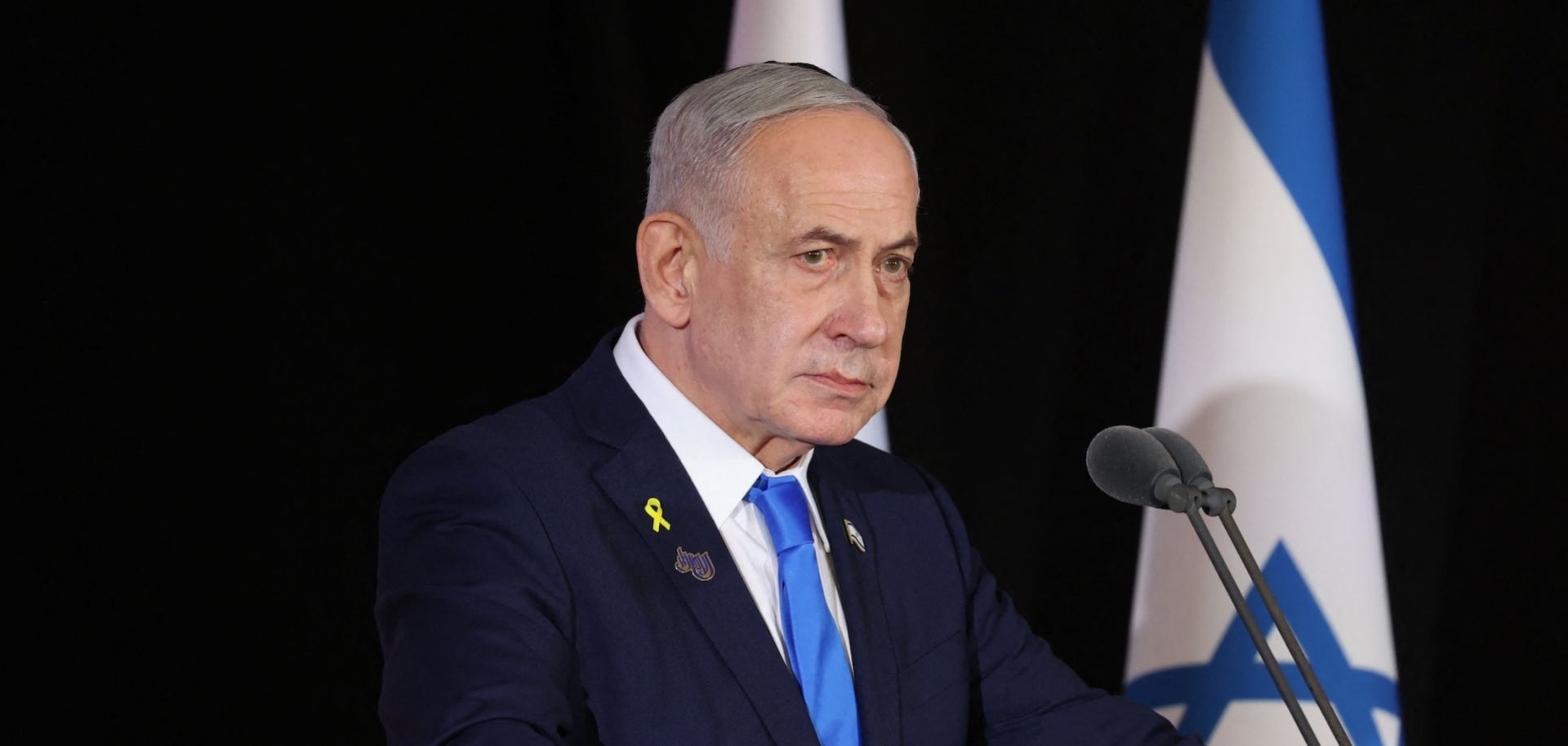
Israeli Prime Minister Benjamin Netanyahu is unlikely to call early elections and will likely increase military pressure on Hamas in Gaza in an effort to reduce the likelihood of being unseated by a right-wing anti-Netanyahu coalition led by former Prime Minister Naftali Bennett. Netanyahu's right-wing Likud party has seen an uptick in support following the Oct. 8 announcement of the first phase of a Hamas-Israel ceasefire and the Oct. 13 release of all 20 remaining living hostages. Prior to the ceasefire agreement, most polls conducted in the second half of September showed Likud winning around 25 seats in the 120-seat Knesset if parliamentary elections due by October 2026 were conducted now. More recently, according to a poll published on Oct. 16 by Zman Yisrael, Likud would win 34 seats and its likely coalition partners a further 25, bringing the total to 59 — just short of the 61 needed to govern. The Zionist anti-Netanyahu bloc led by Bennett would receive 53 seats and Arab parties eight. This poll is in line with others that suggest that Netanyahu and Likud are in the strongest electoral position since the start of the Hamas-Israel conflict on Oct. 7, 2023.
- The Knesset is elected using a closed-list proportional system, meaning that voters vote for political parties but not individual candidates. Following elections and after consultation with party leaders, the Israeli President appoints a Knesset member — typically the leader of the largest party — to try to form a government coalition within 28 days, which must be confirmed through a simple majority vote in the Knesset. If the selected Knesset member cannot form a majority government in the time frame, the president appoints a different Knesset member to try to do so.
- In June, a dispute over drafting yeshiva students between Netanyahu and the ultra-Orthodox parties in his government, Shas and United Torah Judaism, led to a no-confidence vote, requiring a simple majority, against Netanyahu's government. This failed after Netanyahu reached a last-minute compromise on the framework for an ultra-Orthodox draft law, preventing most ultra-Orthodox parliamentarians from voting against the government. The mandatory six-month waiting period before the Knesset can hold another no-confidence vote against the government means the earliest another could be held is December.
- Since the ceasefire's announcement, a few polls have indicated that Netanyahu's coalition would gain a majority, but most predict the coalition winning fewer than 60 seats in the Knesset.
The Netanyahu government's popularity has decreased due to the controversial pre-war judicial reforms, the handling of the Israel-Hamas war, negotiations on the release of the remaining Israeli hostages as well as the economic downturn from reservist mobilization, adverse labor market trends and growing international isolation. Although the popularity of Netanyahu's government was already falling prior to the start of the war due to the controversial 2023 judicial reform efforts to expand the executive branch's influence over the courts, which led to widespread protests, the Israel-Hamas war — Israel's longest — caused a further drop. Critics blame Netanyahu for not preventing the Hamas attack in the first place, lacking a strategy to defeat Hamas, mobilizing tens of thousands of reservists and the government's failure to reach a deal to release the remaining living hostages until earlier this month under heavy U.S. pressure. Furthermore, even though Israel's economy remains stable, with the International Monetary Fund forecasting low to moderate GDP growth at 2.5% in 2025, even after the June war with Iran, the Hamas-Israel conflict has weakened sectors of the economy. Tourism and port operations have been hit due to security concerns, as well as the agriculture and construction, which rely heavily on Palestinian labor that has been severely constrained by the total elimination of work permits for Gazans and limitations on authorizations for West Bank Palestinians. The mobilization of reservists and ongoing brain drain has slowed economic growth. International financial service provider S&P downgraded Israel's credit rating from A+ to A/A-1. Boycotts and some trade restrictions due to the Israel military's actions and the dire humanitarian crisis in the Gaza Strip have further limited trade and in turn added to popular pressure on Netanyahu's government.
- Between April and June 2025, largely due to the 12-day Israel-Iran war, Israel's economy contracted by 3.5% on an annualized basis. This is the second time that Israel's economy contracted since the start of the war — the first time was in the fourth quarter of 2023, just after the war broke out.
- While some Israeli sectors have grown — such as the defense export sector, which saw a 13% increase between 2023 and 2024, rising to $14.8 billion, largely due to military deals with European countries — other sectors, like tourism, have significantly declined because of regional security concerns. According to Israel's Central Bureau of Statistics, the number of foreign tourists visiting Israel dropped 68% from 2023 to 2024. Prior to the COVID-19 pandemic, tourism accounted for around 3% of Israel's GDP. Although the pandemic decreased global tourism, Israel's tourism sector was rebounding prior to the start of the war.
- According to a report presented to the Knesset's Immigration and Absorption Committee on Oct. 20, over 125,000 Israelis have moved abroad since early 2022 due to political instability arising from the 2023 judicial overhaul efforts and security concerns from the Israel-Hamas war.
- In July, the Knesset approved increasing defense spending by $12.5 billion in 2025 and 2026 to enable Israel to continue to fight in Gaza and against other regional threats. Israel's defense spending in 2025 is around 9% of GDP and will likely slightly increase over the next several years.
Netanyahu is unlikely to call for early elections without more signs of growing popular support and while disputes with his ultra-Orthodox and far-right coalition partners remain unresolved. Despite the reported uptick in near-term support for Netanyahu and Likud, Netanyahu is unlikely to call for early elections without additional signs of support and even better projected results for Likud, particularly while tensions with coalition partners continue. For one, Netanyahu's reported uptick in support is largely driven by the ceasefire agreement and the hostages' release, but this surge of support is likely to diminish over time. Even if Netanyahu wanted to capitalize on this momentum, the current polling data does not indicate a clear-cut victory for Netanyahu. Secondly, over time, Netanyahu will face increasing pressure to resume the conflict in Gaza from both on-ground conditions, including likely Hamas or other Palestinian militant violations of the ceasefire as well as pressure from his far-right coalition partners in order to achieve Israel's unresolved war goal of eradicating Hamas. While Israeli citizens will likely tolerate sporadic ceasefire violations, war weariness, rising cases of post-traumatic stress disorder and suicides among reservists and a lack of a clearly articulated plan to end the war will make a return to anything resembling full-scale fighting very unpopular. This, compounded with pre-existing anti-Netanyahu grievances, would likely diminish his re-election chances. Finally, Netanyahu currently faces a turbulent relationship with some of his coalition partners, especially the ultra-Orthodox parties, unhappy about ultra-Orthodox conscription, and the far right, which is pushing for the annexation of Gaza and the West Bank. While these parties could ultimately rejoin a Netanyahu coalition after an election since they have few other political allies and being part of the government could give them leverage to gain concessions, uncertainty about their willingness to remain in the coalition remains. Netanyahu will want to shore up their support ahead of any elections to ensure that they remain in the coalition since he would very likely be unable to form a stable government without them.
- Ahead of the ceasefire, polling showed that around two-thirds of Israelis wanted the war to end, largely driven by pressure to secure the hostages. However, more than half of those responding that the war should continue were motivated by eliminating Hamas. Since all remaining living hostages have been released, the political imperatives to end the war have decreased, but other reasons, including war weariness, remain constraints.
- Tensions between Netanyahu and coalition partners have resulted in intermittent threats to stop voting with the coalition, leave government posts and, at times, quit the government entirely. Far-right coalition partner Ben Gvir has threatened to leave the government or stop voting with coalition interests on multiple occasions — at one point vacating his National Security Minister position, though he later returned to it. On Oct. 20, he threatened to stop voting with the coalition unless a controversial bill that would impose the death penalty against militants who killed Israelis advanced in the Knesset. Similarly, on Oct. 23, Shas left its coalition posts in protest of the unresolved Haredi draft issue, but it remains in the coalition.
- The top priority for the ultra-Orthodox parties has been exempting yeshiva students from military service, the longstanding status quo that was upended by a 2024 Supreme Court ruling that ultra-Orthodox men must serve in the army. Many secular Israelis have long objected to the exemption, an issue which grew in salience with the demand for reservists caused by the Israel-Hamas war.
Absent unlikely early elections, over time Netanyahu is likely to increase military pressure on Hamas. Should that fail to increase support, it will raise the likelihood of a right-wing anti-Netanyahu government led by Bennett taking power. That coalition would likely maintain an assertive foreign policy but would be more willing to align closely with U.S. President Donald Trump's Gaza plan. If Netanyahu does not call early elections himself, he will likely exploit Hamas's unwillingness to disarm and alleged ceasefire violations to drum up support to increase military pressure against the militant group to force it out of Gaza. As is, the Netanyahu government has already alleged that Hamas has repeatedly violated the ceasefire by not releasing all of the hostages' bodies according to the schedule and by attacking Israeli troops in Gaza. Netanyahu's rhetoric since the ceasefire has suggested that Israeli military operations in Gaza are not over. While Trump has touted the ceasefire as a diplomatic victory and pressured Israel and Hamas to adhere to the terms, Trump has also increasingly criticized Hamas and threatened to permit Israel to force Hamas to disarm. While a resumption of the war would be unpopular, the release of the living hostages decreases some of the political constraints of resuming the war. If Netanyahu's popularity were to decline, he would likely take a more aggressive approach against Hamas. While fully eradicating Hamas is likely not feasible, Israeli forces in Gaza could gain control of more territory and further degrade the militants' capabilities, pressuring more pragmatic elements of Hamas to leave Gaza. This strategy would likely be accelerated if ultra-Orthodox parties or far-right parties threaten to, let alone actually, vote against the Netanyahu government in a no-confidence vote that could be held from December 2025. Even if a no-confidence vote does not occur, fails or the elections were conducted according to schedule by October 2026, Netanyahu's boost of support from the ceasefire would still likely decrease over time, especially as his corruption trial continues and pre-existing anti-Netanyahu grievances re-emerge. If Netanyahu loses the election, it would likely be to a right-wing, anti-Netanyahu coalition led by Bennett, whose new right-wing party currently polls second. A Bennett-led government would likely maintain some of the current coalition's key policies, including an assertive foreign policy and commitment to eliminating Hamas. However, it would likely take a more conciliatory approach to the Trump administration to maintain strong bilateral relations with the United States, likely aligning more closely than Netanyahu with Trump's plan to end the war. Such a government could be fragile and short-lived. In 2021, Bennett unseated Netanyahu by forming a broad-based coalition spanning right, center, left and Arab parties. Ideological differences proved too great and the Bennett government collapsed less than two years later.
- On Oct. 9, opposition leader Yair Lapid offered not to vote to collapse the Netanyahu government if the far-right members left the coalition due to the ceasefire agreement. However, while this could prevent a no-confidence vote from passing, such support would be only temporary and would not continue through the next election cycle.
- Netanyahu has been embroiled in three separate corruption cases and charged with bribery, fraud and breach of trust. His trial began in 2020 and has continued for several years. Likud cabinet members and U.S. President Donald Trump have pressured Israeli President Isaac Herzog to pardon Netanyahu.
- Throughout much of Netanyahu's political career, he has appealed to Israeli voters' security concerns, gaining the nickname "Mr. Security." The failure to stop the Oct. 7, 2023 attack has seriously undermined this reputation for many Israelis. Nevertheless, Netanyahu is likely to appeal to voters in a similar way if he resumes fighting Hamas in Gaza.
- Bennett has supported many of the prime minister's policies, including a tough line against Iran and conducting assassinations against Hamas officials abroad, but has criticized Netanyahu's handling of the Israel-Hamas war and alleged that he has prolonged it for his own political survival.
