
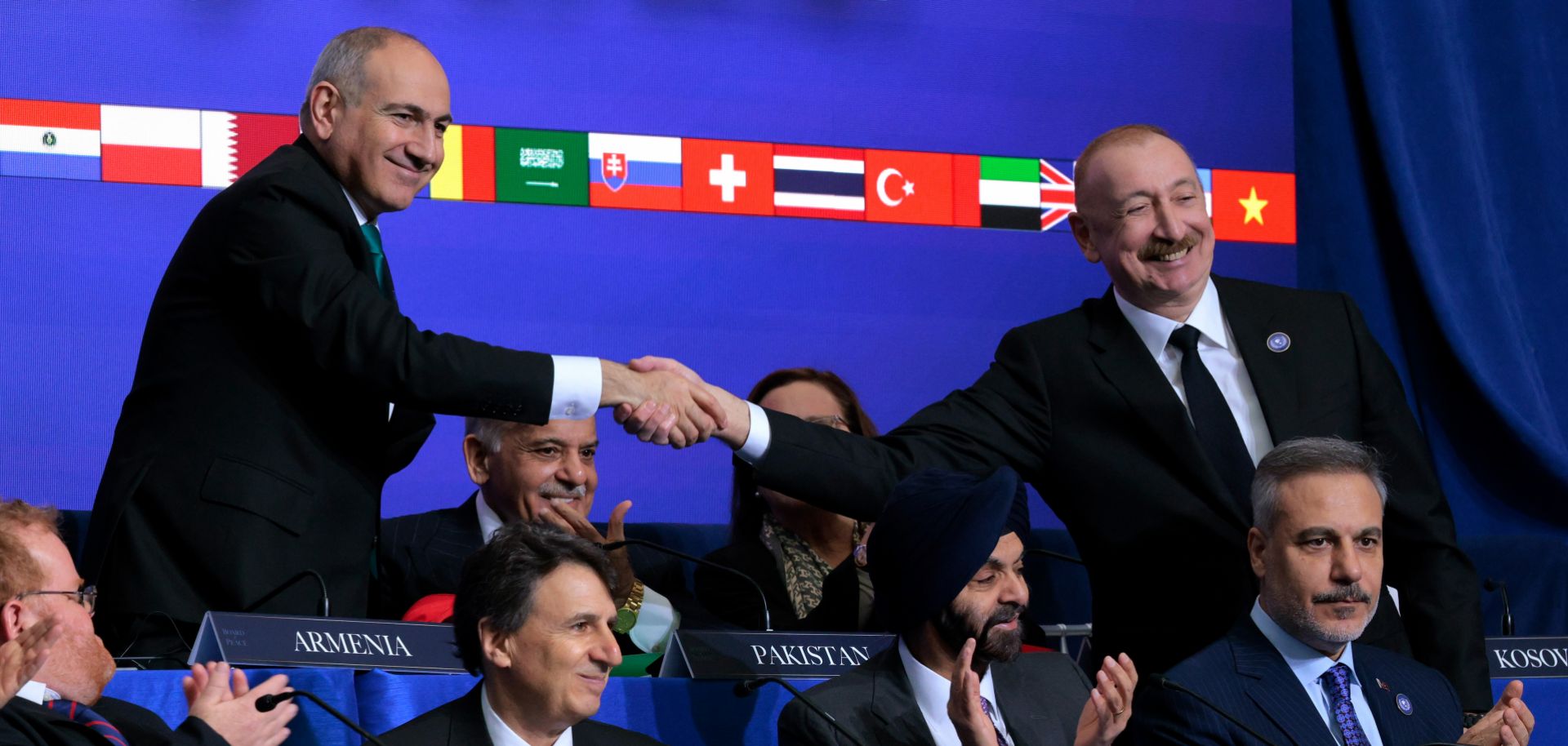
Armenia and Azerbaijan will seek to capitalize on momentum toward a final peace treaty amid expanding Western engagement to fill the vacuum left by a weakened Russia, but this geopolitical realignment will be tested by Moscow's influence operations ahead of elections in Armenia and Iran's competing geopolitical interests. U.S. Vice President J.D. Vance visited Armenia and Azerbaijan on Feb. 9-11, becoming the highest-ranking U.S. official to visit the region since 2008. The trip sought to capitalize on diplomatic momentum generated by the August 2025 White House summit, where U.S. President Donald Trump convened the two nations' leaders to sign a draft peace agreement. In Yerevan, Vance met Armenian Prime Minister Nikol Pashinyan to announce the conclusion of negotiations on a U.S.-Armenia civil nuclear cooperation agreement, establishing a legal framework for the construction of a new nuclear power plant using U.S. technology to replace the aging Metsamor nuclear power plant. He also confirmed export licenses for Nvidia Blackwell AI chips and an $11 million surveillance drone sale, the first-ever U.S. military hardware transfer to Armenia, and launched the TRIPP Enterprise Fund to mobilize capital for the Trump Route for International Peace and Prosperity (TRIPP) corridor. In Baku, Vance and Azerbaijani President Ilham Aliyev signed a U.S.-Azerbaijan Strategic Partnership Charter. This agreement expands defense and cyber cooperation and formalizes U.S. support for TRIPP as a strategic component of the Trans-Caspian Transport Corridor (Middle Corridor). Vance also announced plans to provide U.S. patrol boats to strengthen Azerbaijan's Caspian maritime security.
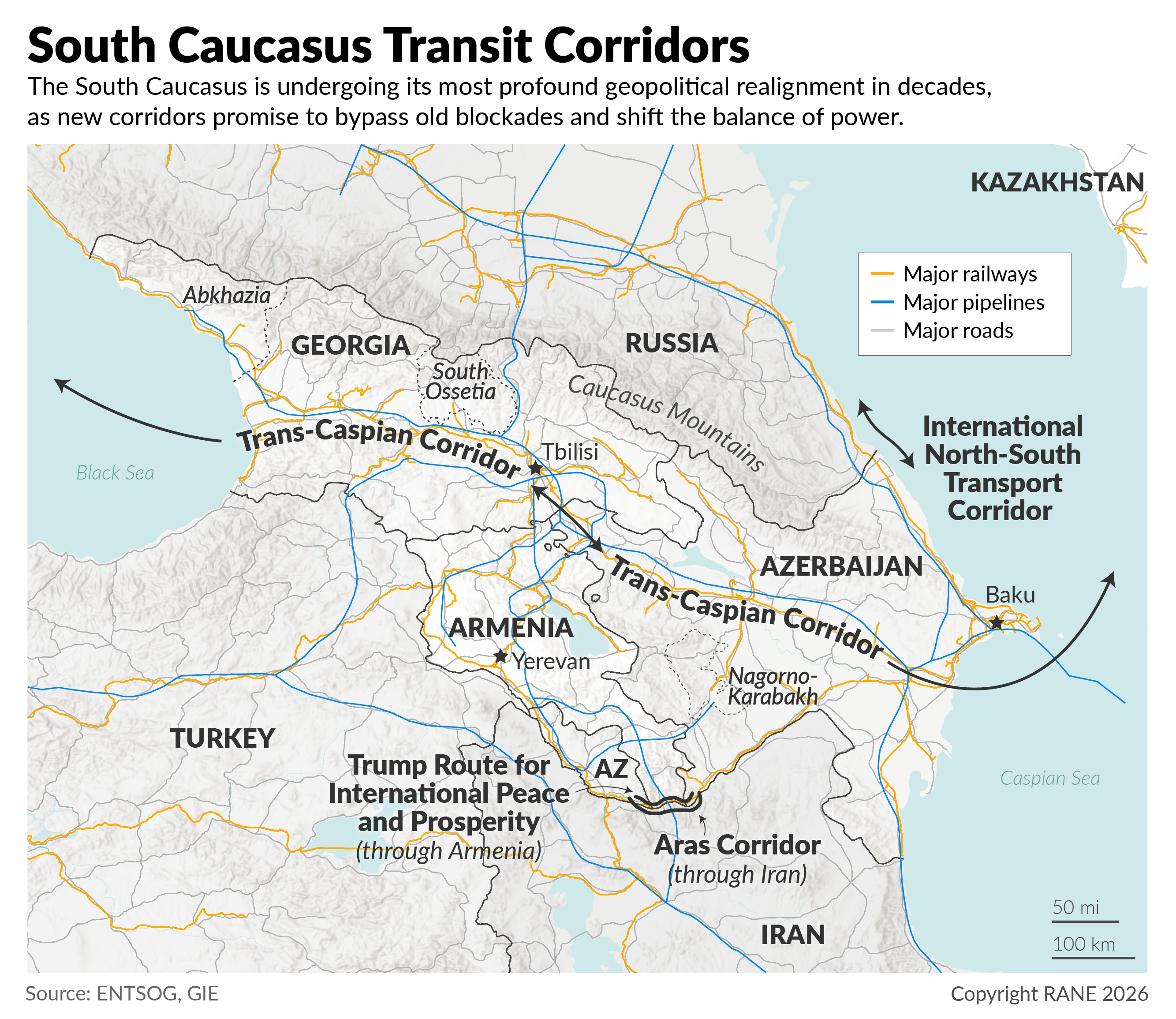
- The conflict between Armenia and Azerbaijan effectively ended with Azerbaijan's 2023 restoration of control over Nagorno-Karabakh and the finalization of a treaty text in March 2025. However, U.S. intervention accelerated the normalization of relations between the two countries. On Aug. 8, the leaders of Armenia and Azerbaijan signed a draft peace treaty in Washington, although Baku has conditioned the formal signing of the treaty on Armenia removing constitutional references to "reunification" with Nagorno-Karabakh. The United States and Armenia also announced the creation of the TRIPP corridor, linking Azerbaijan to its Nakhchivan exclave via Armenian territory, a mechanism intended to resolve the longstanding dispute over opening what Baku had called the 43-kilometer transportation Zangezur Corridor across southern Armenia. Since the Washington summit, Azerbaijan has lifted cargo transit restrictions, allowing Russian and Central Asian wheat and other goods to traverse its territory to Armenia, while Azerbaijani gasoline has begun reaching Armenian consumers as tangible signs of nascent economic rapprochement.
- In January, U.S. Secretary of State Marco Rubio and Armenian Foreign Minister Ararat Mirzoyan released the TRIPP Implementation Framework, outlining the establishment of a TRIPP Development Company. A U.S. partner will hold a 74% equity stake in this company and Armenia will hold 26% for an initial 49-year term, extendable for another 50 years, with Armenia retaining formal sovereignty over the corridor. Azerbaijan had previously sought a sovereign transit corridor with minimal Armenian oversight; TRIPP instead offers a commercially governed model that ostensibly preserves Armenia's sovereignty.
- The Metsamor nuclear power plant, located 30 kilometers west of Yerevan, began its operation with Unit 1 in 1976 and Unit 2 in 1980. But Armenia shut down both units after the December 1988 Spitak earthquake, leaving the country with a severe power shortfall. In 1995, Armenia restarted Unit 2, and the plant has since supplied almost 40% of national electricity. Metsamor's Unit 2 currently operates under a life-extension contract signed with Russia's Rosatom in 2023, which mandates Russian technical oversight through 2036. Vance said the United States could provide up to $5 billion for reactor construction and $4 billion in long-term fuel and servicing agreements, subject to funding and regulatory approvals, as Armenia seeks to replace the aging Metsamor nuclear power plant.
U.S. engagement with Armenia and Azerbaijan is expanding to fill the vacuum created by Russia's weakening regional influence due to the war in Ukraine, which has opened space for renewed competition over transit routes and critical mineral supply chains. Vance's visit underscored Washington's intent to translate diplomatic progress into durable influence, positioning the United States as a long-term investor and security partner in a region undergoing profound geopolitical realignment. This regional realignment is taking place as the war in Ukraine continues to drain Russia's military resources, capital and diplomatic bandwidth, weakening Moscow's influence in the South Caucasus. As a result, Russia's powers as the region's primary security arbiter and mediator have waned, and its heightened tensions with Azerbaijan have further reduced its leverage. Fiscal constraints also limit Moscow's ability to finance infrastructure projects, essential for the South Caucasus' long-term economic development, just as competition over Eurasian transit routes and critical mineral supply chains — both central to U.S. geo-economic strategy in the region — accelerates. Washington has moved to fill this vacuum, framing the TRIPP corridor as a strategic node in the Middle Corridor, which transports Central Asia's energy and minerals across the Caspian Sea to European markets, and a commercial instrument, designed to deliver mutual economic gains through enhanced connectivity. Although the durability of the U.S. commitment and policy continuity is uncertain, both Armenia and Azerbaijan have readily embraced this approach, enabling their governments to justify the political costs of compromises necessary for peace.
- In recent years, Armenia has assumed control of several key border entry points, ending three decades of exclusive Russian management. The Russian Federal Security Service withdrew its border personnel from Yerevan's Zvartnots International Airport in July 2024, from the Agarak crossing with Iran in December 2024, and from the Margara checkpoint on the Turkish border in March 2025 — transferring control of the checkpoints to Armenian forces. Russian units remain engaged in joint patrols along parts of Armenia's border with Turkey and Iran, and Russia maintains the 102nd military base at Gyumri. In 2024, Armenia suspended its membership in the Russian-led Collective Security Treaty Organization.
- Relations between Russia and Azerbaijan have remained strained since the December 2024 downing of an Azerbaijan Airlines passenger aircraft by Russian air defenses. Tensions deepened in mid-2025 following a Russian security raid in Yekaterinburg targeting ethnic Azerbaijanis, during which two people died in custody, prompting reciprocal diplomatic protests and arrests of Russian citizens in Azerbaijan. Although in October 2025, Russian President Vladimir Putin personally apologized to President Aliyev, authorities of both countries have continued to pursue criminal cases against each other's citizens. Baku has also expanded its probe into Russian proxies in its territory, most notably charging former senior official Ramiz Mehtiyev with treason involving "foreign intelligence services," widely interpreted as referencing Russia. But despite diplomatic friction between Baku and Moscow, economic interdependence has endured. In 2025, bilateral trade grew 2.5% to $4.92 billion. Russia remains Azerbaijan's third-largest trading partner, supplying 1.52 million tons of Urals crude in 2025, or nearly a third of its total exports to Baku, enabling Azerbaijan to export its own premium Azeri Light oil. Strategic cooperation also endures via the International North-South Transport Corridor, where Baku remains essential to Russia's Rasht-Astara railway project with Iran.
Whether the emerging regional realignment and normalization consolidate will hinge on Armenia's domestic political cycle and on how effectively Russia can project its leverage during that transition. In the near term, Armenia's June 7 parliamentary election will serve as a critical test for the peace process and the constitutional change Azerbaijan demands as a condition for the formal signing of the peace treaty. While the Armenian economy ended 2025 with strong growth momentum and the political opposition remains fragmented, Pashinyan faces organized resistance from the church and an influential Armenian diaspora that rejects his reconciliation strategy with Azerbaijan. Pashinyan's government also faces coordinated pressure from Moscow, which has signaled it will leverage its economic footholds to halt Yerevan's Western drift. Russia remains Armenia's largest export market, accounting for over 36% of Armenian exports, one-third of imports, and half of all financial inflows, including remittances. However, one of the most potent and plausible avenues for Russian sabotage would be in the energy sector, as Russia accounts for 60% of Armenia's energy needs. As the operator and service provider for the Metsamor nuclear power plant, Russia's nuclear company Rosatom could cause delays in fuel deliveries, maintenance slowdowns or regulatory disputes. Even limited disruptions from such actions could have outsized economic and political effects. Russia also continues to bind the country within the Eurasian Economic Union, limiting the pace and scope of any strategic decoupling. Following a geopolitical setback in Moldova in 2025, where pro-Russian parties lost a parliamentary vote, Moscow is intensifying its political influence campaign in Armenia, with newly funded media and opposition mobilization operations. Armenia's own intelligence services have warned that hybrid threats, including cyber operations, disinformation campaigns and economic pressure, are likely to intensify, particularly around the TRIPP project. To mitigate this, the European Union has committed to bolstering Armenia's resilience and will hold an inaugural EU-Armenia Summit in Yerevan on May 5, reinforcing Pashinyan's pro-European trajectory ahead of the vote.
- According to the Russian RBK news channel, the Kremlin earmarked 13 billion rubles ($165 million) in the 2026 federal budget in presidential grant funding to expand Russia's "soft power" activities abroad, with Armenia identified as a central focus ahead of its 2026 parliamentary election. The initiative reportedly involves state-linked media and civil society institutions.
- In December 2025, Armenia and the European Union adopted a new Strategic Agenda for the EU-Armenia Partnership that, for the first time, formally expanded the partnership into the security and defense domains. This marks a qualitative shift beyond traditional governance and economic reform. The agenda also establishes frameworks for crisis management and intelligence sharing, while underscoring existing commitments to democratic consolidation, trade diversification and visa liberalization.
Pashinyan's reelection would likely preserve Armenia's pro-European trajectory, sustain momentum toward finalizing the peace treaty, and gradually test the limits of Russia's remaining economic and security leverage. Given the fragmented state of Armenia's opposition forces, the parliamentary election will likely bring a renewed mandate for Pashinyan, who has centered his campaign on growing public support for EU integration. Even if Pashinyan secures reelection, a subsequent referendum to adopt a new constitution — a key Azerbaijani demand — could face greater political headwinds, given that a majority of Armenians oppose drafting a new charter. Pashinyan could seek to pair the constitutional referendum with a vote on EU integration, aiming to offset domestic resistance by linking the concession to a broader European trajectory. Consequently, if Pashinyan wins reelection and successfully navigates the constitutional referendum, it would pave the way for finalizing a peace treaty and unlocking the country's gradual reorientation toward European markets (especially if the border with Turkey is finally opened). A finalized peace treaty would accelerate the reopening of borders with Turkey, strengthening Armenia's transit role and reducing its strategic dependence on Iran. In parallel, Armenia will prioritize restoring Soviet-era rail links to Turkey and Azerbaijan to maximize its transit potential once borders reopen, creating parallel routes that reduce dependence on the TRIPP corridor, where majority control and profit capture would initially reside with a U.S. operator. Russia, which holds concession rights on Armenia's rail network until 2038, lacks the fiscal flexibility to restore these lines (Yerevan has already proposed that Moscow sell these rights to a third party, potentially from the Gulf or Kazakhstan). Further consolidation of peace with Azerbaijan would allow Armenia to reassess its security posture, including the future of the Russian military presence, and membership in the Eurasian Economic Union. Under these conditions, Armenia's planned 100-megawatt data center, once operational, could gain strategic relevance (provided construction proceeds on schedule and export licenses remain in force). This is because the facility would be positioned to capture East-West data traffic from the trans-Caspian undersea cable currently being built by Azerbaijan and Kazakhstan to bypass Russian territory.
- In May 2024, Pashinyan directed the Council of Constitutional Reforms to draft "a completely new constitution." On Feb. 4, Justice Minister Srbuhi Galyan confirmed the text would be published in March, setting the stage for a referendum following the June parliamentary vote. According to the November 2025 Gallup International poll, 57.1% of respondents in Armenia opposed changing the constitution, 20.7% supported limited amendments, and only 7.3% favored adopting an entirely new constitution. Similar polling in 2024 and 2025 also showed low support for full constitutional replacement.
- Russia's control over Armenia's rail network, held via a 30-year concession to Russian Railways (RZD) since 2008, faces political and financial challenges. In 2025, RZD reported its first net loss since the COVID-19 pandemic, carrying roughly 4 trillion rubles ($52 billion) in debt and slashing its investment program while seeking a 1.3 trillion ruble (almost $17 billion) state bailout. In February, Pashinyan proposed that Russia sell the concession management rights to a third country that has warm relations with both Armenia and Russia (such as Kazakhstan, the United Arab Emirates or Qatar), arguing that Russian management constrains Armenia's competitiveness. The proposal drew immediate diplomatic rebuke from the Kremlin.
- Following Armenia and Azerbaijan's mutual lifting of cargo restrictions on Oct. 21, the first convoy of Azerbaijani trucks transited Armenian territory to Turkey on Oct. 27. While regular commercial volumes remain limited, the route has stayed operational, facilitating the delivery of Azerbaijani petroleum products and the transit of Central Asian wheat to Armenia in late 2025
- The U.S. government granted export licenses for Nvidia's advanced Blackwell AI chips to support a planned 100-megawatt, $500 million data centre project in Armenia led by a U.S.-Armenian venture. Once operational, the facility would be the largest of its kind in the South Caucasus and is intended to support cloud computing and AI workloads, with construction phases expected through 2026.
Despite the current trajectory, the outcome of Armenia's June 7 election could still slow or reverse the country's strategic reorientation and the formalization of the peace treaty with Azerbaijan. First, if Pashinyan's Civil Contract party fails to secure a majority, opposition blocs could install a pro-Russian prime minister. This new government would likely slow or condition the peace process, recalibrate relations with Moscow and temper EU-oriented reforms, thereby increasing uncertainty around TRIPP and broader Western-backed connectivity projects. The election of a Russia-aligned prime minister would also likely trigger large protests, given the polarized Armenian electorate and the high stakes of the peace process. Second, even if Pashinyan remains in office, failure to pass the constitutional referendum would likely plunge Armenia into political limbo and generate sustained street mobilization from both nationalist and pro-reform protesters. In this scenario, normalization with Azerbaijan would stall, and Baku would indefinitely delay signing a formal treaty. If Pashynian loses the election, and especially if the constitutional reform referendum does not pass, Azerbaijan would likely combine sustained diplomatic pressure with limited border force posturing to retain coercive leverage while avoiding large-scale escalation. This would decelerate Armenia's geopolitical repositioning, preserving Russia's structural leverage over the country's security, energy and trade sectors, while also leaving Yerevan more susceptible to external coercion.
Iran, meanwhile, will likely leverage its economic and energy ties with Armenia to influence how TRIPP unfolds, potentially acting as both a stabilizing partner and a strategic counterweight to competing regional transit and infrastructure agendas. Another variable in any scenario is Iran, Armenia's close ally. Tehran will closely monitor TRIPP implementation to prevent any shift that could introduce an expanded U.S. presence near its northern border, affect the Agarak crossing (Armenia's sole checkpoint with Iran), or affect Tehran's own Aras corridor linking Azerbaijan to its exclave Nakhichivan, which is currently under construction. If it becomes fully operational, TRIPP would compete directly with the Aras route for east-west transit flows, and Tehran could respond to perceived displacement with calibrated economic pressure. Even absent geopolitical disruption, TRIPP's implementation could face delays stemming from electoral uncertainty and land acquisition disputes in Syunik, the southern Armenian province through which the corridor would run and where local communities have historically resisted proposals perceived as compromising sovereignty. Financing constraints and the legal structuring of the U.S.-led development company could further slow progress. A protracted rollout would weaken the tangible economic dividends of peace, particularly if U.S. financing or investor appetite declines, slowing normalization momentum and increasing the risk that unresolved grievances re-emerge as renewed diplomatic friction, even if outright conflict remains unlikely.
- Iran is Armenia's only southern land outlet and a critical transit and energy partner. The two countries maintain mutually beneficial energy cooperation under a long-standing gas-for-electricity swap arrangement. In August 2025, Armenia and Iran extended their gas-for-electricity agreement through 2030, under which Armenia generates power from Iranian gas and returns three kilowatt-hours of electricity per cubic meter while retaining the surplus for domestic use. In southern Armenia, an Iranian-led consortium is constructing the 32-kilometer Agarak-Kajaran section of the North-South highway linking the Iranian border to Syunik's regional center, with completion targeted for 2027. Yerevan and Tehran plan to sign a comprehensive strategic partnership agreement during Pashinyan's scheduled visit to Iran later in 2026.
