
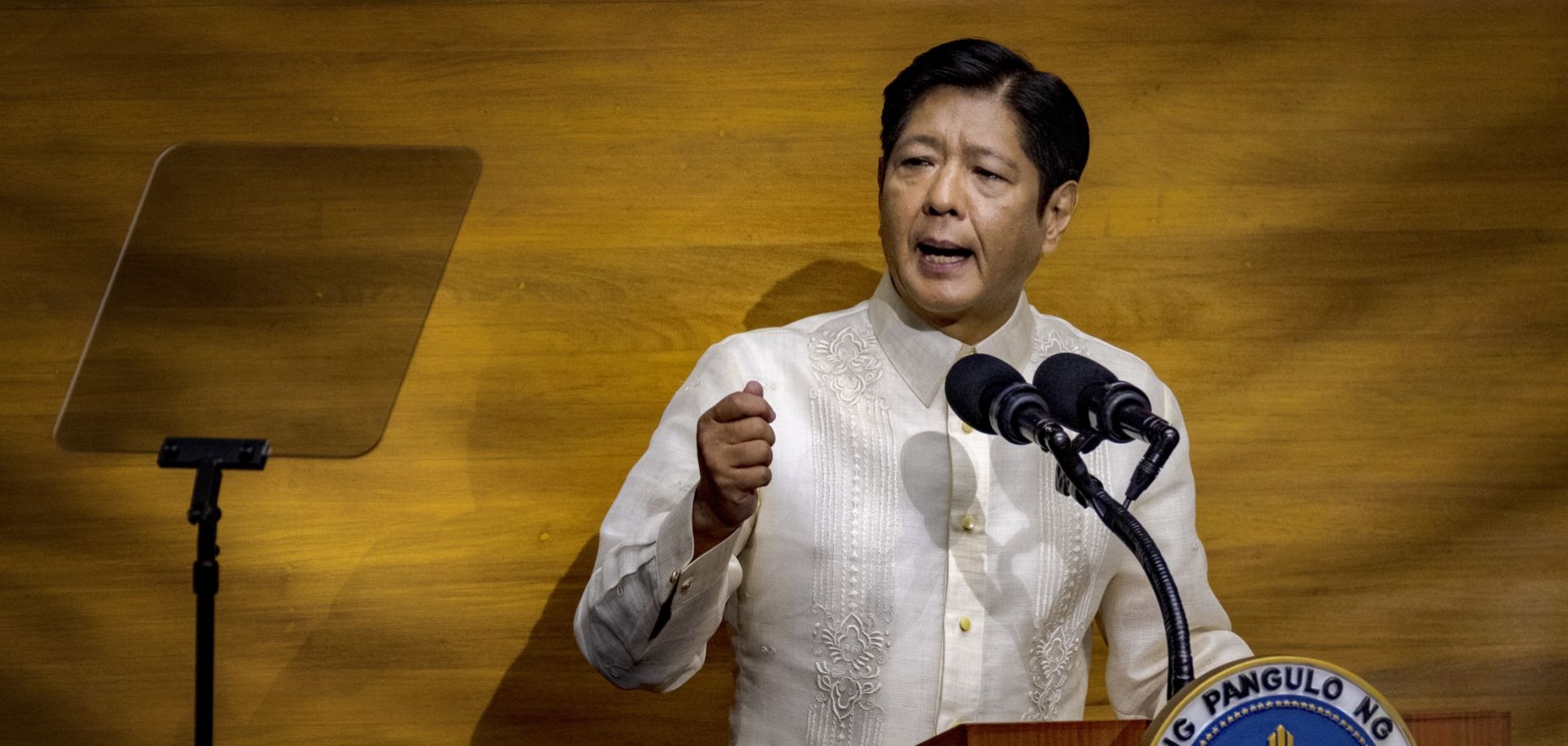
A widening corruption crisis in the Philippines is undermining the president's power, raising the likelihood of policymaking paralysis and political instability, and weakening Manila's capacity to deter China. On Dec. 3, Philippine President Ferdinand Marcos Jr. announced a multi-year 15% base pay increase for all civilian, military and uniformed personnel to be implemented in three tranches beginning Jan. 1, 2026, with additional increases scheduled for January 2027 and January 2028. Marcos also approved an increase in the daily subsistence allowance and directed relevant government agencies to prepare implementation guidelines within 30 days. The announcement was delivered in a prerecorded message that emphasized the security services' role in maintaining order amid what Manila has described as "destabilization attempts." The pay directive came less than a week after the Department of Justice and the Independent Commission for Infrastructure issued a new set of investigative orders on Nov. 29, expanding an ongoing corruption probe into flood control contracts valued at more than $1.6 billion, and one day after senior officials privately acknowledged that the administration had been receiving reports of "organized agitation" within segments of the national security establishment following large protests in Manila. No funding mechanism accompanied the pay hike order, and neither the Department of Budget and Management nor the Department of Finance immediately released cost estimates or financing strategies.
- Philippine media and political commentators have characterized the directive as an urgent move to reinforce military loyalty at a moment of heightened political uncertainty, given the absence of fiscal detail, combined with the abrupt rollout and emphasis on stability within the national security apparatus in Marcos' remarks.
- The timing of the announcement was notable, as it followed internal armed forces briefings circulated Dec. 1-2 in which service commanders outlined personnel concerns linked to rising operational demands, the politically sensitive corruption inquiry and the potential for wider unrest following mass protests in September and November. Marcos' decision also preempted a scheduled Dec. 4 Senate hearing that had been set to reveal new procurement irregularities and to call additional senior officials for questioning.
- The Philippines has a long record of "people power" moments and coup attempts, from the 1986 ouster of Ferdinand Marcos Sr., the president's father, to failed putsch efforts in the 2000s, with the common denominator being the simultaneous loss of both middle-class and military support.
The pay hike announcement comes as Marcos' legitimacy weakens amid an ongoing governance crisis shaped by three long-standing structural vulnerabilities: an infrastructure-led development model with weak oversight, a fiscally unsustainable military pension system and a political order in which the armed forces have historically acted as arbiters during moments of executive weakness. Between January 2022 and March 2025, the government authorized more than $9.5 billion in flood control and drainage projects, but inquiries launched in July revealed that procurement vetting and geotagging requirements had not kept pace with the scale of spending. Roughly 15 politically connected contractors captured a disproportionate share of awards, and more than $1.6 billion in expenditures lacked adequate documentation or verifiable work, exposing risks inherent in using high-volume public works as the backbone of growth in a system where patronage networks shape bidding outcomes and regulators remain unevenly resourced. The subsequent failure of flooding infrastructure during successive climate events in August and November reinforced public perceptions that billions in flood mitigation spending had produced little real protection, with each new weather event becoming a real-time test of state competence in recent weeks. This public discontent translated into large, coordinated street mobilizations, including a 300,000-person march on Sept. 21 and an estimated 600,000-strong rally from Nov. 9-11, signaling that grievances had broadened far beyond activist circles into mainstream urban constituencies. At the same time, the Philippines' fiscal landscape is deteriorating. The military pension scheme is non-contributory and fully budget-funded, with finance officials long warning that it is unsustainable and crowds out social and capital spending. The 15% salary hike adds another substantial fiscal burden with no clear means to finance it. Against this backdrop, Armed Forces Chief of Staff Romeo Brawner Jr. disclosed on Dec. 2 that a group of retired generals and colonels had urged him in October to withdraw support from Marcos and consider "intervention" options, such as staging a coup and installing a junta.
- In early August, floods first revealed widespread failures in supposedly completed dikes and pumping stations. Subsequent weather shocks included an Aug. 30 flash-flood episode in Metro Manila and destructive flooding associated with two typhoons in early November.
- The flood control contract scandal has triggered asset freezes, the creation of an independent infrastructure commission and criminal cases targeting officials, legislators and business figures across the governing coalition.
- Elite cohesion has frayed further as Sen. Imee Marcos, the president's sister, publicly accused her brother of incompetence and drug use, spoke of a "leadership vacuum" and signaled openness to Vice President Sara Duterte — a bitter rival of Marcos — playing a larger role in governance.
Domestically, the most likely outcome over the next 12-24 months is a prolonged period of weakened, crisis-prone governance, but more disruptive alternatives, including an extralegal transfer of power, are possible. Congress — still dominated by pro-administration blocs — remains unlikely to impeach Marcos absent a concrete financial trail directly implicating him or his immediate family. Nonetheless, though the next general election is not due until 2028, political parties, elites and other domestic powerbrokers are already eying the start of the electoral cycle. To this end, elite fragmentation and street pressure will raise the political cost of inaction on corruption and deepen policy paralysis. In the most likely scenario, this means that Marcos will sacrifice more allies to prosecutors, allow selective but high-profile convictions among contractors and mid-level officials, and leverage the Independent Commission for Infrastructure to signal reform while protecting his core circle. Infrastructure spending will resume selectively, but procurement will become slower and more risk-averse, dampening growth. A second, less likely but still possible scenario is an elite-negotiated "soft transition" in which key clans, business groups and church networks push for Marcos' resignation in favor of a successor — most plausibly Vice President Sara Duterte — under the pretext of restoring credibility while preserving continuity. But this scenario would require a clearer collapse in Marcos' popularity, more serious economic damage or new revelations that make him electorally toxic. A third, lower-probability but more disruptive scenario involves an acute crisis in which a violent crackdown on protests, a major split within military leadership or cascading political defections embolden those retired officers already floating intervention. While the pay hike and public displays of loyalty from serving generals reduce short-term coup risk, any move in that direction would almost certainly trigger sharp market selloffs, ratings outlook downgrades and a spike in capital flight. Across all scenarios, governance quality will deteriorate as institutions shift from policymaking to crisis containment, regulatory and reform agendas stall, and politicians concentrate on redistributive, short-term spending rather than structural change.
- The timing of the current crisis comes three years into Marcos' term, with coalition partners eyeing the 2028 electoral cycle, sharpening intra-elite incentives to hedge or reposition. Until now, Marcos had been largely insulated from scandal since taking office in 2022. He presided over robust post-pandemic growth, leveraged nostalgia for his father's era among some constituencies and anchored his legitimacy in infrastructure expansion and a tougher stance against China. However, the flood-graft scandal undercut these pillars by discrediting his infrastructure development narrative, reviving memories of dynastic corruption and forcing him to spend political capital on political survival rather than policy delivery.
- The scandal has already forced out key insiders and Marcos allies, including Executive Secretary Lucas Bersamin, Budget Secretary Amenah Pangandaman and House Speaker Martin Romualdez, the president's cousin, demonstrating the administration's willingness to sacrifice allies to contain political damage.
- On Dec. 4, Rep. Sandro Marcos, the president's son, voluntarily appeared before the Independent Commission for Infrastructure in a closed-door session to respond to allegations linking him to the scandal. This highlights how the investigation has reached the presidential family's inner circle, which could further erode institutional and public confidence in Marcos.
Political instability, especially if it worsens, will also jeopardize Manila's efforts to deter China, incentivizing further Chinese aerial and maritime probes of disputed waters and potentially straining Manila's alliance with Washington. Manila has repositioned itself as the frontline U.S. ally in the South China Sea and a key supporting node for any contingency in a future conflict between China and Taiwan. Under Marcos, the Philippines has expanded U.S. military access under the Enhanced Defense Cooperation Agreement, or EDCA, from five to nine sites, including bases in northern Luzon facing Taiwan and on Palawan and Balabac near the Spratly Islands, while pursuing closer security ties with Japan and Australia. At sea, the administration has adopted a "transparency plus lawfare" strategy, publicizing Chinese coast guard harassment at the Second Thomas Shoal and the Scarborough Shoal and aligning more closely with U.S. and allied messaging on freedom of navigation. However, a domestically weakened Marcos will struggle to sustain this posture at the same tempo. In the most likely scenario that Marcos remains in office but is politically weakened, rhetoric from Manila will likely remain hawkish, but practical implementation will likely become more cautious, with fewer high-risk resupply attempts to contested outposts, longer pauses between public evidence releases and quieter diplomacy aimed at avoiding simultaneous domestic and maritime crises. Beijing is likely to test the edges of this weakness with calibrated pressure, such as larger maritime militia swarm deployments and more aggressive naval maneuvers, but also via renewed offers of economic cooperation or resource sharing designed to encourage Manila to dilute EDCA usage or return to more bilateral dispute management mechanisms. In the "soft transition" scenario that elevates Duterte-aligned forces, the Philippines would probably not scrap the EDCA or break with the United States but could revert to a hedging posture by deemphasizing public confrontation with China, accepting more economic inducements and slowing certain U.S. access projects or joint operations. For Washington, Tokyo and Canberra, that would complicate emerging contingency planning around Taiwan and the first island chain. In the most disruptive though least likely coup scenario, the Philippines' alliance with the United States would be thrown into crisis, while both China and the United States would escalate military signaling and contingency preparations, such as by increasing air and naval patrols around the Bashi Channel (the critical chokepoint between the Philippines and Taiwan) as well as expanding surveillance and reconnaissance operations more broadly throughout the South China Sea, introducing regional security and attendant market volatility. This could open the door to suspended EDCA operations, reduced joint U.S.-Philippine exercises, frozen U.S. military assistance, Chinese opportunistic escalation in disputed waters and a period of legal and diplomatic uncertainty in which Washington cannot rely on Manila for predictable access to bases, airspace or logistical corridors, nor guaranteed cooperation in potential crises.
- U.S. Indo-Pacific Command considers EDCA sites — especially those in northern Luzon and Palawan — as key to a dispersed U.S. force posture and potential Taiwan support operations, making Philippine political stability a direct variable in military planning. In November, a U.S. congressional commission recommended that Taiwan quietly fund infrastructure upgrades at EDCA sites in the Philippines, explicitly framing them as critical to a Taiwan contingency.
