
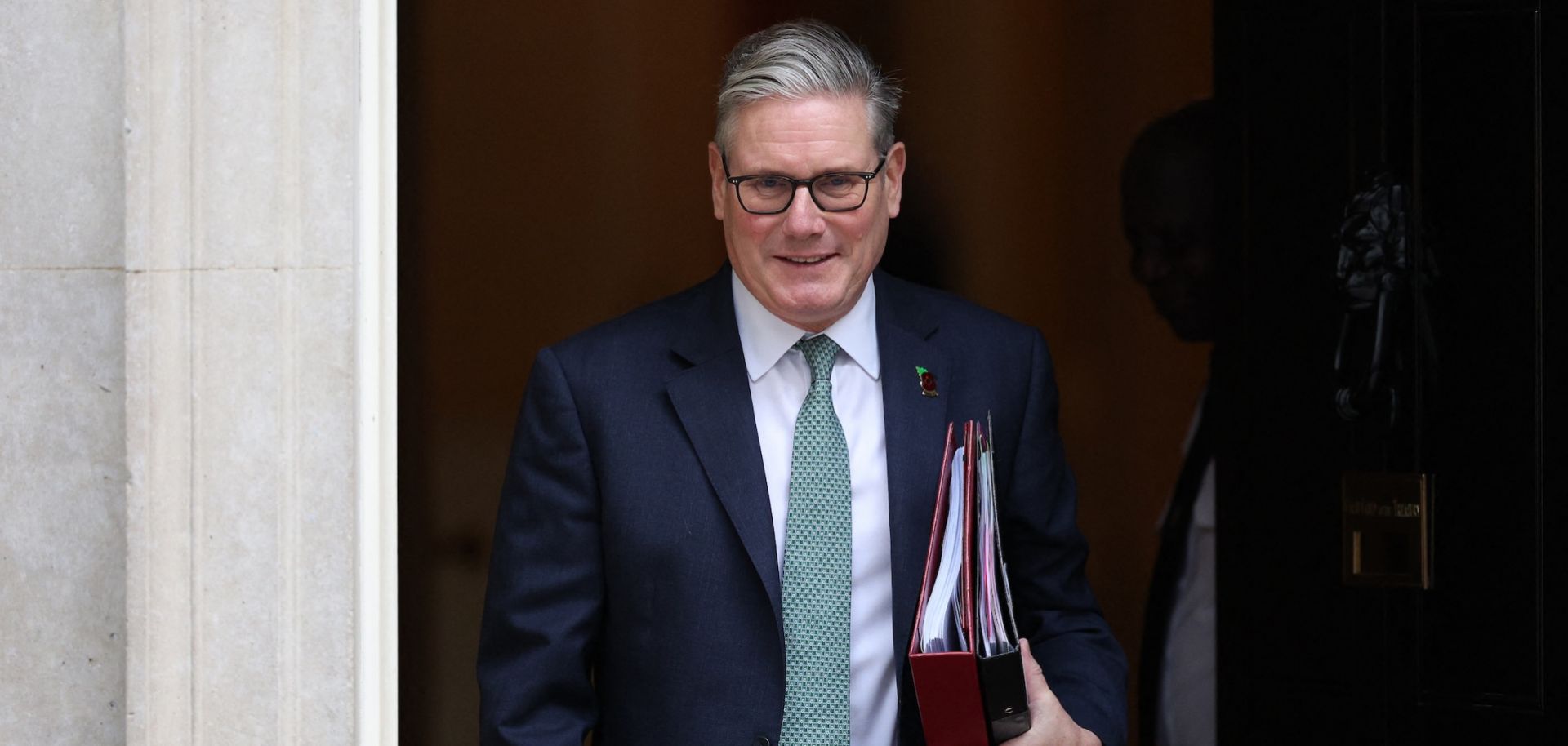
Growing internal divisions within the United Kingdom's ruling Labour party increase the likelihood of Prime Minister Keir Starmer facing a leadership challenge after the unveiling of a budget on Nov. 26 or a defeat in the May 2026 local elections, though any successor would likely maintain broad policy continuity despite some risk of increased fiscal profligacy and limited financial turbulence under a more left-leaning prime minister. In recent days, media speculation about moves within the Labour party to oust Starmer has grown. In fact, Health Secretary Wes Streeting tried to dismiss speculation that he was preparing a leadership challenge against Starmer during a series of media interviews on Nov. 12, following leaks from within the government accusing him of plotting to oust the prime minister. While reiterating his support for Starmer, Streeting criticized what he described as a "toxic culture" within government, urged the dismissal of several Starmer aides and admitted the government was placing heavy demands on voters through high taxes. The dispute followed reports that as many as 50 senior Labour lawmakers were prepared to resign if the upcoming budget triggered a backlash within the party, from the public or from the market and Starmer resisted calls to step down.
- In the United Kingdom, the leader of the governing party is also prime minister. This means that the replacement of a governing party's leader also means the appointment of a new prime minister.
- According to several British media outlets, beyond Streeting, former Deputy Prime Minister Angela Rayner, Home Secretary Shabana Mahmood, Energy Secretary Ed Miliband and Greater Manchester Mayor Andy Burnham (whose potential leadership ambitions would almost certainly require him to seek a parliamentary seat first) are also seen as possible challengers to Starmer.
- Until recently, Streeting had been considered among Starmer's supporters within Labour. Although associated with the party's right wing, he has in recent months used media appearances to broaden his profile beyond his health portfolio, for instance by commenting on issues like Gaza and Brexit in what appears to be an attempt to redefine his image within the party, though without openly challenging government lines.
The rumors come as the Labour ranks grow increasingly uneasy about Starmer's leadership and the government's declining popularity, reflected in mounting internal divisions, public rebellions and declining polling numbers. Recent opinion polls show Labour trailing the right-wing Reform UK party by as much as 8% — a margin that, under the United Kingdom's first-past-the-post electoral system, would probably translate into a decisive defeat for Labour and a parliamentary majority for Reform. Some surveys identify Starmer as one of the most unpopular prime ministers in modern British history. Moreover, the prime minister has been facing mounting backlash from Labour's traditional base over fiscal austerity, a tightening of migration policy and what many within the party view as an overly cautious stance on Israel's military campaign in Gaza. Meanwhile, the party's left wing continues to push for higher social spending financed with borrowing or wealth taxes, a position largely resisted by Chancellor Rachel Reeves, who has pledged to maintain strict fiscal discipline to avoid renewed market instability. This more conservative approach has limited the government's ability to deliver on many of its campaign promises of expanded social services and faster growth, further eroding public approval and internal support. Against this backdrop, Labour lawmakers are increasingly questioning whether a change in leadership could improve their prospects ahead of the next local elections in May 2026 and, longer term, the next general election, due by 2029.
- A YouGov poll from November shows support for Reform UK at 27%, while Labour and the Conservatives are tied at 18%, just four points ahead of the Liberal Democrats and the Greens. A separate YouGov survey found that 73% of respondents believe Starmer is performing "badly" as prime minister.
- U.K. GDP growth has largely stagnated since 2022. Public debt has risen to around 96% of GDP, driven by rising government spending in recent years. Debt servicing costs, now estimated at 3.7% of GDP, exceed core spending areas such as defense, while increases in bond yields and sterling weakness in recent months have reignited comparisons with Liz Truss's 2022 "mini-budget" turmoil. To prevent renewed market instability, Chancellor Rachel Reeves has maintained strict self-imposed borrowing rules, requiring day-to-day spending to be covered by revenues and public debt to fall as a share of GDP within five years.
While fiscal adjustments in the upcoming budget per se are unlikely to trigger an immediate rebellion, they will compound internal tensions and further alienate voters, setting the stage for a later leadership challenge if Labour suffers a significant defeat in the May 2026 local elections. Reeves is scheduled to unveil her Autumn Budget on Nov. 26. A market rout following the budget — which for instance led to the ousting of Conservative Prime Minister Liz Truss in 2022 — appears unlikely given Reeves' cautious fiscal policies and a likely mix of tax hikes and spending cuts aimed at restoring fiscal discipline and reassuring investors. Yet while such measures may stabilize markets, they could also further alienate both many 2024 Labour voters and the parliamentary party's left by implementing spending cuts and potentially breaching Labour's election pledge not to raise income tax. With limited fiscal room and little appetite to make concessions to the party's left, Starmer will likely double down on his current strategy to try and appease a centrist electorate increasingly shifting toward the populist right by maintaining his commitment to fiscal prudence and tighter migration controls while seeking to delay or water down politically sensitive measures that could alienate the public. This strategy may also impact Labour's stated goal of resetting relations with the European Union, with Starmer seeking to avoid policies that could be portrayed as reversing Brexit or imposing new financial obligations. As a result, negotiations with Brussels on politically sensitive issues such as a youth mobility scheme or initiatives requiring U.K. financial contributions to EU programmes on defense cooperation or emissions trading alignment could slow or even stall. Such an approach, would be unlikely to improve Labour's electoral outlook in the coming months and would instead only heighten internal divisions. Should Labour then suffer a significant defeat in the May 2026 local elections across Scotland, Wales and England — losing votes to Reform, the Liberal Democrats, the Greens and Scottish and Welsh nationalist parties, as current polling suggests — internal divisions would likely deepen, potentially leading to a leadership challenge against Starmer.
- Under Labour party rules, a leadership challenge can be triggered if at least 20% of Labour lawmakers (currently 81 out of 405 Labour MPs) formally nominate an alternative candidate. Once that threshold is reached, the contest is overseen by the party's National Executive Committee, with affiliated trade unions and individual party members voting in a one-member-one-vote system. Should Starmer survive a leadership challenge, he would still remain politically damaged. Unlike the Conservative Party, which bars another challenge for 12 months after a failed one, Labour's rulebook offers no such protection, meaning that while surviving an initial contest might consolidate his position in the short term, it would also expose deep internal divisions and leave him vulnerable to renewed dissent and further challenges later on.
- In June, more than 120 Labour lawmakers rebelled over a proposed 5 billion pounds of ($6.8 billion) welfare cuts, undermining Starmer's authority and narrowing Reeves' room for maneuver on budgetary policies. With sluggish growth, high borrowing costs and rising debt pressures, Reeves will likely therefore be forced to unveil a politically painful budget of tax hikes and limited spending adjustments to stabilize public finances and close an estimated 30 billion pound fiscal gap. On Nov. 4, Reeves declined to rule out breaking Labour's pre-election pledge not to raise income tax.
- If the upcoming budget provokes backlash, Starmer may also seek to deflect blame by reshuffling his cabinet and potentially demoting Reeves, using her as scapegoat for unpopular fiscal measures in a bid to contain dissent and preserve his leadership — a move that would carry significant risks, as markets see the chancellor as a stabilizing force and her removal would likely spook investors.
Leadership challenges are common in British politics, though far more against Conservative than Labour prime ministers. Local and by-election results or moments of political and financial instability often serve as flashpoints. Under the Conservatives, former prime ministers Theresa May and Boris Johnson were both forced to resign after losing the confidence of their party in 2019 and 2022, respectively, while Liz Truss stepped down later in 2022 following a market collapse triggered by her unfunded tax cuts.
Early elections remain unlikely and any new Prime Minister would still likely preserve a degree of policy continuity on fiscal discipline, defense and EU relations, with only relatively modest divergence between centrist candidates prioritizing market stability and left-leaning figures favoring stronger social investment and redistribution. Despite Labour's internal disputes, early general elections are highly unlikely in the short to medium term given Labour's large parliamentary majority and weak polling nationwide, which make it unlikely the party could retain power — let alone with such a commanding majority — if a new voter were held, leaving most of the party's lawmakers at risk of losing their seats. If a successful leadership contest against Starmer results in the appointment of a prime minister from the center or center-right wing of Labour, they are likely to emphasize fiscal stability and market confidence while remaining broadly consistent with Starmer's supply-side measures and modest social reforms aimed at meeting some of Labour's key priorities such as stronger workers' rights and improved public services while supporting growth and remaining within existing fiscal constraints. Such a leadership shift would thus likely maintain fiscal restraint, moderate public investment, tighter migration controls and pragmatic re-engagement with Brussels. By contrast, a more left-leaning prime minister would probably seek to more strongly revive Labour's traditional social agenda through a looser fiscal framework, greater investment in green industry and public services and a more cooperative stance with the EU and multilateral partners. Still, any increase in spending would likely remain modest, balanced by offsetting fiscal adjustments such as slower defense spending growth and targeted hikes in wealth and windfall taxes. Overall, both camps would maintain broad continuity on core issues like defense (though potentially with a slower pace of spending increase under a more left-leaning leadership), NATO alignment and EU relations, while differing mainly on the degree of fiscal restraint and ways to achieve it rather than its underlying principle. A leadership change — particularly under a left-leaning figure — could still briefly unsettle markets and weigh on investor sentiment, but a broader financial crisis would remain unlikely given the entrenched fiscal discipline across Labour's senior ranks.
