
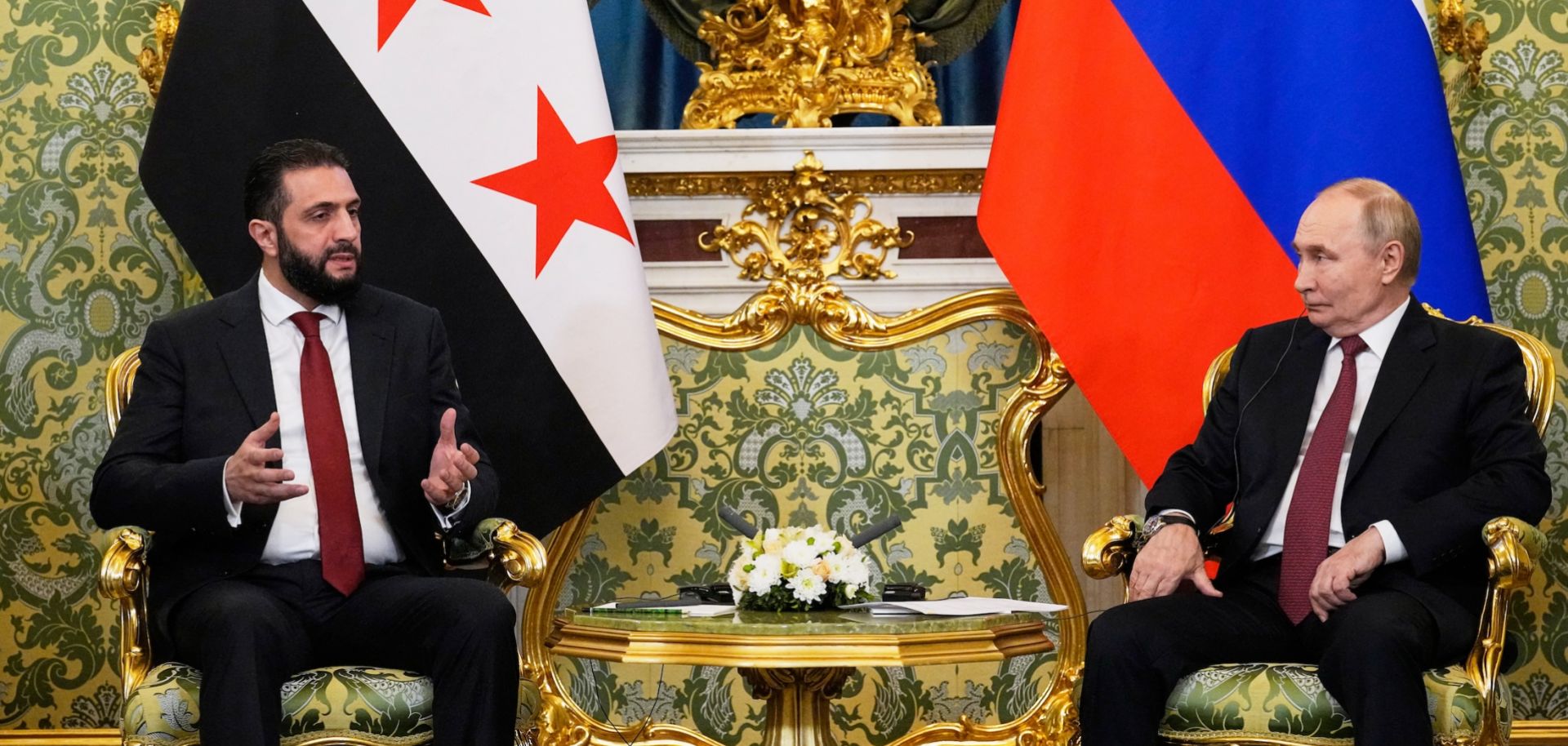
Syria will adopt a pragmatic approach to its relations with Russia that will leave the door open for diversified economic and security ties, help de-escalate tensions between Russia and Turkey, and could eventually facilitate small steps toward Syria's rapprochement with Iran. On Oct. 15, Syria's provisional president, Ahmad al-Sharaa, visited Russian President Vladimir Putin in Moscow. This was al-Sharaa's first state visit to Russia since taking control of Syria in December 2024, following the ouster of Russia's ally, former leader Bashar al Assad, in December 2024. During the meeting, Putin and al-Sharaa addressed several key issues. They discussed the status of Russia's remaining military bases in Syria, which Moscow previously used to fight against rebels challenging the al Assad regime, including al-Sharaa's Hayat Tahrir al-Sham (HTS). Other topics included humanitarian aid, economic ties and the future status of al Assad himself, who remains in exile in Russia and whom Syria wants extradited to face trial back home. Al-Sharaa reportedly reassured the Russians that their military bases and accompanying agreements would remain intact throughout Syria's post-Assad political transition. While al-Sharaa expressed a desire to ''redefine'' relations with Russia, Putin congratulated him on the recent parliamentary elections held in Syria, deeming them a ''great success.''
- Syria's interim foreign minister also visited Russia over the summer, during which Putin extended the invitation for al-Sharaa to visit.
- Russia continued to deliver oil and wheat to Syria after the fall of the al-Assad government in an attempt to maintain its military bases at Tartus and Khmeimim in Latakia. Although Russia has reduced its troop presence and equipment, including advanced S-400 air defense systems, it maintains a skeleton crew and a few fixed-wing aircraft at both bases. This contrasts with Iran — al Assad's other key ally — which evacuated its troops from Syria in December 2024 as the regime crumbled. Iran now has no remaining bases in the country, despite over a decade of investments in building up military infrastructure there.
Syria's Pivot To 'No Problems' Diplomacy
After gaining independence from France in 1946, Syria attempted to chart a non-aligned path between Western democracies and the Soviet bloc. This course ultimately resulted in the country being dominated by pan-Arabists, particularly Gamal Abdul Nasser of Egypt, which led to a brief union between Syria and Egypt from 1958 to 1961, called the United Arab Republic. After the United Arab Republic collapsed in 1961, Syria drifted toward the Soviet bloc as a counterweight to U.S.-aligned Israel, but its communists and nationalists scuffled for power and kept Syria outside of Moscow's network of satellite states. When Hafez al Assad took power in 1970, he kept the Soviet Union as a partner rather than a protector, establishing the Soviet naval base at Tartus the same year. He also developed deeper ties with other non-aligned, anti-Western powers like Iran and China. Then, when the Soviet Union collapsed in 1991, Hafez al Assad continued to look to Russia as an important strategic counterweight to maintain Syria's anti-Western foreign policy and posture. The sudden collapse of his son Bashar's regime in 2024 ended this foreign policy approach, with al-Sharaa instead embracing a policy of shirking confrontation. Al-Sharaa has even taken steps to de-escalate with Israel, despite Israeli air attacks on his government's forces.
Syria's relations with Russia will likely remain pragmatic, as Damascus prioritizes domestic stability and stable foreign relations while leaving Russia's military bases intact inside Syria. Syria's armed forces remain decimated after 13 years of civil war and an intense Israeli air campaign that destroyed much of its remaining heavy weaponry shortly after al Assad's fall. In addition, deep internal divisions between ethnic groups like the Kurds, Druze and Alawites pose serious security risks to the provisional government, which is largely Sunni-dominated and led by former jihadist rebels. Already, there have been numerous outbreaks of violence, with a high risk of further clashes as different ethnic groups seek to preserve their autonomy and defend against potential threats from al-Sharaa's government. Damascus is thus poorly positioned to engage in a confrontational foreign policy with a major military power, including Russia. Instead, Syria will prioritize pragmatic ties with Russia. This will involve leaving Assad-era diplomatic pacts intact, particularly regarding Russia's military bases in Syria. Damascus will also seek to improve personal relations with Russia's government to secure vital energy and food trade, crucial for a war-torn country still in dire need of reconstruction and awaiting full relief from U.S. sanctions.
- Syria may also eventually look to Russia as another security counterweight against Israeli aggression, as the Israelis seek to carve out an informal Druze-dominated buffer state in southern Syria. Russia previously served as a de-escalation force in southern Syria during the civil war. But such a policy would probably require U.S. support, as the United States continues to seek an Israeli-Syrian security pact to help stabilize Syria.
- Most of Syria's air force, armored equipment and artillery were either destroyed during the civil war or bombed by the Israeli air force shortly after al Assad's fall. This has left the current government armed with a collection of small arms and weaponized civilian vehicles, offering little protection from Russian air power, should the Kremlin choose to militarily re-engage in Syria.
- Syria also faces food insecurity due to a diminished harvest. Drought, the collapse of the Assad government, shortages of essential agricultural inputs, and years of neglect have all contributed to this crisis, increasing Damascus's dependence on food imports from international donors. Furthermore, Syria's economy remains in tatters, deepening its dependence on friendly donors such as Turkey, Saudi Arabia and the United Arab Emirates.
While Turkey has historically opposed Russia's involvement in Syria, it will likely see Moscow's improved ties with Damascus as a positive development for Syrian stability. Turkey has long rejected Russia's presence in Syria. This opposition stems from the Kremlin's backing of al Assad, which contributed to a refugee crisis and security vacuum that directly affected Turkey. The 13-year conflict saw three million Syrian refugees cross into Turkey and turned Syria into a breeding ground for Kurdish and Sunni Islamist militants, some of whom carried out attacks on Turkish soil. But with al Assad gone and Russia moving out of an adversarial position with al-Sharaa's provisional government that is largely Turkey-aligned, Ankara can embrace the rapprochement between Syria and Russia as a positive step toward securing its southern border and creating favorable conditions for Syria's reconstruction and the return of up to a million Syrian refugees still living in Turkey. In addition, Turkey and Russia are aligned on their opposition to Israel's plans to create a proto-buffer state in southern Syria, a development they view as a potential step toward destabilizing Syria and undermining their own influence within the country. Consequently, Turkey is unlikely to pressure its partners in the Syrian provisional government to push for the removal of Russia's military bases in the near term.
- Turkey and Russia engaged in several major military clashes during the course of the civil war, including a major flare-up in February 2020 that saw Russia back an offensive against Turkish troops in Idlib province, where al-Sharaa's HTS was based. Turkey also shot down a Russian jet in 2015 after it claimed it had violated its airspace, leading to another major confrontation between them. But each confrontation eventually gave way to de-escalation, as neither Russia nor Turkey wanted to escalate into a major war over the future of Syria. Turkey played only a supporting role in the final rebel offensive against al Assad in 2024 as it sought to maintain this dynamic.
- Russia's global standing has faced significant setbacks since its 2022 invasion of Ukraine, which has used up major amounts of Russian military hardware and troops, and has left Moscow diplomatically isolated. This situation both limits Russia's ability to influence Syria at Turkey's expense and increases Russia's reliance on Turkey, which is one of its few remaining NATO trading partners.
- Despite tensions over Ukraine, the United States still sees Russia as largely a stabilizing force in Syria due to Moscow's record of de-escalating tensions between the al Assad government and former rebels, like the U.S.-backed Syrian Democratic Forces (SDF), over the years. As a result, as the United States lifts sanctions on Syria, it remains largely ambivalent about the future of Russia's bases.
Russia is unlikely to extradite former President al Assad to Syria, despite the provisional government's demands to do so. As Assad remains in Moscow after fleeing Syria in December 2024, Syria will likely continue to demand his extradition, as well as the extradition of other high-level officials who have sought refuge in Russia, so that they can stand trial for crimes committed during the civil war. However, Russia has no precedent for extraditing former allies for such tribunals, fearing the impact on diplomatic relations with other pro-Russian states. With the Syrian provisional government too weak to militarily threaten the Russian military bases and disinclined to start a confrontation with Russia over al Assad, Damascus will instead continue to insist on Assad's extradition without resorting to threats or attempting to leverage Russia's military bases as part of such a negotiation. This will consequently leave al Assad in Russia for the foreseeable future.
- Former Ukrainian President Viktor Yanukovych also remains in Russia after being ousted by anti-Russian and pro-European activists in Ukraine's Euromaidan protests in 2014. Moscow has long sought to leverage exiles to establish shadow governments or boost its diplomatic profile, and hosting Assad demonstrates its willingness to protect allies even if they lose power in their own countries.
Finally, improved Russia-Syria ties may encourage the Syrian government to try to reach out to another former civil war rival, Iran, but divisions and distrust will slow any reconciliation between the two. Compared to engagement with Moscow, Damascus is likely to move more slowly on outreach to Tehran due to sectarian and religious distrust, as well as Iran's own need to re-establish its land corridor through Syria that connects it to Hezbollah in Lebanon, Tehran's primary ally in the Levant. Iran was quick to exit Syria in late 2024 and has not since attempted to overtly undermine the new provisional government — particularly now that Tehran's strongest regional ally, al Assad, has gone into exile, thereby leaving Iran with no clear, viable potential partner on the ground in Syria. Iranian officials have also left open the door to restoring ties with Syria, and they have negotiated protections for religious minorities like Shiite pilgrims and security for Shiite holy sites within Syria. As a result, Damascus will likely seek to normalize relations with Tehran to weaken the drivers that could compel Iran to support rebel groups during Syria's political transition. But this process will face significant obstacles, ranging from Iran's distrust of a Sunni jihadist-dominated Syrian government, to Syria's concern that Iran will seek to improve relations only to re-establish supply lines to Hezbollah through Syrian territory, which would expose Syria to further Israeli military action and a potential snapback of U.S. sanctions. As a result, while Syria is likely to increasingly focus on Tehran as part of its normalization push, it will find progress with the Iranians to be notably slower than that with the Russians.
- Since a bruising war with Israel in late 2024, Hezbollah has focused on rearming and recruiting to restore its former power. The war with Israel also notably deterred Hezbollah from intervening to save Assad that same year, leading to the loss of the land route through Syria. For decades, this route had been the main channel for weapon shipments from Iran.
- Iran's vast network of militias and bases in Syria, originally intended to deter Israel, instead provoked an Israeli shadow war against both Syria and Iran that escalated in 2018 when Israel embarked on a more expansive air campaign. However, when the al Assad government fell in 2024, these bases were abandoned and the militias were withdrawn.
