
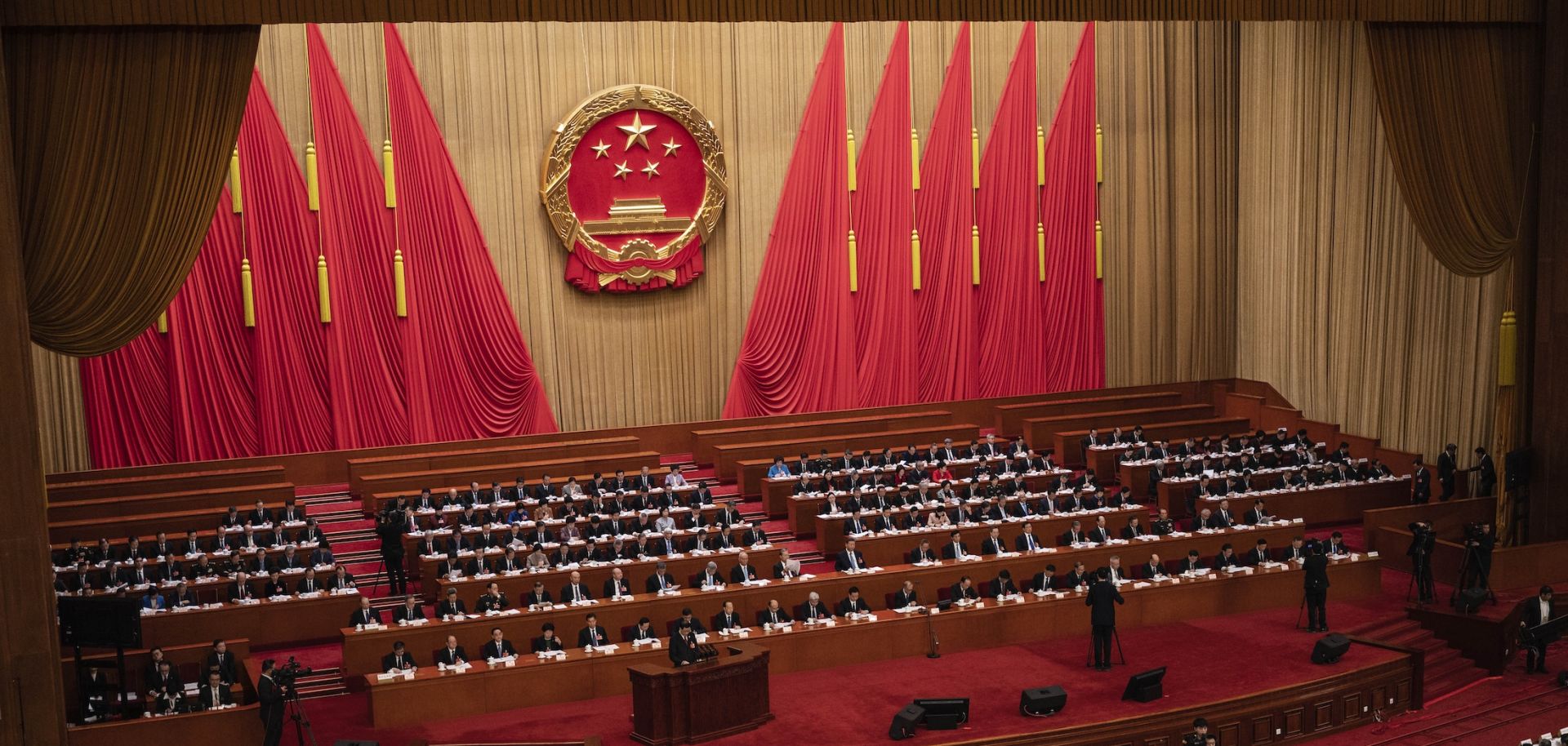
The Chinese government's fourth plenum will reveal its next five-year plan, elucidating economic and security objectives; it will likely also update Beijing's indigenous industrialization plans and fill the thinned ranks of the Chinese Communist Party, giving insights into future policy priorities and the trajectory of President Xi Jinping's political purges. China's Central Committee (CC), the national decision-making body of the Chinese Communist Party (CCP), will hold its fourth plenum from Oct. 20-23. In its five-year tenure, each CC holds seven plenums, with this fourth plenum set to discuss China's 15th five-year plan. Each five-year plan is a policy document that roughly outlines the CCP's top economic, security and political priorities for China, with this latest iteration covering 2026-2030. Though the full details will not be published until China's ''Two Sessions'' rubber-stamp legislative meetings in March 2026, the CCP usually publishes a proposal containing the broad policy contours and ideological framing for the upcoming plan after the fourth plenum ends. The plenum is also expected to unveil the next ten-year phase of the Made in China 2025 plan, which has guided the CCP's efforts to advance China's manufacturing and innovative capacity and its industrial self-reliance since 2015. Furthermore, the plenum will disclose new information regarding CC membership, including the formal replacement of officials who have either died or been politically purged.
- The Chinese government is run directly by the CCP. Policy decisions are made in a top-down manner, originating with CCP General Secretary and Chinese President Xi Jinping. The hierarchy then extends downward through the Politburo Standing Committee, the Politburo, the Central Committee, and finally to the provincial and local party committees. This means that by the time policies (e.g., the five-year plan) reach the broader Central Committee for discussion during a plenum, their main contents have already been mostly finalized by elites. Still, until a document is formally adopted, any publicized details will be largely thematic and qualitative.
This fourth plenum comes as China is juggling myriad domestic and foreign challenges, suggesting the next five-year Plan will be heavily focused on insulating the country from risks. China's economic recovery following the end of COVID-19 lockdowns in December 2022 has been weaker than Beijing expected. Consumer confidence remains low and retail growth is lagging economic growth — a dynamic exacerbated by producer and consumer price deflation and growing youth unemployment. Moreover, the real estate sector is still in a depression following Beijing's ''three red lines'' debt crackdown in August 2020, and local government budgets are highly strained due to low land revenues and lingering debts from their COVID-19 expenditures. But while growth is slow by historical standards, China remains on track to meet its goal of ''around 5%'' growth for 2025, which explains the government's resistance to recent domestic and international calls for major economic stimulus. Xi's power remains unchallenged, but questions are emerging about the effectiveness of his fear-based tactics — after 13 years of application — in fulfilling his policy visions. These concerns stem from Xi's growing anticorruption campaigns and political purges, particularly within the military and foreign ministry, and his accelerating efforts to root out ''formalism and bureaucratism'' (i.e., passive resistance to Beijing's policies). Meanwhile, the West's growing economic and national security concerns with China are manifesting in higher tariffs and investment barriers, as well as curbs on China's access to key technologies like advanced chips. These external pressures are emphasizing the necessity of Beijing's industrial ''self-reliance'' policies and its trade diversification. They are also fueling China's own national security policies, which in some cases compound China's trade problems, like Beijing's recent decision to curb imports of advanced, U.S.-made Nvidia chips over espionage and sabotage concerns.
The next five-year plan will outline Beijing's updated strategy for boosting consumption and employment, alleviating local governments' financial difficulties, and combating destructive industrial trends; it will also inform China's vision for its mixed economy, including the role of public and private companies. The 2026-2030 plan will largely update the CCP's top-level guidance about overcoming economic challenges and achieving development goals, as opposed to detailing specific policy prescriptions, in order to preserve flexibility in the coming years. However, the plan's language will still indicate China's policy direction on multiple economic fronts. A major focus will be on stimulating consumption, given the prolonged post-COVID downturn and Beijing's goal of raising consumption as a share of GDP to advance the economy and insulate it from Western tariffs and other import restrictions. But the plan will likely only signal tweaks to existing consumption support (i.e., via expanded consumer goods and services subsidies), instead of a paradigm shift toward fiscal expansion, due to Beijing's ongoing concerns about debt and moral hazards. Lowering youth unemployment is also a priority, but structural constraints — including a mismatch between abundant college-educated youth and a dearth of skilled, blue-collar labor — will likely lead Beijing to focus on technological upgrades across industries (e.g., better incorporating AI into manufacturing and delivery services) to create more white-collar jobs, while also improving employment benefits and protections for blue-collar workers, especially for rural migrant workers. To shore up local government revenues, the plenum may examine tax reforms, but those most needed to fill government coffers — including real estate and income taxes — would exacerbate the real estate and consumption downturns and are thus unlikely to be a main focus. The plenum may reveal plans to ease the overconcentration of provincial- and city-funded enterprises in key sectors (e.g., AI, data centers and electric vehicles), including by designating new city and provincial industrial clusters. It could also elucidate Beijing's plans to counteract industrial price-cutting and overcapacity, which threaten innovation and China's trade relations, by, for example, closely monitoring pricing models and industrial capacity utilization rates.
- Each proposed five-year plan is often less explicit about what tools Beijing will employ than about Beijing's motivations and priorities. The plan reveals subtle shifts in ''tifa,'' or stock phrases that encapsulate the CCP's sometimes contradictory governing formulations. For example, the ''two unwaverings'' tifa describe the CCP's ''unwavering'' commitments since 2012 (when Xi came to power) to both providing private sector opportunities and strengthening the public sector, a change from previous CCP formulations that clearly prioritized private sector growth.
The five-year plan will also update Beijing's focus on national security versus the economy, emphasize grassroots surveillance as an antidote to public dissent, urge greater political loyalty (especially in the military) to meet policy goals, and continue building out a ''rule of law society'' to protect China from foreign threats. Compared with economic issues, the plan will likely be even vaguer on political and security matters, given the sensitivity of these topics to the CCP, but wording and relative topic focus will still offer insight into policy direction. One wording shift that will be important to watch is how Beijing balances development and security, with recent Party documents framing security as a basis for development, insinuating the former's supremacy over the latter. If this formulation continues or puts additional emphasis on security, it will increase the likelihood of policies that could sacrifice short-term growth for the sake of long-term economic security, such as more curbs on Western tech imports. The five-year plan will likely continue to emphasize ''grassroots engagement'' as a means to preserve public stability, such as employing volunteers to monitor neighborhoods for aggrieved individuals who could perpetrate mass knifings or car rammings. However, this approach will only exacerbate public discontent over the government's failure to improve economic conditions and its ongoing suppression of dissent, which will steadily raise the risk of large-scale demonstrations, particularly among unemployed and underemployed youth, even if such protests are mostly short-lived. The five-year plan will also emphasize instilling political loyalty into and rooting out corruption from the military, a key focus for Xi over the past two years that has led to dozens of high-ranking purges. While this will continue to jeopardize short-term military readiness, it may improve long-term readiness by reducing conspicuous waste and curbing rent-seeking and policy obstructionism among local military leaders. Language about making China a ''rule of law society'' — a reference to standardizing domestic regulations and foreign trade measures — will be prominent as well. This longstanding goal of Xi's aims to improve the implementation of national policies, as well as deter and retaliate against foreign trade restrictions, as seen in China's recent expansion of rare earth export licensing regimes.
- China's youth unemployment (for those aged 16-24) reached 21% in June 2023, a sharp increase from the 10% recorded in 2012, the year Xi came to power. After June 2023, Beijing temporarily stopped publishing the figure before reinstating it in December 2023, saying that the rate stood at 15% and that students were now excluded from that number. But the youth unemployment rate has nonetheless continued its rise since then, reaching 19% in August 2025.
- On Oct. 9, China's commerce ministry announced it would institute licensing regimes for Chinese exports of technologies related to mining, processing and manufacturing products from rare earths. The same day, it imposed a licensing regime on exports by overseas companies (including foreign firms) of any product whose value comes at least 0.1% from Chinese rare earths.
The next iteration of the Made in China program will update Beijing's industrial and technological advancement goals, including for its green industries, in a bid to address development chokepoints, highlighting areas of opportunity for foreign investors. Whether within the five-year plan or as a separate document, the plenum will likely reveal the next phase of Made in China 2025, extending it through 2035. This will include updates to the CCP's list of ''strategic emerging industries,'' which will receive the bulk of government subsidies and other state resources (e.g., cheap credit, access to research facilities and easier licensing procedures) in the coming years. The MIC updates may also flesh out Xi's vision for ''new quality productive forces'' by outlining how China plans to use technological advancements to move manufacturing up the value chain, break through scientific barriers, commercialize related technologies, alleviate unemployment problems, and reduce China's reliance on certain Western technologies that make it vulnerable to trade wars. As with the five-year plan itself, the updated MIC document will be high-level guidance, meaning exact technological details may be scarce. But it will still give insights (like the ''strategic emerging industries'') into the sectors and policy areas that the government will prioritize for regulatory loosening and greater funding, including central government revenue transfers that provide guaranteed income to local governments to pursue provincial research and development ventures. It will also set topline manufacturing goals, such as increases in industry energy efficiency and the share of industry revenue allocated to research and development (both objectives set in MIC 2025), which will clarify Beijing's development priorities, even if the methods used to measure these figures are sometimes questionable. China's green industry plans will feature prominently in the MIC update as well, including what breakthrough technologies Beijing will be pursuing (e.g., next-generation battery tech) and in what sectors Beijing will increase project supervision (e.g., slowing the buildout of renewable generation capacity relative to transmission infrastructure or deterring fake or unprofitable projects that pad local officials' performance metrics). Though much of this document will elucidate the ways in which China aims to improve technological and industrial self-reliance, it will also serve as a crucial indicator for foreign companies by highlighting areas where the Chinese government intends to facilitate or hinder foreign operations and investment. Given China's propensity for rapidly scaling up production capacity for industrial priorities, the MIC update will additionally help forecast what areas of international trade are most likely to see Western anti-dumping investigations and national security restrictions against China issued on the grounds of protecting Western economic and industrial security.
- The MIC update will also set forth goals on broader topics, such as the protection of intellectual property rights and China's domestic industrial capacity. This will offer insights into Beijing's enforcement priorities (for instance, regarding patent or branding disputes) and the sectors where Beijing will pressure local companies to ''Buy Chinese.''
Finally, the replacement of recently purged officials will provide insights into the technical capabilities and policy leanings of China's next cohort of leaders, as well as reveal Xi's future targets for political persecution. The upcoming plenum will fill the vacancies within the Central Committee, which currently has 193 full members and 165 alternates. Dozens of officials, including 20 military leaders, have been absent from public view, investigated by Party discipline authorities, or officially removed from the Party or their public positions since the last plenum, according to a recent report by the U.S. think tank Asia Society. These officials in question include three former members of the Party's Central Military Commission (CMC), China's top military decision-making body led by Xi, whose seats are likely to be filled at the plenum as well. The profiles of these replacements on both the Central Committee and the Central Military Commission — namely, the depth of their career connections to Xi, whether they are technical experts or political apparachiks, their focus on economic vs. security affairs, and their age (indicating future leadership potential) — will offer crucial insights into the governing capabilities and policy inclinations of China's next leadership cohort over the next five years. The replacements may be coupled with formal Party announcements clarifying what happened to the missing or purged officials. Such announcements could indicate who among them has been rehabilitated (i.e., retaining Party membership) and who has been implicated in corruption or political crimes, informing what foibles are most likely to topple officials and the trajectory of Xi's future purges.
