
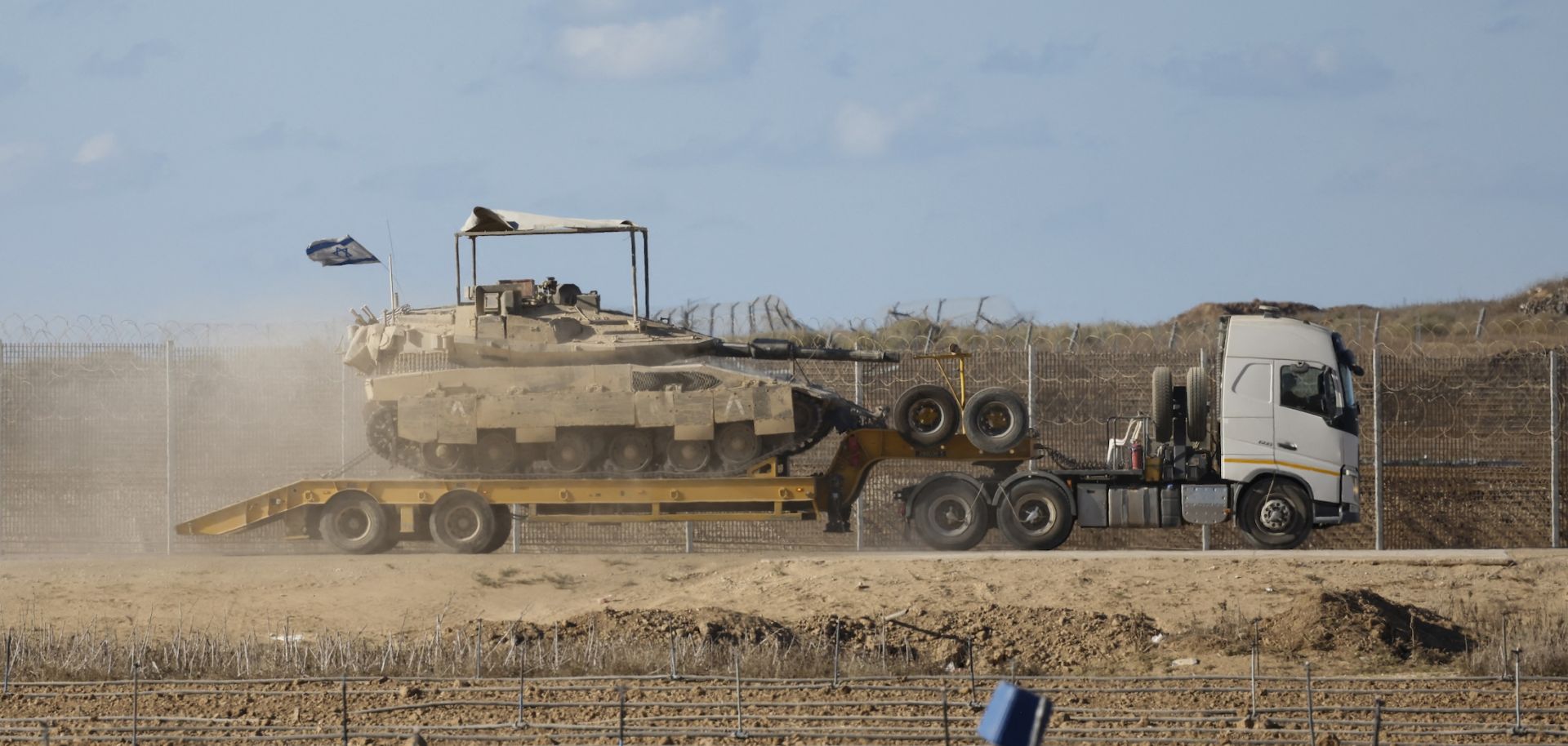
The ceasefire in the Israel-Hamas war will temporarily ease regional diplomatic tensions and free Israeli military resources for other fronts, but a collapse in the coming phases would almost certainly reignite conflict with Hamas, cause diplomatic friction with regional powers and risk a wider escalation involving Hezbollah, the Houthis and Iran. On Oct. 15, Israel and Hamas entered negotiations over the second phase of the U.S.-backed 20-point Gaza peace plan that they reached on Oct. 8 as tensions flared over Israel's accusations that Hamas was not complying with the first phase by not releasing enough bodies of Israeli hostages. On Oct. 15, Israel announced that while three bodies handed over by Hamas the previous day were those of Israeli hostages, a fourth body was not. Meanwhile, mediators began discussing the deployment of an initial 1,000-strong Palestinian police force, trained by Egypt and Jordan, to help manage security in Gaza under the prospective phase-two framework. The entry into negotiations followed the Gaza peace plan summit that was held in the Egyptian city of Sharm el-Sheikh on Oct. 13. The summit followed the release of all 20 remaining living Israeli hostages from Gaza and the release of roughly 1,900 Palestinian prisoners on Oct. 13. The discussions in Sharm el-Sheikh aimed to transition from the exchanges of prisoners and hostages toward talks on phase two of the ceasefire which includes Gaza's governance, demilitarization of Hamas and reconstruction.
- The Oct. 13 summit, co-chaired by Egyptian President Abdel Fattah al-Sisi and U.S. President Donald Trump, focused on implementing the first phase of the plan, including securing the truce, coordinating humanitarian aid into the Gaza Strip, forming a Palestinian security force trained by Egypt and Jordan to take the helm of internal security in the Gaza Strip to replace Hamas and preparing for an international stabilization mission.
Israel's aggressive military actions across the region over the past two years have severely damaged its international standing and strained relations with neighboring states. In Gaza, Israeli military operations and reported plans to forcibly displace Palestinians toward Egypt provoked sharp backlash from Cairo, triggering a security crisis and the ِEgyptian remilitarization of the Sinai Peninsula. At the same time, escalating violence, restrictive laws and measures against Palestinians in the West Bank signaled a de facto annexation process, heightening fears in Jordan of mass displacement and a potential influx of refugees. Israel's plans to occupy Gaza and calls to annex the West Bank, attacks against Iran's nuclear program and attacks in Lebanon, Syria and Qatar further eroded its international relationships. These actions led the United Arab Emirates to reassess normalization with Israel and Saudi Arabia to freeze its normalization talks, while halting new entries into the Abraham Accords framework. Throughout this period, Washington's failure to rein in Israel's behavior weakened U.S. credibility across the region, until it began to apply pressure on Israel to agree to a ceasefire.
With the Gaza ceasefire freeing up Israeli military capacity, the likelihood of renewed military action against Iran will increase in the coming months. The June Israel-Iran war, which marked the first direct military confrontation between Israel and Iran, shattered long-standing deterrence norms and exposed vulnerabilities on both sides. Israel's extensive strikes significantly disrupted Iran's nuclear program and degraded its missile and air defense capabilities, though Tehran has since accelerated efforts to rebuild these systems and harden key sites. As Israel reallocates intelligence and strike assets from Gaza, there is a growing likelihood that the Israel Defense Forces (IDF) will consider another round of preemptive military operations against Iranian facilities — particularly if intelligence points to resumed nuclear enrichment or imminent missile deployments. Israel could interpret U.S.-Iran diplomatic talks, frozen since the war, resuming but later stalling as a strategic cover to act unilaterally and launch a new wave of attacks against Iran in a bid to further reduce Tehran's nuclear and ballistic missile program. Such a move would elevate the risk of Iran's remaining proxies in Yemen and Iraq launching retaliatory attacks on Israel and potentially also Western assets — particularly if the United States decides to intervene again, as it did the first time — across the region, including the Gulf.
The ceasefire will also allow Israel to redirect military and intelligence resources away from Gaza toward containing other pressing regional threats, particularly Hezbollah in Lebanon and the Houthis in Yemen. Hezbollah's leadership, military capabilities and political influence in Lebanon were severely degraded by Israel during the war in 2024. However, the group continues to resist domestic and international pressure to disarm. Against this backdrop, with the Gaza ceasefire in place, Israel will be able to divert intelligence and military resources from Gaza toward Lebanon, where it conducts near-daily strikes against Hezbollah under the guise of enforcing the Nov. 27 ceasefire and thwarting Hezbollah's attempts to re-arm. In the coming months, the United States and Israel may grant the Lebanese government additional time to demonstrate progress toward Hezbollah's disarmament. However, as U.S., Western, Arab and Israeli diplomatic pressure on Lebanon mounts amid Hezbollah's likely resistance and the government's unwillingness or inability to act without risking sectarian conflict, the likelihood of broader and more intense Israeli strikes to enforce disarmament will grow, heightening the risk of government destabilization and renewed conflict between Israel and Hezbollah. Finally, with the Gaza ceasefire freeing up military and intelligence resources, the IDF is likely to also focus more on the threat of Yemen's Houthi rebels, who have conducted weekly attacks against Israel throughout the Israel-Hamas war. Given Israel's aggressive and preemptive military posture, the risk of IDF strikes on Houthi targets will remain elevated, even though the group has halted its attacks following the ceasefire. Israel will likely attempt to assassinate senior Houthi leaders whenever there is intelligence on their whereabouts, which would in turn likely trigger a Houthi response and renewed cycle of tit-for-tat attacks.
- A day after the ceasefire, Israel launched airstrikes deep inside Lebanese territory south of Sidon, targeting a construction and bulldozer facility. The strikes are a likely signal of Israel's intent to deter and obstruct reconstruction efforts in southern Lebanon, an issue Hezbollah has been pushing as a key condition for engaging in disarmament talks.
- Hezbollah has, since the Nov. 27 ceasefire, refused to disarm unless Israel withdraws from five positions it still holds in Lebanon. While the Lebanese government adopted a plan by the army in September on Hezbollah's disarmament, the plan does not include a timeline and also sets the conditions for Israel's withdrawal, as well as logistical support for the Lebanese army to carry out the task. Hezbollah will resist disarming for the foreseeable future. The Lebanese government and army are unlikely to take any drastic measures to forcefully disarm it.
The Hamas-Israel ceasefire will enable many Palestinians displaced from Gaza City to return home. As long as it holds, it will defuse diplomatic and security tensions between Israel and Egypt. Throughout the war, Egypt mainly feared that Israel would attempt to displace Gazans toward the Sinai, which the Egyptian government viewed as unacceptably destabilizing. With the ceasefire in place and Israel unable to displace Gazans to Egypt for the foreseeable future, Cairo will now be able to re-engage with Israel on efforts to prevent border security incidents and weapons smuggling into Gaza. Egypt will also participate in the postwar Gaza plan by training and sending Palestinian security forces to the Strip. This will somewhat defuse diplomatic tensions and improve the domestic situation in Egypt, where the government feared for the past two years that the combination of domestic socio-economic grievances and anti-Israel feelings would destabilize the country. Egypt — with the backing of various Arab states participating in the postwar Gaza plan — will pressure both Israel and Hamas to adhere to the terms of their ceasefire, aiming to prevent violations that could reignite fighting in Gaza and potentially trigger a refugee crisis. However, Egypt has limited leverage to prevent violations and will only use diplomatic channels to try to prevent them. This also means, with the ceasefire fragile, a collapse in the second phase would reignite the war in Gaza and with it, Egypt-Israel tensions.
The ceasefire will at least temporarily defuse diplomatic tensions between Israel and the United Arab Emirates. If it proves durable, it may open the door for talks on normalization with Saudi Arabia, though progress will remain reversible. With the ceasefire in place and any Israeli plans to displace Palestinians and annex the West Bank at least temporarily postponed, economic and diplomatic tensions between the United Arab Emirates and Israel will likely improve in the coming weeks. However, this relief is likely to be short-lived. The ceasefire remains fragile. Israel's high risk tolerance, coupled with the influence of far-right coalition members, leaves open the possibility of renewed hostilities and territorial expansion in the West Bank. Despite the vague references to Palestinian statehood in the postwar framework, Israel has already advanced de facto annexation measures in the West Bank — including settlement expansion and administrative integration — undermining Arab confidence in a genuine trajectory toward the creation of a Palestinian state. While the truce could reopen space for Saudi-Israeli normalization talks, particularly as Riyadh seeks diplomatic leverage through a symbolic commitment to Palestinian sovereignty, any progress will remain conditional and reversible.
- The resumption of Israeli operations in Gaza or the intensification of military operations and concrete steps toward annexation in the West Bank would quickly reignite regional anger, jeopardizing both the ceasefire and prospects of Saudi-Israel normalization and also leading the United Arab Emirates to review relations with Israel.
- Further steps toward annexing the West Bank would likely reignite diplomatic and security tensions between Israel and Jordan by raising Amman's fears of a refugee influx toward the country, something it considers a red line and fears could destabilize the country.
Breaking the terms of the October 2025 ceasefire in its second and third implementation phases would risk reigniting the conflict between Israel and Hamas and, therefore, regional tensions. Despite the almost completion of the first phase of the ceasefire deal, the second phase — which stipulates the gradual return of displaced civilians to Gaza, talks on disarming Hamas and the deployment of an international monitoring mission to oversee reconstruction and security arrangements — is fragile and at a high risk of threatening the ceasefire. Despite the ceasefire, Israel is likely to maintain limited intelligence and counterterrorism operations inside Gaza to target residual Hamas infrastructure and prevent the group from reorganizing. Such actions, including precision airstrikes, drone surveillance or cross-border special operations, would carry a persistent risk of military escalation, particularly if they result in civilian casualties or are perceived by Hamas as major violations of the truce. Meanwhile, over the coming months, Prime Minister Benjamin Netanyahu's government will face increasing domestic political pressure from ultra-nationalist and far-right factions and segments of the security establishment to retain some military presence or buffer zones in Gaza. Hamas and other Palestinian factions will likely resist any prolonged Israeli oversight and disarmament. Any major breach, such as a large-scale Israeli operation or renewed Hamas attacks on Israeli troops, could reignite full-scale hostilities, undoing months of diplomacy. Any resumption of fighting would likely reignite diplomatic tensions between Israel, its neighbors and other regional powers.
