
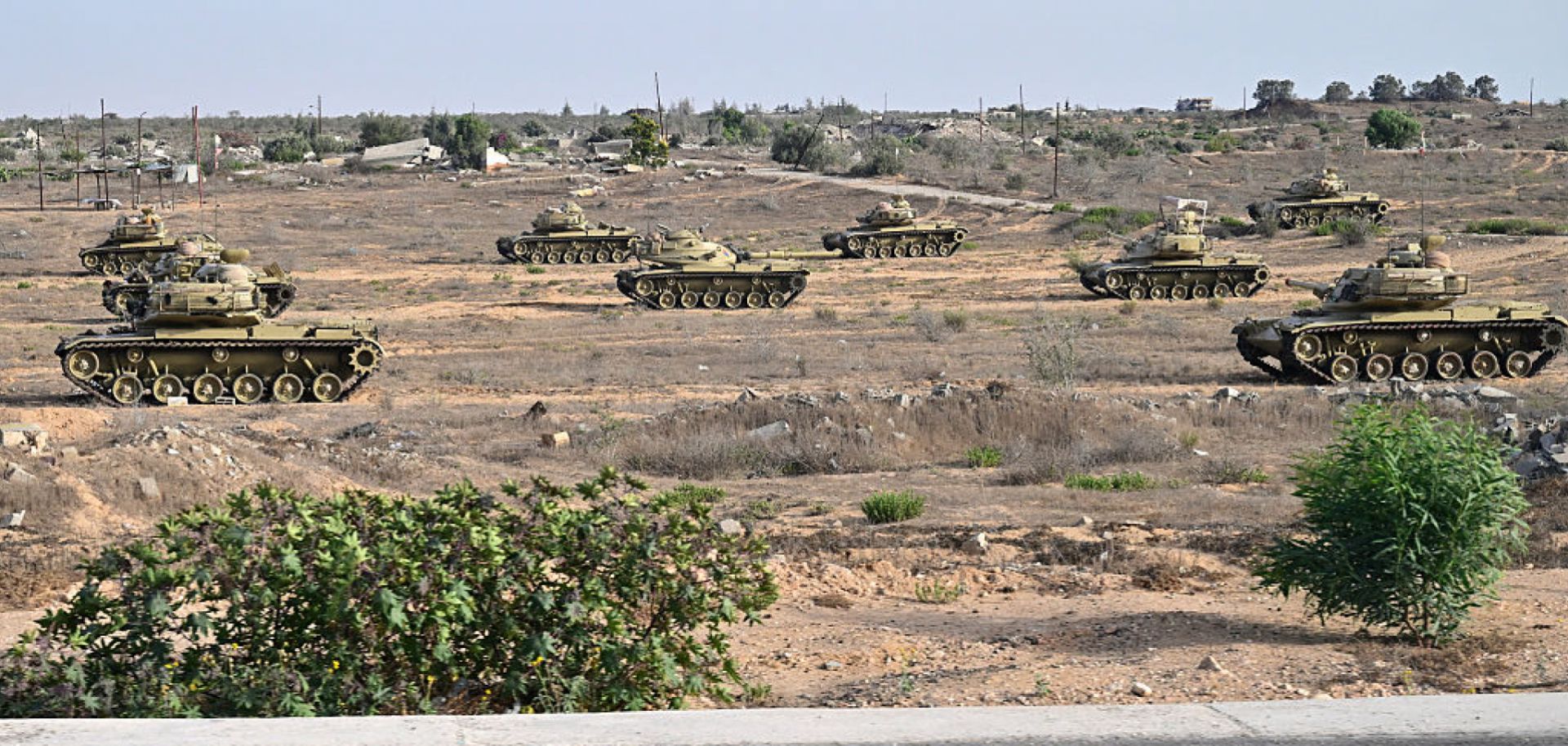
Egypt's military buildup in the Sinai Peninsula will not trigger a war with Israel. Still, the risk of sporadic border incidents in the coming months will be heightened. If Egypt does not reduce its military footprint, Israel could force it to diversify its energy supply by suspending a major energy deal. Israeli Prime Minister Benjamin Netanyahu reportedly asked U.S. Secretary of State Marco Rubio during his Sept. 14 to 16 visit to Israel to pressure Egypt to reduce the number of Egyptian troops it has stationed in the Sinai, according to a Sept. 20 Axios report citing U.S. and Israeli officials. The disclosure came after Egypt deployed around 40,000 troops to the Sinai in late August to boost its military presence near the Gaza Strip border in a coordinated effort with the Israeli army ahead of Israel's expanded ground operations in Gaza. While Israel cautiously coordinated on the troop increase, Axios also reported that Israeli officials had alleged what they viewed as more explicit Egyptian violations of the 1979 peace treaty, including expanding runways that could be used by fighter jets, building up military infrastructure in areas where only light weapons are permitted and constructing underground facilities where missiles could be stored, though there is reportedly no evidence that any missiles are currently being stored there.
- The 1979 peace treaty between Egypt and Israel limits the number of troops that Egypt is permitted to deploy to the Sinai to around 26,000, with only a limited number of security personnel permitted near the border. However, previous exceptions through coordinated efforts have been made, including in 2011, to enable Egyptian forces to combat terrorism in the Sinai.
- Throughout the Hamas-Israel war, Egyptian officials have reiterated that any Israeli plan to forcibly displace Palestinians, which they fear would cause a mass influx of refugees into the Sinai, would be a ''red line.'' Some estimates suggest Israel's expanded military operations to take over Gaza City and expand its military presence in central Gazan refugee camps to combat Hamas's insurgency in the strip could push up to 1 million Palestinians in Gaza southwards toward the Egyptian border.
- Cross-border incidents have occasionally occurred near border crossings. In June 2023, a member of Egypt's security forces entered Israeli territory and killed three Israeli soldiers, injuring two others. In May 2024, an Egyptian soldier was killed in a cross-border clash with Israeli soldiers. In both cases, the situations were quickly de-escalated to prevent additional clashes.
Egypt's military buildup in the Sinai reflects growing concern about Israel's expansionist, risk-tolerant regional strategy and fears that it plans to displace Palestinians toward Sinai. Since the Oct. 7, 2023, Hamas attack, Netanyahu has repeatedly demonstrated a high risk tolerance. The Israeli prime minister has prioritized a maximum-pressure campaign against Hamas in the face of growing international condemnation of the military campaign in Gaza and the wider region. Israel's regional strategy and the displacement of Palestinians southward toward the Egyptian border have stoked concern among Egyptian officials about the potential security threat Israel poses to its neighbor. Growing tensions have led Israel to threaten Egypt's energy security. After Egypt's military buildup, Netanyahu reportedly ordered Energy Minister Eli Cohen to reconsider the $35 billion Leviathan deal, signed in August 2025, to expand Israeli natural gas exports to Egypt through 2040. Tensions further escalated after Israel's Sept. 9 attack against Hamas leadership in Doha, Qatar, which marked the first direct Israeli attack on a Gulf Cooperation Council country. During the Sept. 14 to 15 emergency Arab-Israeli summit at which leaders discussed their response, Egyptian President Abdel Fattah al-Sisi implied that Israel was ''the enemy,'' a notable rhetorical shift away from the language Egyptian officials usually use to describe the pragmatic relationship between Egypt and Israel.
- Following the Sept. 9 attack, Prime Minister Netanyahu said that Israel would attack Hamas leadership anywhere, raising the possibility that Israel could target Hamas on Egyptian soil. During Egyptian-mediated negotiations for a hostage ceasefire deal, Hamas senior officials have frequently visited Cairo to discuss the latest proposal and their demands for an agreement. The Doha attack occurred while senior Hamas officials were reportedly reviewing a U.S.-backed ceasefire proposal.
- Egypt relies on Israeli natural gas exports to support its growing domestic energy demand, with Israeli exports comprising about 15% to 20% of Egypt's natural gas consumption. Although Egypt has imported liquefied natural gas (LNG) cargoes to support its energy needs, Israeli natural gas imports are cheaper. Israel's conflicts have at times disrupted natural gas exports to Egypt when operations at the Leviathan gas field were preemptively stopped during heightened periods of tension.
The prospect of armed conflict between Egypt and Israel remains extremely low. Egypt views its peace treaty with Israel as a cornerstone of national security, even though it is growing increasingly uneasy with what it sees as aggressive Israeli military actions. The peace agreement secures not only a stable border but also facilitates cooperation on security, economic and energy issues. Egypt is unlikely to jeopardize its peace accord with Israel and risk a diplomatic rupture with Washington, which could result in crucial U.S. military support being reduced or suspended. For its part, Israel is unlikely to target Egypt mainly due to its reliance on Egypt for security cooperation. The peace treaty with Egypt remains symbolically and strategically vital for Israel. Egypt was the first Arab state to formally recognize Israel, has mediated ceasefire talks with Hamas (especially important since Qatar suspended its mediator role following the Sept. 9 Doha attack) and is a formidable adversary due to its sizable military. More importantly, the Israeli military is already overextended, simultaneously managing the war with Hamas, the occupation of the West Bank, shoring up military gains in Lebanon and Syria and preparing for a potential further confrontation with Iran. Both countries, therefore, will almost certainly prioritize preserving their uneasy but durable peace, not out of trust but pragmatic necessity.
- In 2023 — the last fully reported year — the United States provided $1.2 billion in foreign military financing to Egypt, second only to Israel, which received about $3.3 billion.
Outright war between Egypt and Israel remains improbable, but localized security incidents are more likely to escalate into short-lived crises in the coming months. Egypt's unease is mostly rooted in Israel's conduct during the Israel-Hamas war, and its increasingly aggressive security strategy, prompting Cairo to undertake a major military buildup along the border to signal deterrence. This buildup, while likely defensive in intent, increases the density of armed forces operating in proximity to the borders with Israel, thereby raising the chances of an accident or miscalculation. Additionally, over the past two years, several cross-border shooting incidents on their shared borders have resulted in Israeli casualties, showing that even small-scale exchanges can quickly escalate into political flashpoints. For Israel, already stretched across multiple fronts, a confrontation with Egypt is strategically undesirable. Yet its increasingly aggressive military doctrine raises the risk that border incidents are met with rapid and forceful responses rather than restraint. On the Egyptian side, anti-Israeli sentiment among the public and within segments of the military creates political pressure on Cairo to project toughness and resist appearing complicit in Israel's perceived crimes. Taken together, these dynamics mean that political disputes — particularly over Gaza's humanitarian situation, border management and Palestinian displacement — could trigger localized tit-for-tat actions such as border skirmishes, targeted shootings or brief artillery exchanges. While such incidents will almost certainly not spiral into prolonged conflict, they will nevertheless test the durability of the peace accord and strain mediation efforts to end the Israel-Hamas war.
- Israel has frequently accused Egypt of turning a blind eye to smuggling tunnels and networks between Gaza and the Sinai. Cairo views such claims as politically motivated. Israel could resurface the grievance in the coming months, particularly if seeking to deflect blame for Hamas's resilience in Gaza.
If Egypt does not draw down its troops near the border, Israel could suspend the Leviathan deal, which would force Egypt to diversify its supply of energy. However, buying more expensive LNG would further weigh on the Egyptian economy. Israel will likely continue to use the Leviathan deal as leverage to pressure Egypt to reduce its military presence along the border and cease the construction of military facilities in the Sinai. If Egypt does not significantly reduce its military presence along the border, Israel could suspend the Leviathan deal, casting doubt on the future of Israeli natural gas exports to Egypt. Supply being disrupted for a prolonged period would incentivize Egypt to diversify its energy sources by purchasing more LNG cargoes. Cairo has already secured cargoes from Saudi Aramco, Shell and Trafigura through the beginning of 2026. LNG supplies globally are expected to increase in the coming years as new supplies from Qatar and the United States come online. However, at first, compensating for lost expected Israeli supply with LNG would come at a higher cost. While Egypt has greater flexibility to increase energy imports because of greater foreign currency reserves, the economy remains weak. Increasing the cost of energy imports will add further economic strain, potentially fueling inflation.
- During the first stage of the Leviathan deal, Israel will provide Egypt with 20 billion cubic meters of natural gas annually in 2026 after additional pipelines are connected, around double the 2024 volume. The Leviathan deal was expected to decrease Egypt's annual LNG imports by 1 to 2 billion cubic meters per year. Between late 2024 and early 2026, Egypt secured around 11 billion cubic meters of LNG.
- Egyptian foreign currency reserves reached a record $49.25 billion in August following an expanded $8 billion agreement for its International Monetary Fund loan program, an investment deal with an Emirati development company and a strategic partnership agreement with the European Union, all reached in 2024, and increased remittances.
