
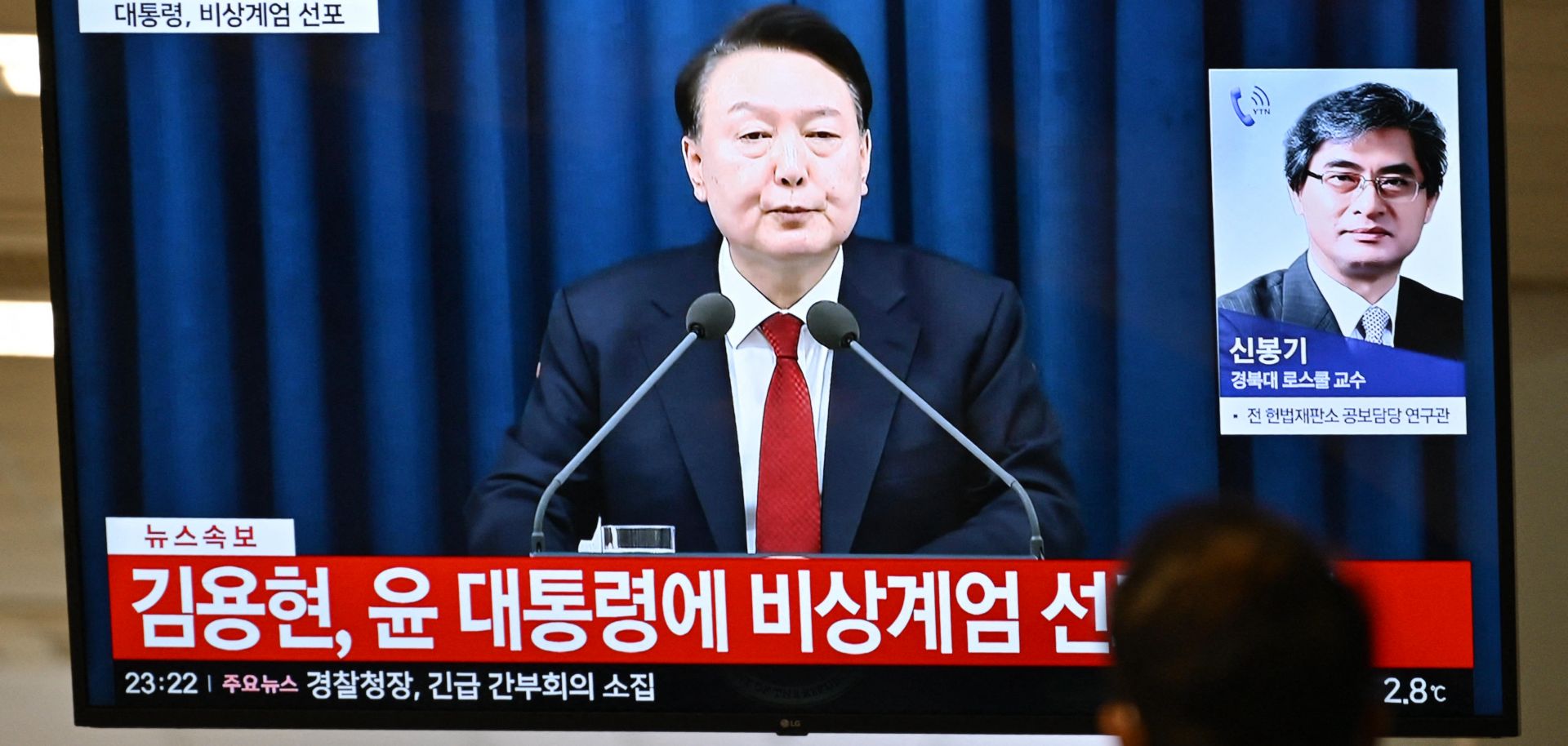
Despite South Korean lawmakers voting to impeach President Yoon Suk Yeol, there is still ample room for political instability in the months ahead, keeping the country's economic and foreign policy trajectory in limbo. On Dec. 14, South Korea's National Assembly voted 204-85 to impeach President Yoon over his abortive Dec. 3-4 martial law bid. Yoon was immediately suspended from his duties, with Prime Minister Han Duck-soo becoming acting president until the Constitutional Court rules on whether to confirm Yoon's impeachment within the next six months. Meanwhile, the head of Yoon's ruling People Power Party (PPP), Han Dong-hoon, announced on Dec. 16 that he was stepping down after he called for Yoon's impeachment ahead of the Dec. 14 vote, going against the wishes of most PPP lawmakers. Meanwhile, the head of the opposition Democratic Party (DP), Lee Jae-myung, said on Dec. 15 that the party would ''for now'' not seek to impeach acting President Han, but urged him to maintain political neutrality in carrying out his duties. Since the Dec. 14 vote, Yoon has publicly vowed to ''never give up'' in his efforts to serve the people, and has generally been uncooperative with investigations into his martial law declaration.
- Late on Dec. 3, Yoon declared martial law, alleging the legislative opposition was cooperating with the North Koreans to impede the functioning of South Korea's government — a veiled reference to the DP's repeated impeachments of Yoon's cabinet officials, bribery investigations into Yoon's wife, and refusal to appoint new judges to the Constitutional Court. Six hours later, Yoon ended martial law amid anti-government protests and military insubordination regarding the implementation of his martial law demands. Legislative interviews of Yoon officials since then suggest that during martial law Yoon ordered the military to use force to stop a legislative session aimed at rescinding martial law and he ordered the arrest of the heads of the DP and the PPP.
- The opposition controls 192 seats in the 300-seat National Assembly, but 204 lawmakers voted to impeach Yoon. This suggests 12 PPP lawmakers supported the motion, up from the three who supported the National Assembly's first impeachment vote on Dec. 7.
- On Dec. 15, Yoon ignored a summons from the prosecutor's office related to the martial law investigation. On Dec. 11, presidential security services denied police efforts to raid the presidential office in connection to their investigation into Yoon's alleged insurrection.
The Constitutional Court will likely confirm Yoon's impeachment in the coming months due to his weak justification for martial law, though a disagreement between judges or a mistrial could see Yoon resume his presidential duties. Despite the six-month procedural timeline on the Constitutional Court's investigation, previous impeachment cases against South Korean presidents have taken two to three months, and the court has pledged to make Yoon's case their top priority. The court will likely confirm Yoon's impeachment, as it has a strong legal case. Per South Korea's constitution, the president can only declare martial law if the country is at war, if there is a major national security threat, or if there is a severe risk to public order — none of which Yoon can reasonably claim. To wit, he also still has not substantiated his North Korean influence claims. However, court confirmation is not guaranteed. For one, all six of the Constitutional Court's currently sitting judges must agree on Yoon's impeachment, and at least two are believed to be politically aligned with Yoon. Additionally, the police, the prosecutor's office (where Yoon spent most of his career), and a National Assembly-appointed special counsel are all conducting separate investigations into Yoon's martial law activities without coordination on assembling evidence for his impeachment, which risks complicating the court's proceedings. The high threshold for court confirmation plus competing investigations into Yoon's martial law bid sustains a low likelihood that the court fails to confirm Yoon's impeachment, either due to disagreement between judges or a mistrial (e.g. over missing or invalidated evidence). This would end Yoon's suspension from his presidential duties and bar the opposition from seeking impeachment against him on the same grounds in the future.
- The majority of PPP lawmakers have maintained their opposition to Yoon's impeachment largely because it is politically expedient. With only 108 out of 300 National Assembly seats after the April 2024 legislative elections, the PPP's ability to pass legislation is weak, as the DP's opposition coalition, with 192 seats, can easily attain the simple majority threshold required to pass bills. Yoon's veto of opposition legislation has been the PPP's saving grace, as the legislature must garner 200 votes to overturn his vetos, a difficult prospect even for the DP unless they can flip eight PPP lawmakers. Thus, Yoon's impeachment would risk eliminating the presidential veto and further enfeebling the PPP's policymaking power.
If impeached, Yoon would likely be replaced by a DP president who would push pro-union policies and greater social services while improving South Korea's relations with China and South Korea at the expense of the United States and Japan. If Yoon's impeachment is confirmed, early presidential elections must take place within the next 60 days. Given current party public support rates and the PPP's guilt by political association with Yoon's martial law bid, the ballot would likely yield a DP president, with the most likely candidate being party leader Lee Jae-myung. Domestically, a DP president would focus on pro-labor policies, empowering unions and reducing the risk of strikes that disrupt transportation and export industries. He or she would also focus on strengthening social services (e.g. better healthcare and pension coverage and a universal basic income) and improving housing access via rent controls, affordable housing construction, and curbs on speculation. In terms of foreign policy, a liberal South Korean president would try to ease border tensions with North Korea, seeking humanitarian support and dialogue (including a potential revival of U.S.-North Korea talks under U.S. President-elect Donald Trump). This would reduce the chance of border clashes with North Korea, in contrast to Yoon's maximum-pressure approach to Pyongyang. Additionally, a DP president would seek to improve economic ties with China by slowing supply chain security cooperation in high electronics with the West and reducing (to the extent possible) South Korean participation in U.S.-led chip restrictions on China, though this would risk Washington removing U.S. carve-outs for South Korea chip sales to China or imposing other trade restrictions (e.g. tariffs). South Korea's ties with Japan would suffer too, as a DP administration would revive historical grievances with Japan (i.e. from Japan's 1910-1945 occupation of South Korea), as well as reduce security cooperation with Tokyo (like sharing intel regarding North Korean missile threats) to support better relations with Pyongyang. A DP president would also slow or even reverse efforts under Yoon to expand South Korea's exports of arms and nuclear reactor technology, curbing Seoul's push to expand beyond South Korea's traditional trade role as an electronics exporter.
- A Dec. 10-12 poll by Gallup Korea showed President Yoon's approval rating had dropped to a record low of 11%. The PPP's approval rating was at 24%, down 3% from the previous week, and the DP's approval rating stood at 40%, up 3%. This 16-point gap in support between the two major parties is the largest since Yoon took office in May 2022.
- In the case of an early presidential election, leadership instability in the PPP and DP could disrupt the field of candidates and policymaking. With PPP head Han Dong-hoon's resignation, the party lost a key presidential contender, while internal disputes, such as Kweon Seong-dong's opposition to Yoon's impeachment, have weakened party cohesion. In the DP, corruption charges against leader Lee Jae-myung, who has accused Yoon's allies in the prosecutor's office of targeting him, may yet disqualify him as a candidate. Factionalism in both parties risks dividing tickets in the presidential race and hindering policy initiatives.
If the court does not confirm Yoon's impeachment, political volatility will continue, as he will seek to push the limits of his power for the remainder of his term, exacerbating protest and strike risks and confrontations with North Korea. Yoon has pledged not to declare martial law again. But with a constitutionally mandated single five-year term that expires on May 2027 and an opposition-dominated legislature, Yoon would likely double down on his policy priorities if he is able to resume his presidential duties. This would include cracking down on union activity — which would portend more industrially disruptive strikes — and stoking tensions with North Korea, as the South Korean military did when it flew drones over Pyongyang in October, risking more border clashes. Yoon would also continue to wield his legislative veto power liberally, portending less across-the-aisle cooperation, even on policy issues affecting South Koreans' economic livelihoods (e.g. cost of living and housing). Additionally, Yoon would leverage his ties to the prosecutor's office to pursue criminal charges against the opposition and labor unions. This, and the DP's continued efforts to impeach him, would exacerbate policy gridlock. Yoon may also wield more obscure presidential powers, like calling for national referenda (e.g. to alter espionage laws to allow the state to counter threats from China, not just North Korea) and even dissolving the National Assembly, if he can plausibly claim South Korea is under wartime conditions (i.e. following a North Korean border provocation). Yoon would continue strengthening military ties with Japan and the United States, as well as supply chain security efforts and export of arms and nuclear reactors. Domestically, however, Yoon's failed impeachment would raise the risk of large street protests turning violent and of union strikes expanding to many export industries. For the already virulently anti-union Yoon, this could spur a police crackdown that draws Western opprobrium and hurts Yoon's efforts to further integrate South Korea into Western defense architectures (e.g. NATO) and deepen South Korean exporters' access to Western markets.
Acting President Han Duck-soo's tenure is also uncertain amid rivalrous politics, risking the mismanagement of domestic economic and civil affairs and of South Korea's ties to Japan and the United States, which are experiencing their own leadership transitions. In the forthcoming months of court impeachment proceedings and ahead of a potential early presidential election, Han will have to carry out Yoon's duties, including passing household support measures (e.g. reducing the tax burden) for a public jaded by political infighting and handling ongoing doctors' strikes in Seoul that have impeded critical medical services since February. As he carries out these duties, political pressures will be high. The PPP will expect Han, like Yoon, to use his presidential veto to strike down DP policies; if Han does not oblige the PPP on this, PPP leadership could threaten to support Han's impeachment. Likewise, though the DP has claimed it will not impeach the acting president ''for now,'' it too could move to oust Han if he does wield his veto or does not sufficiently facilitate the various investigations into Yoon. The DP could also impeach Han's cabinet officials, impeding his ability to govern. Meanwhile, Han will have to forge a personal relationship with incoming U.S. President Donald Trump, both to facilitate future military cooperation with the United States and to head off potential U.S. tariffs or a renegotiation of cost-sharing for U.S. forces in South Korea. Han and his conservative cabinet will also likely attempt to maintain South Korea's security cooperation with Japan under new Prime Minister Shigeru Ishiba, which will likely require fending off efforts by DP lawmakers to revive historical grievances with Japan and impede new diplomatic talks. As a career technocrat under five presidents and a former foreign minister, Han likely has sufficient diplomatic and organizational skills for the task, but the impermanence of his position will impede even his best efforts to nurture South Korea's critical foreign relations. If Han is impeached or resigns before the presidential elections, South Korea's finance minister would take over as acting president, triggering another leadership transition that would further disrupt domestic and foreign policymaking.
