
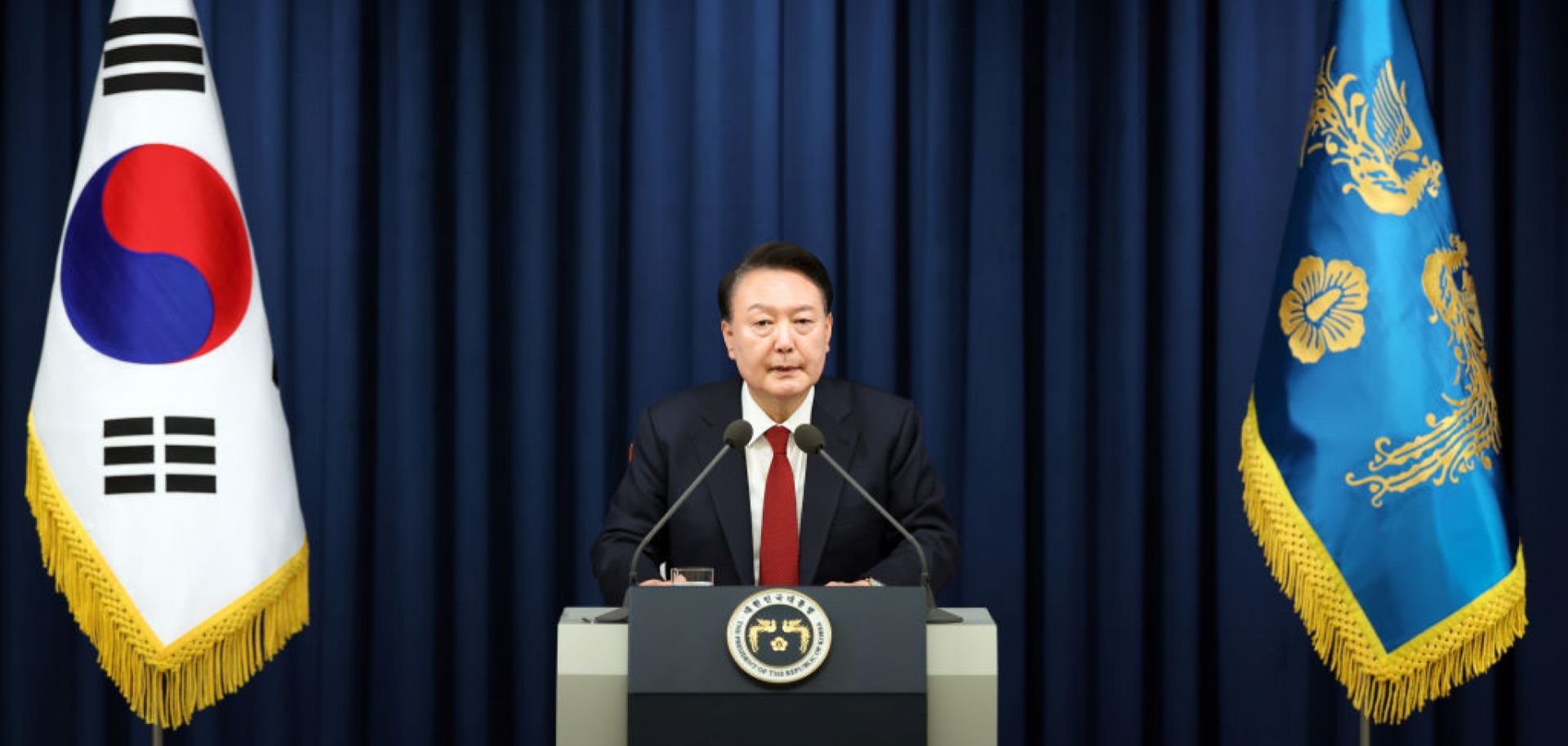
Though South Korea's president survived an impeachment vote following his failed martial law bid, legal, social and political pressures will likely force him out of office in the coming months, bringing a liberal president to power who would pursue pro-labor policies and reorient South Korea's ties with China, North Korea, Japan and the United States. On Dec. 7, President Yoon Suk Yeol survived a vote in South Korea's National Assembly to impeach him over his brief declaration of martial law from Dec. 3-4. Only three lawmakers from Yoon's People Power Party, or PPP, joined the opposition to vote yes, while the rest of the PPP lawmakers boycotted the vote, leaving the final tally five shy of the necessary 200 votes. On Dec. 8, PPP head Han Dong-hun and Prime Minister Han Duck-soo pledged in a public address to restore political stability by seeking an ''early'' and ''orderly'' resignation for Yoon, adding that Prime Minister Han would run state affairs until Yoon's resignation and that PPP head Han would consult regularly with Prime Minister Han to assist the transition. Lee Jae-myung, the leader of the opposition Democratic Party, or DP — which proposed the impeachment vote — held a press conference on Dec. 8 calling this PPP plan to transfer Yoon's powers unconstitutional. Lee also pledged to propose another impeachment vote on Dec. 14 and every week thereafter until Yoon resigns.
- The state's corruption investigation office, prosecutor's office and the police have each opened investigations into Yoon for allegations of treason, while the DP will put to a vote in the National Assembly on Dec. 10 a motion to set up a permanent special counsel, also to investigate Yoon for treason.
- Yoon, for his part, apologized for the martial law order on Dec. 7, prior to the National Assembly vote, and asserted his fate was in the hands of the PPP, but he has been relatively quiet since the vote failed. Yoon's cabinet also resigned en masse following the martial law order, including his defense minister, who is now under investigation for his role in the marital law debacle.
Despite a divided PPP's desire to avoid ceding power to the DP, state treason investigations and large street protests make Yoon's premature departure seem all but certain in the coming months, while policymaking will likely grind to a halt. The PPP is trying to avoid a repeat of 2017, in which a presidential impeachment ferried an opposition candidate to victory in an early presidential election, which must be held within 60 days after an impeachment is upheld by the Constitutional Court or after the president's resignation, hence why the PPP boycotted the Dec. 7 impeachment vote. Moreover, the PPP is seeking time to recover its reputation among the public, dented by the party's association with Yoon, and to unify around a clear party candidate to succeed Yoon as president, as PPP head Han leads just one of many factions in the party. The DP, meanwhile, has sought Yoon's ouster since he came into office in May 2022, alleging various abuses of power, including Yoon's use of his ties to the prosecutor's office to target DP leader Lee with corruption charges. Now, the DP senses it has its strongest chance yet to impeach Yoon and to catapult Lee to the presidency. This is why the DP is helping organize massive street protests and pledging unlimited impeachment votes. Though the DP has struggled so far to convince PPP lawmakers to support an impeachment, ongoing treason investigations into Yoon and growing street protests will make the case for Yoon's political survival seem increasingly bleak and will put pressure on especially younger PPP lawmakers to support Yoon's impeachment in a bid to protect their long-term political careers and future reelections in local constituencies. Moreover, any of the three to four treason investigations into Yoon could result in criminal charges, which would escalate pressure for his impeachment or resignation. Thus, he seems likely to leave office in the next three to six months, triggering an early presidential election; and in the meantime, there is unlikely to be much significant movement on policies, with politicians focused almost exclusively on Yoon's future.
- Former President Park Geun-hye was impeached while in office in early 2017, leading to the splintering of the conservative Saenuri Party and to a landslide victory by the DP's presidential candidate, Moon Jae-in, in May of that year.
An early departure for Yoon would likely bring a liberal president to power, allowing the DP to pursue pro-labor and pro-green transition policies while presaging a cooling of military tensions with North Korea, a chill in U.S. and Japanese military ties and an improvement in economic ties with China. The ignominious downfall of a president from one party is highly likely to yield a successor from its rival party, an outcome supported by historical precedent in South Korea and by recent polls showing rising public support for the DP and dropping support for the PPP. The most likely candidate for this liberal president is DP head Lee, who lost against Yoon in the 2022 presidential election by less than three-quarters of a percentage point. If Lee is elected, the DP — which currently has a near supermajority in the legislature — would pass its economic policies relatively unopposed, including measures supportive of labor rights (reducing the risk of union strikes), household wages and social spending, as well as measures curbing the monopolistic power of large and politically influential business conglomerates (known as chaebols) and supporting the green transition, including phasing out coal and ramping up production of wind, solar and hydrogen. Lee would also push for a cooling of military tensions with North Korea, rekindling a focus on humanitarian support and dialogue, and thus reducing the rising risk of border clashes, as Yoon had taken a hard-line approach. Lee would also seek to reduce military engagement with the United States and Japan, e.g. by reducing joint drills in the Sea of Japan and curbing intelligence-sharing cooperation on North Korea, which the DP perceives is stoking regional tensions, particularly with China. Relatedly, Lee would seek to improve economic ties with China — to the extent they do not contravene U.S. long-arm chip restrictions on China — and would reduce state support for expanding South Korea's nuclear energy and arms export industries, a heavy focus under Yoon.
- A Realmeter poll from Dec. 9 showed that Yoon's support rate had dropped to 17% following his failed martial law bid, while public support for the PPP had dropped six percentage points to 26% and support for the DP had risen four percentage points to 48%.
