
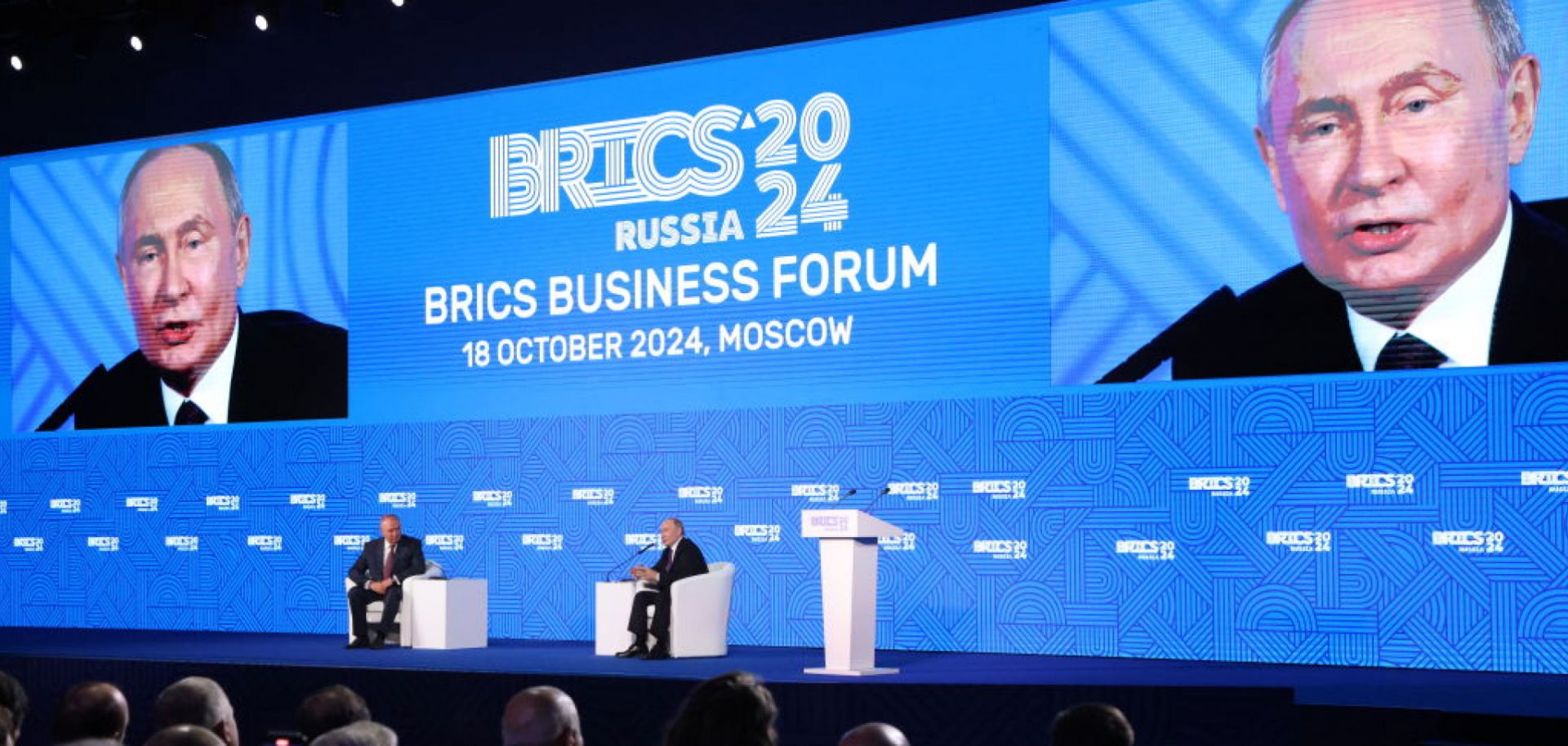
Despite host nation Russia's desire to speed progress on key issues like future expansion, de-dollarization and greater financial integration, internal disagreements mean the 2024 BRICS summit is unlikely to yield major breakthroughs that seriously challenge the Western-led order in the near term. From Oct. 22-24, Russia will host the 16th BRICS Summit in the southwestern city of Kazan. Russian President Vladimir Putin effectively opened the summit's associated gatherings on Oct. 18, when he addressed the BRICS Business Forum in Moscow. Overall, the summit and associated gatherings will constitute the largest and most momentous foreign policy event held in Russia since its 2022 invasion of Ukraine. Moscow claims that of the 38 countries invited to the summit, 32 have confirmed their participation and 24 will be represented by heads of state, with the 9 BRICS members all represented at the highest level. Moscow's ambitious agenda for the summit includes the creation of a BRICS partner state status, concrete steps by bloc members to de-dollarize parts of their economies, and related steps to bolster the group's credentials as an alternative Western-led order.
- BRICS is named after its five founding members: Brazil, Russia, India, China and South Africa. Egypt, Ethiopia, Iran, and the United Arab Emirates also became full members effective Jan. 1, 2024. Saudi Arabia was invited to participate in the expansion as a result of the 2023 BRICS summit in South Africa, but ultimately declined to join. Saudi Arabia's foreign minister will attend the 2024 Kazan summit. Argentina was also slated for inclusion in the expansion, but Argentine President Javier Milei backed out following his inauguration.
- On Oct. 10, Putin's lead foreign policy advisor Yuri Ushakov made several comments regarding Russia's vision for BRICS and expectations for the summit. He acknowledged that certain member states are interested in admitting more new full members, while others were not, and that this would be discussed at the heads of state level. To include new participants in the bloc, Ushakov called for the creation of a partner state formula, suggesting this could be a way to expand the organization without harming its cohesiveness or slowing decision-making among full members. He noted that Russia has its own priorities and considerations regarding which countries could be BRICS partner states, and that BRICS should consider applications from the Commonwealth of Independent States (CIS) that are interested in BRICS membership. Finally, Ushakov singled out Indonesia as a country that would increase BRICS' authority if admitted to the bloc, though Indonesia declined an invitation to join BRICS last year.
- During an Oct. 10 meeting of BRICS finance ministers and central bankers in Moscow, Russian Finance Minister Anton Siluanov said that the International Monetary Fund and the World Bank were ''not performing their roles or working in the interests of BRICS countries,'' and that it was therefore ''necessary to form new conditions or even new institutions, similar to the Bretton Woods institutions, but within the framework of BRICS.'' He specified that a key topic of the upcoming summit will be the construction of an ''international multipolar financial system that will promote the development of all countries,'' including using digital capabilities to further develop the BRICS cross-border payment initiative and inter-depository interaction system, and create a BRICS reinsurance system.
Russia's grand ambitions for BRICS are driven by both acute pressures from Western sanctions and longer-term calculations about the trajectory of the global economy and expectations of confrontation with the declining Western-led order. Russia has been a leading proponent of the BRICS bloc since its conception, hosting the group's inaugural summit in 2009. To this day, Russia holds arguably the most ambitious and aggressive vision for the bloc among all of its full members for three main reasons. The first is that Russia is currently subject to substantial, immediate pressure from Western financial sanctions, which strongly compels Russia to use BRICS infrastructure to establish alternative financial mechanisms to reduce its exposure to Western sanctions. Secondly, Moscow wants to weaken and dismantle the Western-led global order, which its leaders believe encroaches on Russia's historic geopolitical sphere of influence and Russia itself, inevitably entailing confrontation that could destabilize Russia. Third and finally, the Kremlin believes Western states are in decline due to a combination of political and ideological contradictions, as well as economic and demographic stagnation, and thus sees aligning with non-Western countries as its only option. By contrast, the BRICS states, which are the standard bearers of an inevitable emerging multipolarity, already constitute a greater share of global GDP in purchasing power parity terms compared with the Western states in the Group of 7 (G-7); more importantly, the non-Western countries of the Global South are also projected to constitute a larger percentage of economic growth compared with the West in the coming decades. These factors push Moscow to want to turn BRICS into as large a coalition of states as possible willing to agree on measures targeted against the United States, Europe and allied countries. For Russia, this is a geopolitical bandwagoning strategy that seeks to align it with a large group of steadily rising states, whereby Russia's 2022 invasion of Ukraine is quietly accepted as a normal element of the emerging alternative to the current global order.
- The nine BRICS members currently constitute about 35% of global GDP in purchasing power parity terms, while the G-7 countries constitute about 30%.
- Long-term economic forecasts that extend to 2050, 2060 or even 2100 suggest that non-Western states in the Global South will together constitute a larger share of future GDP growth compared with Western states. This is predominantly due to strong growth from countries such as India, Brazil, Indonesia, Vietnam, Nigeria, the Philippines and Pakistan, among others. For example, the OECD projects the GDP of non-OECD countries to grow faster than those of the OECD up to 2060.
During the summit, the bloc will discuss a litany of contentious issues, such as de-dollarization and future expansion, with Russia pushing for bolder steps in a bid to solidify the bloc's anti-Western orientation. As the host nation, Russia has played a leading role in forming an ambitious agenda for the 2024 BRICS summit. One of the primary focuses of this year's agenda is ''de-dollarization'' (i.e. reducing the use of the U.S. dollar in trade and other transactions) and the interrelated issue of creating alternative financial mechanisms. During the summit, Russia will seek to reach a pact where countries agree to grow the share of national currencies in their bilateral trade, or, if that is unworkable due to trade imbalances, use the Chinese yuan whenever possible rather than euros or U.S. dollars. This is because, like most experts, Moscow believes a BRICS currency is likely impossible, and instead sees the promotion of the Chinese yuan in international trade settlement and as a reserve currency as the only realistic path to faster de-dollarization. Russia will likely also push the bloc to endorse a phased reduction in BRICS countries' central bank reserves held in dollars. In addition to reducing Western global economic influence, progress on de-dollarization can help build a more sanctions-proof payments system and financial infrastructure through BRICS; this means the bloc is likely to promote alternatives to the SWIFT banking messaging network that processes international payments, including with distributed ledger technology (DLT) to create a new multinational platform that allows settlements with tokens, which could lead to allow faster and less expensive processing times amid lower credit risk and a lack of compliance checks. De-dollarization will also be pursued through other BRICS initiatives, such as the BRICS Contingent Reserve Arrangement (generally seen as a competitor to the International Monetary Fund), where Russia will likely push for expansion of non-dollar central bank liquidity swap lines, and in the New Development Bank (a rough BRICS analog to the World Bank), where Russia will seek a reversal of the multilateral bank's continued position that it is not considering new projects in Russia. To maximize the utility and impact of these alternative financial system initiatives, Russia will also advocate for BRICS expansion. Moscow is open to accepting additional full members, seeing little downside. But for now, Russia and the other four founding BRICS countries remain focused on integrating the bloc's four new members. Instead, Moscow will advocate the creation of a ''partner state'' designation, to which as many states as possible could be invited, effectively serving as a waiting room for the numerous countries regularly invited to BRICS events that have expressed interest in eventual membership. Moscow will likely also raise discussions about a tiered membership system and a two-speed or multi-speed BRICS, whereby states interested in bolder and more binding multilateral agreements could under some conditions use BRICS infrastructure for multilateral initiatives, even if not all BRICS members initially participate.
- Russia has long been at the forefront of de-dollarization, having ditched all U.S. dollar-denominated assets from its sovereign wealth funds in 2021. Russia has developed a high dependence on the Chinese yuan, with Putin telling Chinese President Xi Jinping in March 2023 that Russia was ''for the use of the Chinese yuan in settlements between Russia and Asian countries, Africa [and] Latin America.''
- In addition to inviting all CIS members to attend this year's summit, Russia supports BRICS membership for the aligned states in its periphery. Belarus and Azerbaijan have applied for and are actively pursuing membership. Kazakhstan also previously expressed interest in joining BRICS, but on Oct. 16, the country's president said Kazakhstan would refrain from applying for the foreseeable future, presumably to preserve its ''multivector'' foreign policy and secure Russian concessions regarding a proposed nuclear power plant in Kazakhstan. China is unlikely to push back against the accession of such Russia-aligned states, as their admittance to BRICS would facilitate greater influence for both Russia and China at the expense of the West.
However, internal disputes and a dependence on actions from China will likely prevent breakthroughs that would enable BRICS to quickly or significantly challenge the West. Concrete progress is most likely regarding a framework for the creation of partner states. This is because, while the bloc is still reeling from the infighting over the last expansion (which Brazil and India initially opposed for fear of strengthening the anti-Western vector of BRICS), states are much less likely to feel threatened by the creation of a partner state status without voting rights. However, the summit is less likely to yield notable progress on de-dollarization and financial cooperation due to internal disagreements and Chinese inaction. BRICS countries may pledge to increasingly opt for their own commercial payment systems (such as the newly launched BRICS Pay application) and mechanisms that use local currencies instead of the dollar, though the financial volumes using them will likely remain inconsequential. Furthermore, while token steps like creating working groups are possible, immediate concrete progress toward a BRICS currency or the creation of a BRICS gold standard remains highly unlikely due to internal pushback, mainly from Brazil and India, which do not necessarily see reduced dollar usage in favor of the Chinese yuan as in their financial or geopolitical interest. This will, in turn, leave Russia dependent on China's analogs to Western financial systems (like the Cross-Border Interbank Payment System, the Chinese alternative to SWIFT) to reduce its vulnerability to sanctions. But Beijing is also not immediately focused on dismantling the dollar-denominated global financial system, which China remains heavily reliant on to sell the exports on which its economy is based. Therefore, while Russia may believe the BRICS forum is a platform through which it can encourage Beijing to accelerate its own de-dollarization by presenting a broad coalition of countries allegedly in support of faster Chinese action, China will continue to develop alternative financial mechanisms at its own pace, and will only pick up that pace if Beijing deems the need for faster economic decoupling from the West is worth the significant economic and political risks this entails. With Beijing unwilling to open up its capital account and reduce capital controls, this means the yuan will not seriously threaten the U.S. dollar's global dominance for the foreseeable future, even if agreements reached at the BRICS summit marginally speed the Chinese currency's already increasing use for global trade.
- A desire to show increased multilateral cooperation among BRICS could lead the summit to produce statements about cooperation in other headline-grabbing spheres such as tech, space, AI cooperation, climate change and energy cooperation. However, the most impactful cooperation on such issues will likely entirely remain on a bilateral basis between individual BRICS members.
