
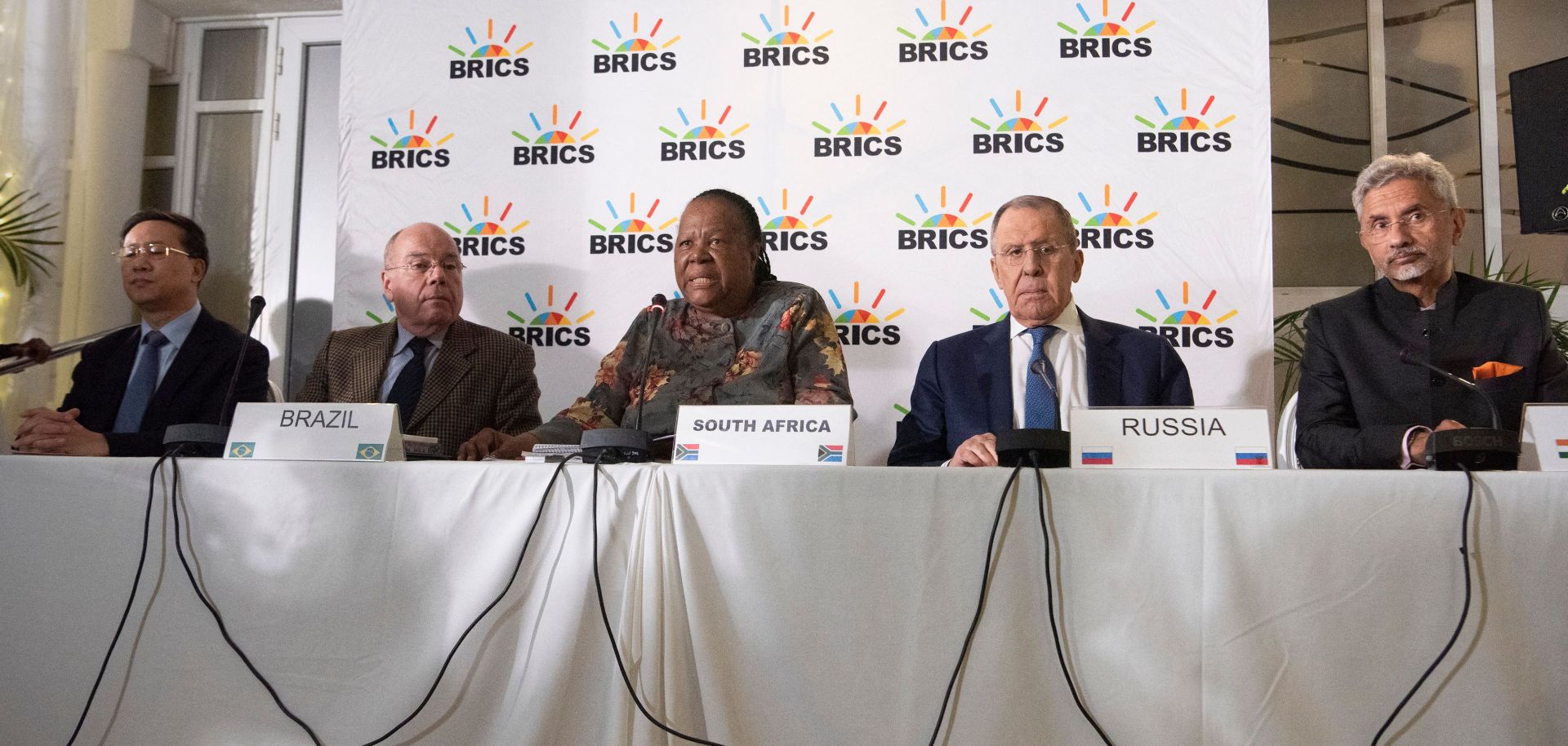
The 2023 summit of the BRICS economic bloc may finally lay the groundwork for future membership criteria and mechanisms to generate greater trade and financial flows using non-Western currencies, although internal divisions will slow this progress. South Africa will host the 15th summit of BRICS members (Brazil, Russia, India, China and South Africa) on Aug. 22-4 in what is poised to be the bloc's most consequential meeting in nine years; it will also be the bloc's first in-person event since the COVID-19 pandemic began in 2020. Two of the summit's major topics will be expanding the bloc's membership and increasing the use of non-dollar currencies in trade. Moreover, the summit's official theme, BRICS and Africa: Partnership for Mutually Accelerated Growth, Sustainable Development and Inclusive Multilateralism, demonstrates how South Africa, China and Russia are pushing BRICS to engage with the Global South, with an eye to offsetting Western influence — a goal of which other BRICS members are more skeptical.
- In recent years, BRICS summits have failed to significantly advance cooperation. The most impactful summit of the last decade was in 2014, when the bloc created the BRICS Bank, now known as the New Development Bank (NDB), a multilateral development bank designed to be a non-Western alternative to the World Bank. At the same summit, the bloc also created the Contingent Reserve Arrangement, which is intended to be a non-Western alternative to the International Monetary Fund that helps buffer countries' economies as they deal with short-term liquidity crises.
- South Africa claims that more than 40 countries have expressed an interest in joining the bloc, with nearly two dozen formally applying to do so. Countries known to have an interest include Algeria, Argentina, Egypt, Indonesia, Iran, Saudi Arabia and the United Arab Emirates.
- The term BRIC — Brazil, Russia, India and China — was first coined in 2001 by a Goldman Sachs economist to represent high-growth emerging economies. The countries in question adopted the moniker to justify the economic bloc's 2006 creation. BRICS has only expanded once in its history, in 2010, when it added South Africa.
Russia and especially China want to use BRICS to curb the West's dominance in global institutions and international clout by providing an alternative to the Group of Seven (G-7). While China and Russia have pursued this goal for more than a decade, the U.S.-led tech war on China and Russia's invasion of Ukraine are motivating Beijing and Moscow to boost BRICS' global prominence even faster. To be sure, BRICS is not the perfect forum for this power projection plan due to geopolitical rivalries within the bloc — such as that between China and India — and its consensus decision-making process that gives any member the power to scuttle an initiative. However, from the perspective of Beijing and Moscow, using BRICS as an international forum is far easier than creating a new one from scratch. From this perspective, it is no surprise that China is pushing BRICS to expand, which would make the stature of BRICS summits more comparable to that of G-7 summits. An expansion would also mean that any decisions made on matters that can reduce the influence of the West — such as through increased financing for the NDB — would have more global buy-in. China also hopes that greater political ties would lead to more support for Chinese initiatives in other international forums, like annual climate change conferences, the World Trade Organization and the United Nations. For Russia, BRICS' expansion would similarly lead to more deals involving trade in non-Western countries, helping it circumvent Western sanctions.
On the other hand, Brazil and India have expressed concern about Beijing's and Moscow's goals of using BRICS to challenge the G-7. Brazil and India have deep ties with the United States and/or Europe and simply do not have the same geopolitical tension with the West as China and Russia. New Delhi, for example, has close security ties with Washington through the Quadrilateral Security Dialogue, which is largely designed to help curb Chinese naval expansionism in the Indo-Pacific, and when Indian Prime Minister Narendra Modi visited Washington, D.C., earlier this year, he signed a host of defense agreements. Under President Luiz Inacio Lula da Silva, who took office at the beginning of 2023, Brazil has also sought to reestablish its global and regional status, but under a non-aligned strategy that has long been enshrined in the country's constitution. Like India, Brazil has few strategic quarrels with Washington, and its policy of non-alignment precludes the possibility of formal allyship with China (or Russia) against the West. The fault line between China and Russia and the rest of the BRICS members is unlikely to close given that India and Brazil are unlikely ever to find themselves as strategic rivals of the United States or Europe. And because BRICS makes decisions through consensus, China and Russia will be unable to push through arrangements, including on expansion, in their favor without Brazil's and India's approval.
- South Africa has sought to remain uninvolved in the disputes and is instead aiming to focus the group on investment and partnerships within Africa.
Disagreements may prevent BRICS leaders from agreeing on expansion at this summit, but members may develop criteria for formal expansion or partnerships. Even ahead of the summit, disagreements over expansion are already on display, with Brazil and India proposing alternative viewpoints to China. Beijing wants to offer Saudi Arabia and the United Arab Emirates — two large, wealthy, non-Western countries that have close relationships with Washington — membership in the bloc, as their entry into BRICS would give more credibility to the bloc's economic stature and more money to fund joint initiatives. But India — the world's most populous democracy — has balked at including Saudi Arabia and other authoritarian countries and instead has pressed the bloc to establish specific criteria for admission; it also wants expansion to focus on emerging economies and democracies, like Argentina and Nigeria, which further disqualifies Saudi Arabia. Also in opposition to China's goal of quick expansion, Brazil has proposed selecting observer or partner countries under unspecified conditions that the bloc could later consider for promotion. Ultimately, because Brazil and India can effectively veto proposals with which they disagree, the BRICS summit will likely result in a watered-down agreement that focuses on merely establishing criteria for a formal expansion process.
- China holds little direct leverage over India through economic pressure due to the two countries' already poor economic relations.
- The United Arab Emirates joined the New Development Bank in 2021.
BRICS countries will likely agree on some mechanisms to increase payments and trade in local currencies, but the discussion of a BRICS currency and de-dollarization appears to be off the agenda. BRICS members are all largely aligned on the bloc's need to create financial mechanisms for its members and the Global South to use as alternatives to Western currencies. To this end, they are reportedly discussing the establishment of a common payments system, which could reduce transaction costs and delays for payments across borders; they also aim to increase the use of local currencies. Additionally, members may set up a technical committee to evaluate the feasibility of a BRICS currency. However, such a currency would face challenges, as it would likely need to be backed by a commodity like gold or the national currencies of BRICS members. Regarding de-dollarization, by which BRICS members could attempt to use a national currency other than the dollar, officials from host South Africa have stressed that such efforts are not part of the agenda. Even if BRICS members warm to the idea, de-dollarization efforts would run into roadblocks, as China is the only country with a large enough economy outside the West to potentially use as a global currency for trade and financial flows. For this effort to succeed, China would have to open up its capital account and reduce currency controls, which China appears highly unlikely to do, given that it would open up the country to increased external financial risk.
