
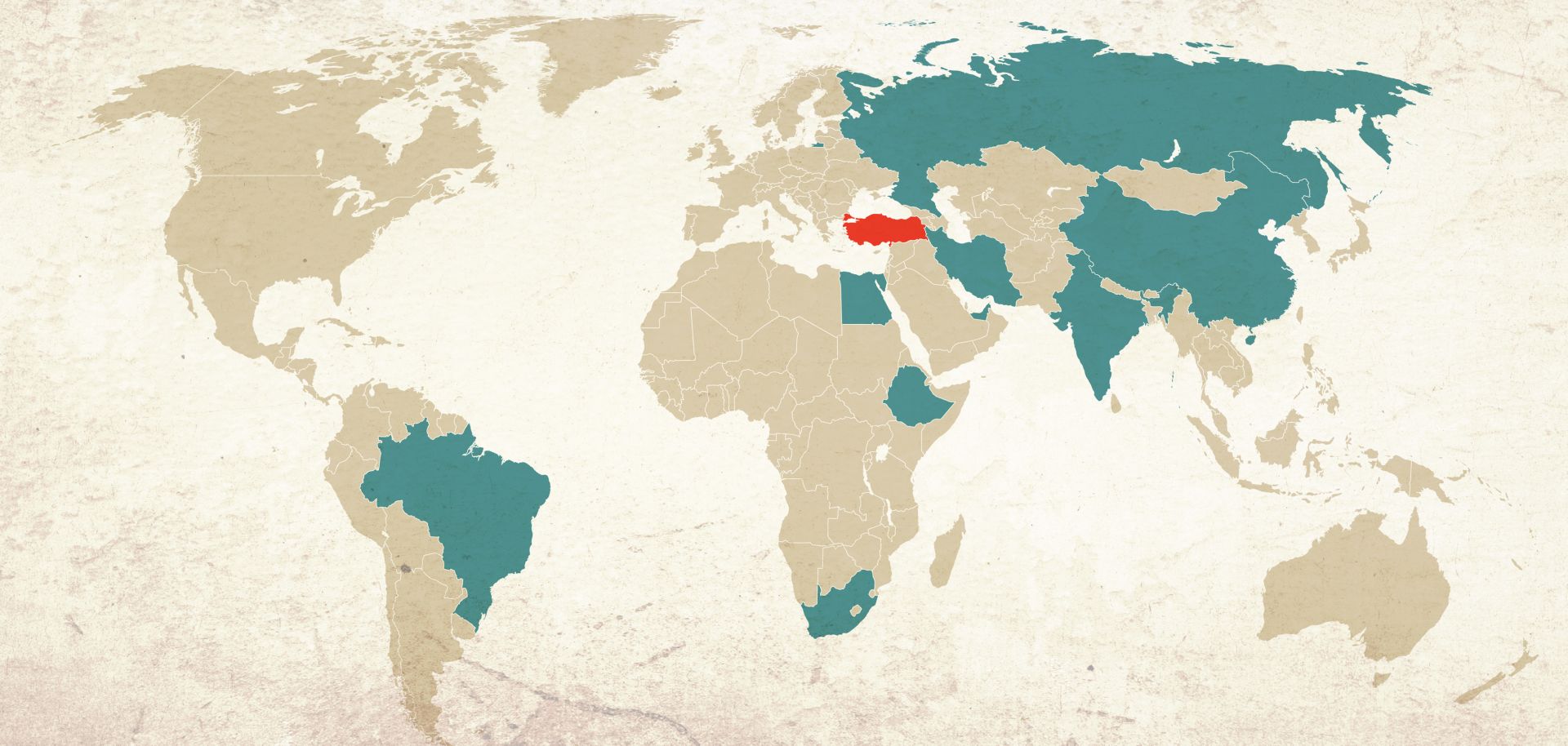
While joining BRICS would highlight Turkey's balancing act between the West and the Global South, the organization's institutional weaknesses will limit its ability to support Turkey's economic growth or reduce its reliance on the U.S. dollar. In recent weeks, Turkey has reiterated its interest in joining BRICS, a multinational group of emerging economies named after its original members: Brazil, Russia, India, China and later South Africa. Turkish Foreign Minister Hakan Fidan attended the BRICS foreign ministers meeting in Russia on June 10-11. In a sideline meeting between Russian President Vladimir Putin and Fidan on June 11, Putin said, "We welcome Turkey's interest in the work of BRICS." He continued, "Undoubtedly, we will fully support this aspiration and desire to be together with the countries of this union, to be closer." The dialogue in Russia echoes a similar conversation Fidan had with senior Chinese officials during his June 3-5 tour in China, during which Fidan also expressed Turkey's ambitions to join BRICS.
- BRICS, originally established in 2009 with Brazil, Russia, India and China, and later joined by South Africa, has recently expanded its membership to include Iran, Egypt, Ethiopia and the United Arab Emirates, which joined the bloc in 2024.
- As early as 2018, Turkish President Recep Tayyip Erdogan expressed interest in Turkey joining BRICS while attending the 10th BRICS summit in Johannesburg, South Africa, which marked Turkey's "first high-level contact" with the BRICS organization. At the time, Erdogan said, "I wish [BRICS members] would take the necessary steps to let us in and we could take our place in BRICS."
Turkey's interest in BRICS comes as Ankara seeks to balance its relations with Western and non-Western countries, but its influence on the bloc will be limited, and membership will not lead to drastic changes in Turkish foreign policy. Turkey's membership in NATO and its customs agreement with the European Union have created robust economic and security ties with the West. However, these relationships also grant Western countries some influence over Turkey's foreign affairs — such as the United States conditioning Turkey's acquisition of F-16 fighter jets on its approval of Sweden's NATO accession bid. To balance this influence, Turkey has been striving to deepen its relations with Middle Eastern countries, Russia and China. This effort was recently reinforced by Fidan's tours to Russia and China and Turkey's interest in increasing bilateral trade and investment, particularly from China, in Turkey's economy. Amid this balancing act, Turkey has been trying to assert itself as a middle power. However, Ankara has struggled to establish its diplomatic influence on the global stage. For instance, Turkey has been largely excluded from Israel-Hamas negotiations despite early offers to mediate the two sides' ongoing conflict in Gaza, and the Turkish-brokered Black Sea grain deal between Russia and Ukraine was short-lived. As a result, Ankara views joining BRICS as an opportunity to assert itself in an international economic forum representing countries of the Global South and as a vehicle to diversify its political and diplomatic relations beyond the West. Still, the ongoing expansion of BRICS will make future consensus difficult as the bloc becomes more heterogeneous, which will limit Turkey's ability to influence the institution. Turkey's commitment to maintaining its ties with the West also indicates that Turkey will remain wary of backing any policy suggestions from China or Russia that might impact its economic and security ties with the West, aligning Turkey more closely with the positions of India and Brazil within the group.
- Fidan commented that Turko-Russian relations were going "really well" during the June 11 meeting with Putin. However, bilateral trade between Turkey and Russia has decreased following U.S. financial pressure and the threat of secondary sanctions on Turkish banks. According to the Financial Times, Turkish exports to Russia fell by one-third in the first quarter of 2024 compared with the same period in 2023.
- In addition to its interest in joining BRICS, since 2012, Turkey has been a dialogue partner of the Shanghai Cooperation Organization, an intergovernmental organization composed of Asian member states that fosters military and intelligence cooperation, as well as regional economic initiatives. In 2022, Erdogan expressed interest in becoming a full member of the organization, demonstrating Turkey's inclination to grow economic ties with China.
- On June 4, during Fidan's visit to China, he called BRICS a "good alternative" to the European Union as Turkish accession talks have stalled for more than a decade. However, BRICS, which primarily focuses on the economies of its member countries, is a much weaker entity than the European Union, which encompasses political, economic and defense mechanisms. Furthermore, BRICS has not established a permanent bureaucracy and has produced few tangible outcomes, except for the New Development Bank and the Contingent Reserve Arrangement, which are frameworks intended to serve as alternatives to Western financial institutions such as the International Monetary Fund.
While joining BRICS may support Ankara's ongoing efforts to strengthen ties with member states and attract investment, it is unlikely to significantly increase transactions in local currencies due to limited trade within BRICS. BRICS membership would complement Ankara's existing efforts to strengthen bilateral trade with China and the Middle East and attract investment into growing Turkish sectors, particularly from Chinese and Emirati investors. If Turkey gains membership, Ankara may also take advantage of BRICS' initiative to expand trade in local currencies to reduce reliance on U.S. dollar-denominated transactions. This decreased reliance would somewhat insulate Turkey from the external risks associated with U.S. dollar-denominated transactions and reduce its exposure to changes in U.S. Federal Reserve policy. However, Ankara will face limitations, as BRICS membership has done little to increase intra-BRICS trade among members other than China. As a result, the global impact of increased transactions in the local currencies of BRICS members remains limited, and Turkey's membership would be unlikely to alter that trajectory.
- China and Russia have been spearheading efforts to reduce reliance on the U.S. dollar — in BRICS and more broadly — due to the United States' ability to weaponize its currency in trade, foreign exchange reserves and sanctions.
- Conducting trade in local currencies is not mandated as part of BRICS membership; however, most BRICS countries have signed bilateral agreements to increase trade in local currencies.
- While Russia has looked toward trade in local currencies to evade U.S. and EU sanctions, Turkish banks are unlikely to follow suit, given their tendency to scale back ties with Russia following threats of secondary sanctions from the United States in December 2023 and again in June 2024.
