
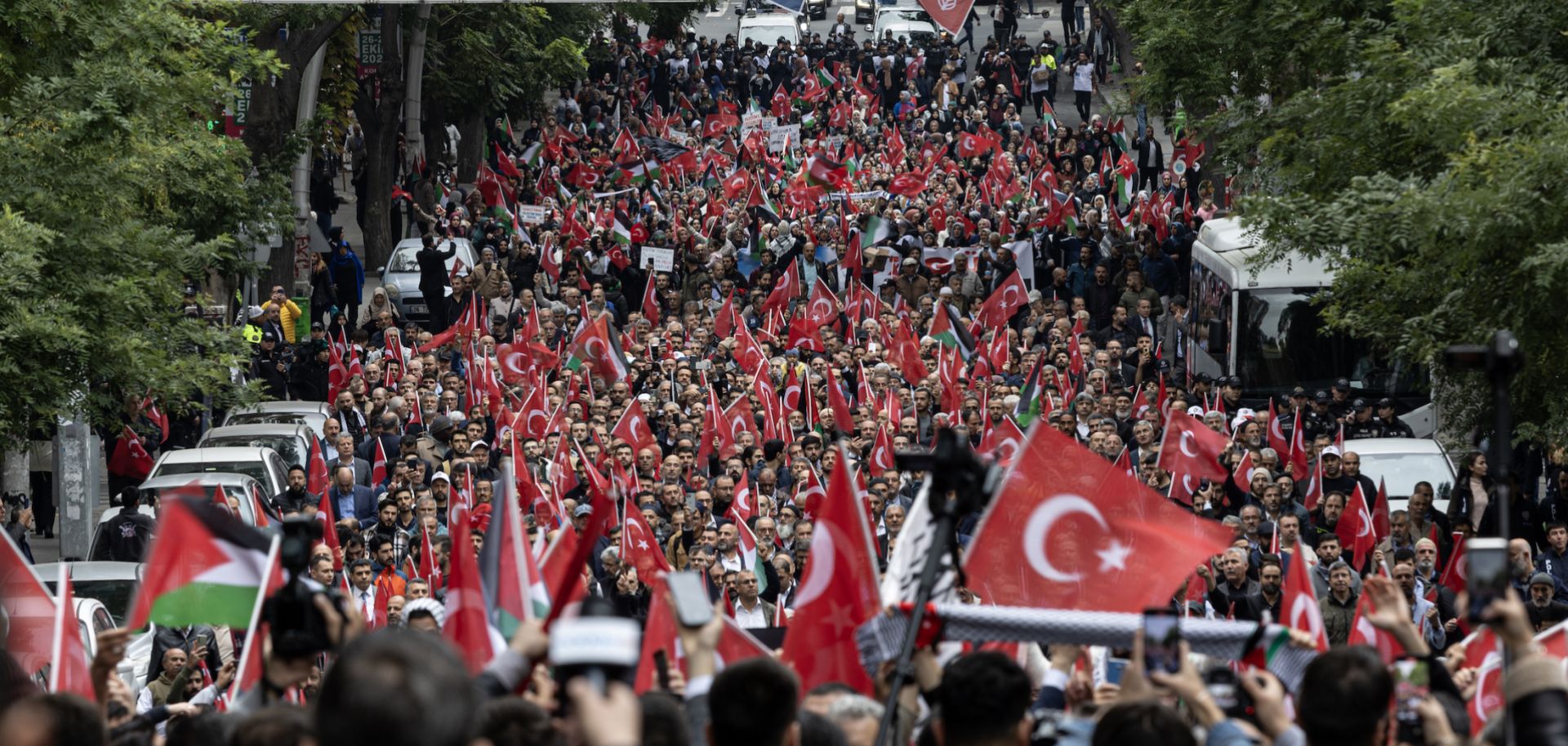
In the ongoing Israel-Hamas war, Turkey will try to leverage its population's pro-Palestinian sympathies to position itself as a mediator for humanitarian aid and hostage releases. However, Turks' growing anger over the recent hospital attack in Gaza will ultimately strain Ankara's relations with Israel and prompt Turkey to align closer with neighboring Arab countries. Allegations of Israel's involvement in the Oct. 17 Al-Ahli Hospital explosion in Gaza City immediately triggered a public outcry in Turkey, where pro-Palestinian protests have erupted in more than 12 cities over the past two days, as well as outside the Israeli embassy in Ankara. In the aftermath of the blast, the Turkish government issued several statements publicly blaming Israel amid conflicting accusations from Israel and Hamas. Prior to the hospital blast, Turkey had been positioning itself as a potential mediator in the Israel-Hamas war, given Ankara's relationships with Israel and other regional stakeholders, as well as its robust communication networks with Hamas. Indeed, the day before the explosion on Oct. 16, Turkish Foreign Minister Hakan Fidan held a call with Hamas' political bureau chief, Ismail Haniyeh, to discuss the current state of the war and potential negotiations to release the hostages that the militant group kidnapped during its surprise Oct. 7 assault on Israel. In the days leading up to the Gaza hospital blast, Ankara had also coordinated similar calls with Israel, Arab countries and NATO allies regarding the conflict. Although Turkey initially backed de-escalation after the Oct. 7 Hamas attacks, its more strongly-worded response to the recent hospital blast indicates that Ankara's approach to the war may be shifting.
- On Oct. 17, shortly after reports of the Gaza hospital attack emerged, Turkish President Recep Tayyip Erdogan shared a post on X, formerly Twitter, in which he said: ''hitting a hospital containing women, children and innocent civilians [was] the latest example of Israel's attacks devoid of the most basic human values.'' That same day, Turkish Foreign Minister Hakan Fidan also announced that Egypt would host a high-level summit including Israeli and Palestinian leaders on Oct. 21 to discuss the ongoing conflict and potential solutions.
The Israel-Hamas war has provided Turkey with the opportunity to act as a mediator between the warring sides, and to establish itself as a regional peace broker. But the pragmatic relationship that Turkey has worked to form with Israel will weaken as Ankara increasingly faces domestic pressure to more firmly side with the Palestinians. Turkey has a very pro-Palestininan population and its government is controlled by the Justice and Development Party (AKP), in coalition with the Nationalist Movement Party (MHP), which had demonstrated Muslim solidarity with Palestinians prior to the start of the Israel-Hamas war. But despite this tilt, Turkey has sought to work with its NATO allies to avoid an escalation in the Middle East during this conflict by positioning itself as a conduit between the region and the West. Ankara's move to restore full diplomatic ties with Israel in 2022 after years of hostile relations, though its relationship is still tenuous from the years of tension after Israeli forces killed 60 Palestinian protestors in 2018. On Oct. 8, a day after Hamas' initial attacks against Israel that triggered the current war, Erdogan began offering to act as a mediator to end the conflict. However, the pro-Palestinian stance of Turkey's ruling party and many of its citizens will challenge Ankara's ability to maintain a moderate approach to ending the conflict, as well as its ability to sustain pragmatic ties with Israel. Prior to the Oct. 7 Hamas attacks, there had been reciprocal plans between Turkey and Israel for official visits as part of their normalization efforts. However, any progress in Turko-Israeli relations after normalization will be stalled since Turkish citizens will not support any deals with Israel while the war is ongoing — including deals that are economically beneficial for Turkey, like a planned energy bridge between Europe and Israel. As its relationship with Israel cools as a result of the conflict, Turkey will thus likely experience some economic stagnation. Additionally, the post-normalization tourism boom that Turkey experienced in 2022 from an influx of Israeli tourists will decrease amid security concerns, as evidenced by the Israeli government calling its citizens to immediately evacuate from the country on Oct. 17 in the wake of the violent protests that broke out nationwide following the Gaza hospital blast.
- In a display of pro-Palestinian solidarity, in April 2023, Erdogan called for Muslim solidarity with Palestinians after a series of clashes between Israeli police and Palestinians at the Al-Aqsa Mosque in Jerusalem.
- During an Oct. 10 press conference, Erdogan said the recent U.S. deployment of an aircraft carrier to the Mediterranean risked being perceived as an escalation, stating ''What will the aircraft carrier of the U.S. do near Israel, why do they come? What will boats around and aircraft on it will do? They will hit Gaza and around, and take steps for serious massacres there. According to an Oct. 16 Reuters report, Erdogan also warned the United Kingdom and other Western allies to not take ''provocative steps'' and to ''remember unkept promises to Palestine'' during a phone call with U.K. Prime Minister Rishi Sunak.
- Hamas and Turkey's ruling AKP are both local branches of the pan-Islamist Muslim Brotherhood movement, giving the Turkish party long-standing sympathy for the Gaza-based Palestinian group.
- Turkey's decision to restore ties with Israel last year was largely driven by Ankara's pragmatic desires to improve its regional relationships, facilitate a potential energy bridge between Israel and Europe via Turkey, and further ingratiate itself with the United States in order to gain support for a pending F-16 deal to modernize Turkey's air force.
- Turkey also recently served as a mediator in the Russia-Ukraine conflict, where it helped broker the now-defunct grain export deal that Moscow and Kyiv signed in July 2022. In addition, Ankara helped negotiate the release of five Ukrainian commanders in Mariupol, though Russia claims Turkey reneged on its end of the deal by allowing the commanders to leave for Ukraine instead of keeping them in Turkey, as Ankara previously agreed to.
The War's Impact on Turkish-Israeli Ties
Turkey's ties with Hamas — combined with questions over Israeli-Palestinian relations — had long strained Turkish-Israeli relations prior to the two countries' move to normalize ties in 2022. Bilateral relations hit a low point in 2010 after Turkey backed a humanitarian flotilla that tried to break through Israel's blockade of the Gaza Strip. Tensions then flared again in 2018 following the killing of 60 Palestinian protesters along the Gaza border, which saw Turkey and Israel expel each other's ambassadors. As the Israel-Hamas war rages on and more allegations of Israeli human rights violations emerge, these old wounds risk reopening between the two countries.
In addition to limiting its relations with Israel, domestic pressure will see Turkey align its foreign policy more closely with that of its Arab neighbors. This will, in turn, harm Anakara's image as a potential mediator, even as it seeks to avoid any actions that its NATO allies might see as escalation. Lawmakers in Turkey's parliament are currently united in supporting mediation efforts focused on humanitarian aid and hostage negotiations through the Egypt-Gaza border. But if another catastrophe happens in Gaza that results in significant civilian casualties, or if Israel launches a ground invasion that extends the bloody conflict, domestic anger and protests — as well as the consequent threat of fragmenting the government's parliamentary coalition — will pressure Ankara to take a more pro-Palestinian stance. Should such a scenario materialize, the AKP would likely increase its anti-Israel, pro-Palestinian rhetoric. The party would probably stop short of backing calls for violence from Iran or militant groups for fear of straining Turkey's relations with its NATO allies and regional partners. To mitigate the threat of Western pushback, Turkey will seek to avoid any escalatory measures (such as taking significant action in Kurdish-controlled areas of Syria), even as it intensifies its rhetoric. That said, Turkey's move to publicly accuse Israel of conducting the recent Gaza hospital attack (despite Israel's immediate and adamant denial of such claims) nonetheless indicates that Ankara is already aligning itself with a block of Palestinian-sympathetic Arab countries who have made similar statements denouncing Israeli aggression in Gaza, which will still risk triggering pushback from Western allies like the United States that are more stridently backing Israel.
- On Oct. 12, deputies from the six major political parties in Turkey's parliament signed a statement calling for unity in protecting Gazan civilians and de-escalating the war.
