
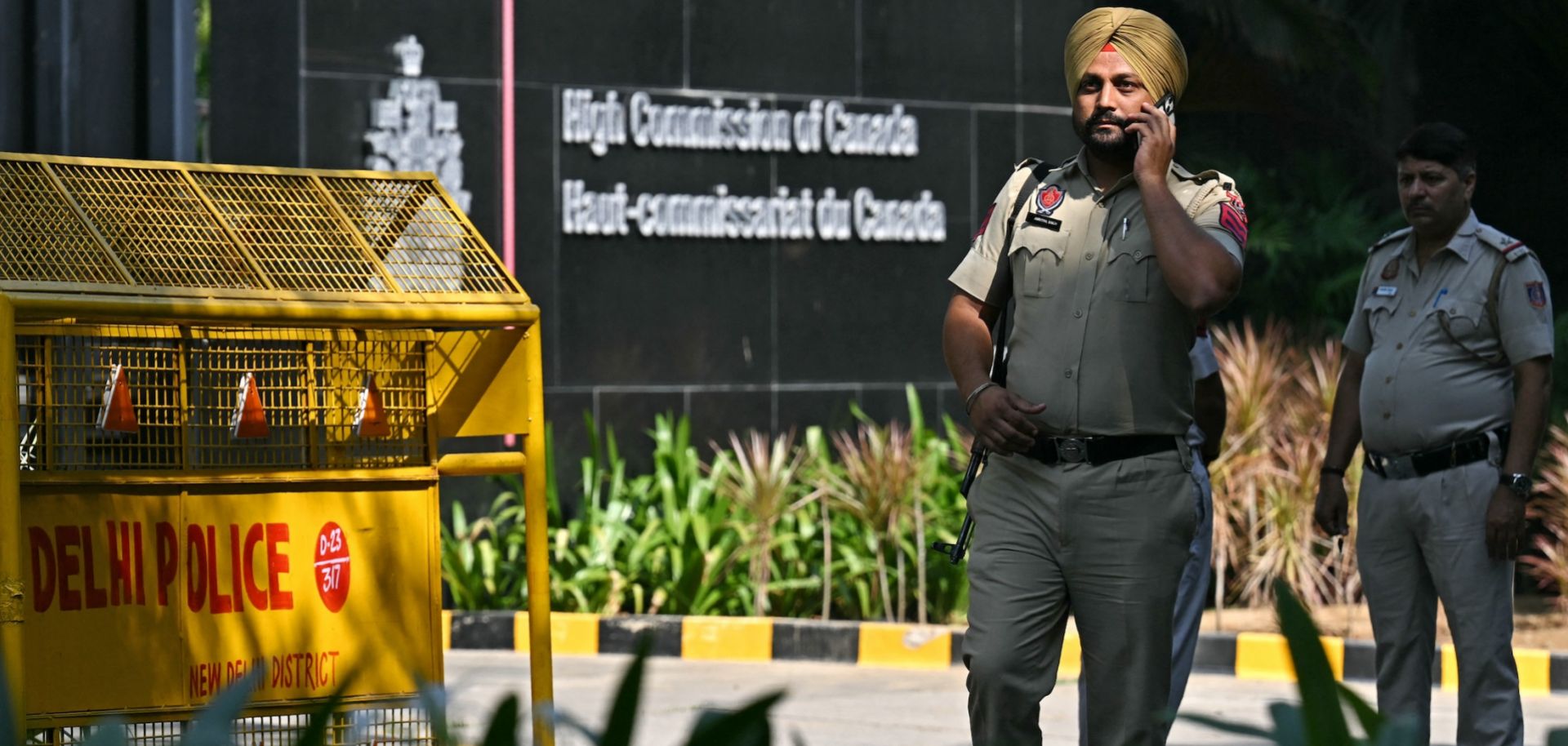
Canada's latest allegations against India will worsen already strained relations, reducing the possibility of near-term reconciliation and increasing the likelihood of consular service limitations, travel disruptions for Indian employees and protests from activist groups, though bilateral trade will likely remain mostly unaffected. On Oct. 14, the Royal Canadian Mounted Police (RCMP) accused Indian diplomats and consular staff in Canada of using their official roles for covert activities on Canadian soil, including by working with organized crime groups to sponsor murders, extortion and intimidation targeting Indian dissidents and the broader South Asian community in Canada. RCMP also accused India of interfering in democratic processes, though they did not provide specifics. Amid these allegations, the Canadian government announced the same day that six Indian diplomats and consular officials — including High Commissioner Sanjay Verma, the country's top diplomat in Canada — had been formally expelled from the country. Canada's foreign minister, Melanie Joly, stated the expulsions were a result of India's refusal to waive its diplomatic and consular immunity and cooperate with Canada's investigation. Hours before the RCMP issued its statement on Oct. 14, India's Ministry of External Affairs (MEA) announced that Canada had identified the Indian High Commissioner and other diplomats as ''persons of interest'' in connection with an ongoing investigation linked to the killing of a Canadian-Sikh citizen. The Indian ministry has since dismissed the RCMP's accusations as ''absurd,'' suggesting they were part of Canadian Prime Minister Justin Trudeau's ''political agenda.'' In response, India announced it would recall its top diplomat in Ottawa and others involved, claiming that the ''climate of extremism and violence'' in Canada threatened their safety. India also accused the Trudeau government of allowing room for violent ''extremists and terrorists'' who harass, threaten and intimidate Indian diplomats and community leaders in Canada. Later in the day, the MEA announced that six Canadian diplomats in India, including acting High Commissioner Stewart Ross Wheeler, had been asked to leave the country by Oct. 19.
- Contrary to the Indian government's statements, Canadian officials say they expelled the Indian diplomats first due to their alleged involvement in criminal activities, before India announced it was withdrawing its diplomats.
- The RCMP accused Indian government agents of having ties to an organized crime group known as the ''Bishnoi group.'' India's top investigative body, the National Investigation Agency, describes the group as a criminal gang led by Lawrence Bishnoi, a well-known organized crime figure who faces over 40 criminal cases over charges like murder and extortion, with many trials still pending. Although Canada did not specify evidence, the RCMP indicated there was ''specific targeting'' of individuals in Canada supporting Khalistan, a secessionist movement advocating for an independent Sikh state in India. The RCMP identified the Bishnoi organized crime group as having previously claimed responsibility for some of these actions and alleged its connection to Indian government agents.
- The RCMP stated they presented their evidence directly to Indian government officials in an effort to forge collaboration to curb violence and request joint efforts between their law enforcement agencies. However, due to the Indian officials' repeated lack of cooperation, the RCMP felt compelled to make their findings public for security reasons.
- While the RCMP did not elaborate on how India has interfered in democratic processes, in April 2024, the Canadian Security Intelligence Service alleged that the Indian government attempted to meddle in Canada's 2019 and 2021 elections through ''clandestine activities'' aimed at specific electoral districts and particular politicians.
The RCMP's allegations come after a year of high tensions between India and Canada as Ottawa continues investigating allegations of Indian involvement in the assassination of a Sikh separatist leader in mid-2023, while New Delhi continues to accuse Trudeau of political maneuvering, supporting separatist groups and undermining India's security. Tensions between the two countries escalated after a prominent Canadian Sikh leader, Hardeep Singh Nijjar, was killed in British Columbia in June 2023, with Trudeau later claiming in September 2023 that he had ''credible allegations'' linking the incident to the Indian government. India has strongly rejected these allegations, accusing Trudeau of appealing to Canada's sizable Sikh community for political reasons and collaborating with Sikh separatists who support him and his Liberal Party. In a series of retaliatory actions, both countries expelled each other's diplomats, with Canada removing India's top intelligence officer and India expelling his Canadian counterpart. Additionally, India suspended new visas for Canadians, though later resumed visa services in late October. At the time, Canada's accusations were bolstered by the United States, which alleged in November 2023 that Indian agents had attempted to assassinate another Sikh separatist leader, Gurpatwant Singh Pannun, in New York in 2023, leading to the U.S. indictment of an Indian national allegedly acting under the orders of an unnamed Indian government official.
- On Oct. 14, the U.S. State Department announced that an Indian inquiry committee, established to investigate a plot to assassinate Pannun, would visit Washington on Oct. 15 to discuss the case as part of the department's ongoing probe into Pannun's death. India's seemingly greater willingness to work with the United States, compared to Canada, on the Pannun case is likely due to New Delhi's overall stronger relationship with Washington, which is underpinned by mutual strategic interests and strong economic ties, and the fact that the United States has been less publicly vocal about the Indian government's alleged involvement in the Sikh separatist's death. In contrast, India's interactions with Canada are complicated by perceptions of Canadian support for the Khalistan movement, leading to a hesitance to engage fully.
- Canada is home to the largest Sikh community outside India, with Sikhs comprising around 2% of the Canadian population. India has claimed that some members of the Canadian Sikh community are actively involved in a pro-Khalistan movement. India has also criticized Canada for allowing pro-Khalistan protests, alleging that the Canadian government is supporting this movement; however, Ottawa has said it is merely protecting free speech and the right to political protest.
- In June, a Canadian parliamentary report, drawing on intelligence from national security services, highlighted India and China as the leading sources of foreign interference in Canadian politics. Indian High Commissioner Verma dismissed the findings and called the report politically motivated.
Canada and India's escalating dispute will raise the risk of restricted consular services and protests in both countries. The expulsion of diplomats increases the likelihood of reduced consular services in both India and Canada, complicating travel for Indian employees and disrupting corporate travel plans. Such disruptions could also affect the large Indian student population in Canada by potentially hindering their access to essential services and visa-related assistance. India had previously suspended new visa issuances to Canadians and could thus potentially do so again, though no indications of this have emerged so far. Additionally, while no major related protests have occurred since bilateral tensions resurged in recent days, activist groups in both Canada and India could mobilize demonstrations related to the ongoing dispute in the coming days or weeks, especially if the RCMP releases more information on India's alleged covert activities in Canada. Sikh groups, known for their previous protests in Canada and India, are among the most likely to take to the streets, though groups in India could also organize anti-Canada protests, potentially targeting the Canadian Embassy or Canadian businesses. While the recent detailed allegations will be a strong driver for protest activity, during the last round of protests, attendance at Sikh demonstrations was more limited than anticipated, potentially due to fears of Indian reprisals, such as the revocation of visas for Sikh activists; this may discourage participation in future protests. Nonetheless, such demonstrations could disrupt transportation in both countries and pose increased safety risks for local employees — especially if they trigger counter-protests from Hindu nationalists or other pro-India groups, which would raise the likelihood of violent clashes.
- Indian students make up nearly 40% of the total international student population in Canada, with approximately 427,000 currently enrolled in the country. Furthermore, the number of Indians immigrating to Canada surged by 326% between 2013 and 2023, according to data from the National Foundation for American Policy.
But major economic disruptions remain unlikely as political tensions have so far had a minimal impact on bilateral trade, despite Canada seemingly leaving the door open to sanctions in its latest allegations. On Oct. 14, Canadian Foreign Minister Melanie Joly appeared to raise the possibility of sanctions by warning that ''everything [was] on the table.'' But while the recent expulsion of diplomats signifies a further escalation in tensions between Ottawa and New Delhi, neither government is likely to take steps that would disrupt trade. Indeed, in their past political disputes, India and Canada have avoided regulations that restrict the flow of goods or services, and remain unlikely to break with this trend. In fact, despite bilateral tensions, India's imports from Canada grew to $4.6 billion between September 2023 and 2024. Additionally, any potential Canadian retaliation in the economic sphere would only narrowly affect India, which is not heavily reliant on Canadian trade and can find alternative suppliers if it loses access to Canadian imports. If Ottawa were to impose sanctions, they would thus more likely target specific Indian individuals or entities, rather than larger sectors of the Indian economy.
- India's primary exports to Canada include gems and jewelry, pharmaceuticals, textiles and machinery, while Canada's leading exports to India consist of pulses, timber, pulp and paper, and mining products.
