
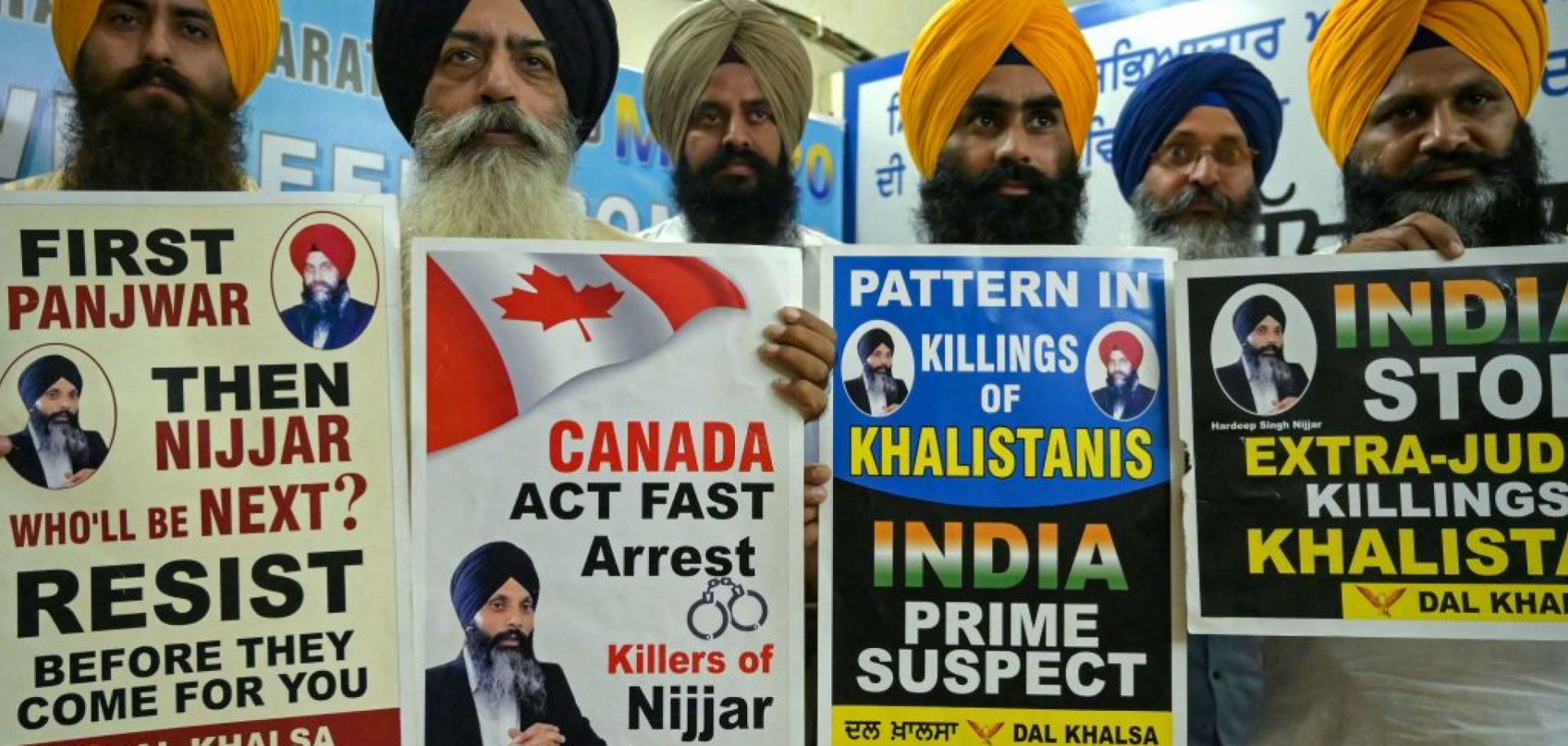
India may be willing to conduct further covert action in the West that likely prompts occasional challenges to diplomatic relations and security cooperation, but more consequential, longer-lasting ruptures between the two sides remain unlikely. On Oct. 19, Canada announced that it had recalled 41 of its diplomats from India after the Indian government threatened to revoke their diplomatic immunity, and said that some in-person Canadian consular services in certain Indian cities would consequently be temporarily suspended or disrupted. The move was the latest in the diplomatic fallout after Canadian Prime Minister Justin Trudeau on Sept. 18 announced Canadian security agencies were "actively pursuing credible allegations" that "agents of the government of India" were potentially involved in the killing of Canadian citizen and Sikh separatist leader Hardeep Singh Nijjar in British Columbia. Among other things, the two countries have since expelled high-ranking diplomats from each other's countries — which media reports indicate were the station chiefs of each other's respective intelligence organizations — while India temporarily suspended issuing new visas for Canadian nationals. That said, India announced Oct. 25 that its High Commission in Ottawa and Consulates General in Toronto and Vancouver would resume some visa services given "some recent Canadian measures" to address India's "safety and security considerations;" this, alongside recent reported statements by unnamed Indian officials that India is not planning on imposing restrictions on bilateral trade or investment, suggest tensions between the countries may be stabilizing.
- India designated Nijjar a terrorist in 2020 for allegedly leading the Khalistan Tiger Force separatist militant group and purportedly being linked to violence in India, accusations that Nijjar denied. Prior to his June 2023 killing, he reportedly was organizing a referendum for the creation of a Sikh homeland. While initial reports indicated three individuals and one getaway vehicle were involved in Nijjar's fatal shooting outside a Sikh temple in Surrey, British Columbia, The Washington Post later reported that witness accounts and a video reviewed by the paper suggested a more complex operation involving at least six people and two vehicles.
- Media reports citing unnamed Western officials claim U.S. intelligence agencies provided Canada with important contextual information that, alongside Canadian intercepts of Indian diplomatic communications, informed Canada's assessment that India was involved in the Sikh separatist leader's killing.
Canada's public allegation has also focused international attention on India's relatively obscure foreign intelligence service, the Research and Analysis Wing, which has reportedly increased its operations in the West since 2008 despite historically conducting the majority of its work in South Asia. While RAW's collection requirements and operational priorities have changed under different prime ministers, it has primarily operated in India's near abroad, collecting intelligence on strategic adversaries like Pakistan and China and conducting covert action and influence operations to advance India's interests. But RAW and India's Intelligence Bureau — the country's other intelligence entity — also conduct comparatively limited operations in the West, which anonymous Indian intelligence officials have claimed were expanded following the 2008 Mumbai attacks. This appears driven at least in part by the alleged involvement of U.S. citizen David Headley in the 2008 attacks, which were perpetrated by Pakistan-linked militant group Lashkar-e-Taiba, and that killed some 164 people and wounded hundreds of others. At least one Indian intelligence official has stated RAW's activity in the West has primarily focused on non-kinetic operations like intelligence collection and influence campaigns largely because India's diplomatic relationships and security cooperation with many countries have allowed it to extradite or access persons of interest, giving it options other than targeted killings.
- RAW's publicly known operations have included support for East Pakistani separatists during the 1971 Bangladesh Liberation War, initial support for the militant Liberation Tigers of Tamil Eelam in Sri Lanka before later turning against them, as well as covert action and targeted killings against Pakistan and Khalistan militant leaders.
- While detailed information on RAW's budget and staffing are not publicly known, the U.S.-based think tank Federation of American Scientists estimated that in 2000 RAW had a budget of around $145 million and some 8,000-10,000 "agents." The expansion of the agency's mission in subsequent decades suggests its budget and staffing have grown significantly, though media reports in recent years also claim its resources are being stretched by competing security priorities.
Against this backdrop, New Delhi's long-standing concerns over the Sikh separatist Khalistan movement have grown in prominence over the past year, leading India to press Western authorities to curtail pro-Khalistan activities in their countries. Even after the decline of the Sikh separatist insurgency in the mid-1990s, the Khalistan movement has remained a priority security concern for India. This is in part due to concerns that a resurgent Khalistan movement may fuel security risks not only in India's Punjab state — the historical center of the Khalistan movement — but also inflame separatist sentiment and violence in Kashmir and other parts of India. India has also repeatedly accused Pakistan's Inter-Services Intelligence of attempting to revive Khalistan militancy, including by using unmanned aerial vehicles to drop weapons and ammunition into Punjab state. The late-2022 rise of pro-Khalistan activist Amritpal Singh in Punjab garnered particular attention from the government given Singh's relative popularity locally and leadership of sometimes violent protests. Security services in Punjab engaged in a massive manhunt for Singh beginning in mid-March involving thousands of security personnel; a dayslong, statewide mobile internet blackout; and the arrest of more than 100 of his followers before ultimately arresting him April 23 in Punjab's Moga district. A number of recent high-profile violent incidents and protests involving the Khalistan movement abroad, where the center of the movement has largely shifted in recent decades, have further stoked Indian security concerns. Major cities in several Western countries with large Sikh diaspora populations — including Canada, the United States, the United Kingdom and Australia — have seen violent pro-Khalistan protests in the past year that have damaged Indian diplomatic buildings as well as street brawls between pro-Khalistan and pro-India protesters. While a number of these countries have consequently bolstered security at Indian diplomatic buildings, most Western governments, including Canada, have generally resisted Indian pressure to crack down on the Khalistan movement, often underlining their responsibility to uphold and protect the right to free speech and political protest.
- While India's Ministry of External Affairs rejected Canada's allegations of complicity in Nijjar's killing as "absurd" in a Sept. 19 statement, it also criticized Canada for allegedly providing shelter to "Khalistani terrorists and extremists … [that] continue to threaten India's sovereignty and territorial integrity." The ministry called Canada's "inaction" on this a "long-standing and continuing concern," and urged Canada "to take prompt and effective legal action against all anti-India elements operating from their soil."
- Indian officials and local media reports claim Canada has disregarded or otherwise not fulfilled its extradition requests for several Khalistan figures and alleged separatist militants, including Nijjar.
India's potential new willingness to undertake brazen action in Western countries is unlikely to curtail its growing ties to the West, though it will prompt sporadic challenges to bilateral relations and security cooperation. If Canada's allegations are true, it would appear that India's patience with what it considers Canada's — and potentially other Western governments' — inadequate response to the Khalistan movement has worn thin and it is now willing to engage in targeted hits to mitigate what it perceives as a resurging threat. India's reportedly expanded presence and activities in the West likely already provide infrastructure with which to undertake and support such activities, and may thus enable further covert action should it continue to consider Western responses to the Khalistan movement — or potentially other perceived threats — inadequate. India likely also feels emboldened because many Western countries have demonstrated their regard for India as an important, if not essential, geostrategic and security partner — particularly in their efforts to counter China. Many Western states also maintain or are seeking closer economic ties that will further constrain these countries' willingness to punish India for its alleged transgressions. That Canada's closest allies and fellow members within the Five Eyes intelligence alliance — the United States, the United Kingdom, Australia, and New Zealand — have all demonstrated relative restraint when speaking about Canada's allegations, and that the United Kingdom has said it is still continuing trade talks with India, underlines likely upper limits to the consequences of India's actions. Indian officials have also reportedly stated the country does not intend to escalate the current spat to restrictions on Canadian imports or investments. Thus, while sporadic disruptions to relations, including such things as diplomatic expulsions, visa restrictions and potentially some economic or trade restrictions, remain possible, they will likely remain temporary. Western intelligence services may also be more suspicious of RAW and feel compelled to dedicate greater counterintelligence resources to monitor its activities and be more cautious in the intelligence they share. But mutual strategic interests, particularly in countering China, make it even more unlikely that challenges more severely disrupt, let alone sever, the ever-important security side of relations between India and the West. Recent statements from both Canadian and Indian military officials that bilateral military cooperation remains unaffected by the diplomatic spat underline this.
- Canada's Five Eyes allies have all expressed "deep" or "serious" concern regarding Canada's allegations, but have avoided expressing more explicit support for Canada's assertions or more severely condemning India. Canada's allies recently expressed greater displeasure after India pressured Canada to withdraw dozens of its diplomats, but even these statements appeared fairly restrained, with the United States "urg[ing] the Indian government not to insist upon a reduction in Canada's diplomatic presence," and the British Foreign Office "not agree[ing] with the decisions taken by the Indian government that resulted in a number of Canadian diplomats departing India."
- Underlining that broader interests are restraining some countries' responses, a day after Canadian Prime Minister Trudeau leveled the allegations in September, a spokesperson for the British prime minister stated that while the allegations were serious, the United Kingdom's "work on trade negotiations [with India] will continue as before," and that "these are negotiations about a trade deal and we are not looking to conflate with other issues."
- While disruptions to India's relations with Western countries will likely remain temporary, India's potential dissatisfaction with the West's response to its concerns could prolong individual episodes of diplomatic challenges. Additionally, while less likely as New Delhi probably does not want to alienate its partners and establish a perceived pattern of brazen attacks in Western countries, a series of high-profile Indian covert actions — particularly those that result in civilian casualties — would likely provoke a stronger response from the Five Eyes and other Western states.
