
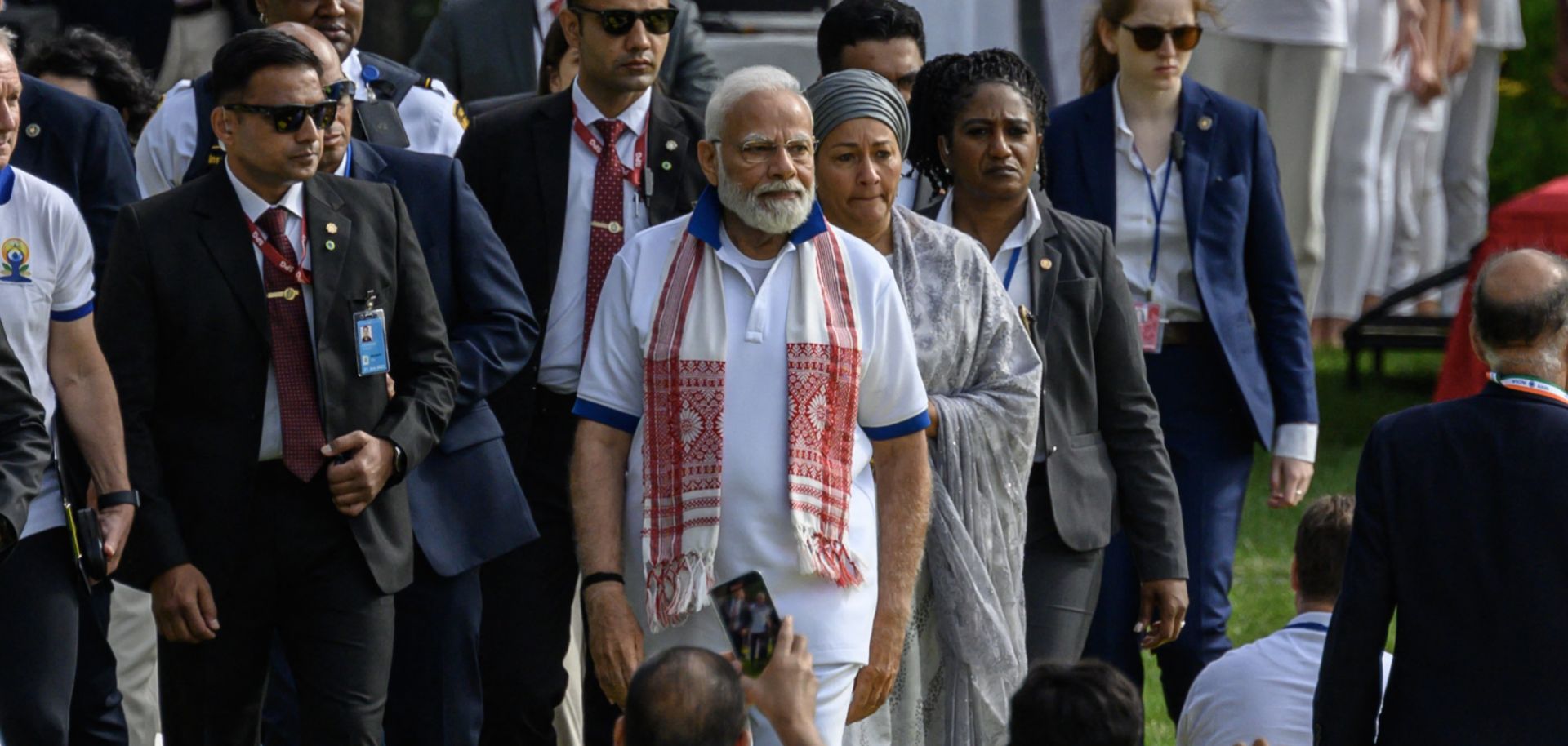
Indian Prime Minister Narendra Modi's official state visit to the United States will likely see the announcement of multiple agreements that will strengthen India's domestic defense industry and bolster U.S.-India defense ties. Modi is currently in the United States for his first official state visit to the country, following high-level but non-official state visits in prior years. The June 21-24 trip will only be the third official state visit ever by an Indian prime minister, and the first since former Prime Minister Manmohan Singh's official state visit in November 2009. After attending a June 21 commemoration of International Yoga Day at the United Nations in New York, Modi landed in Washington this afternoon, where tomorrow he'll address a joint session of the U.S. House of Representatives and Senate (making him the first Indian prime minister to have given two speeches to U.S. Congress) and attend an official state dinner. During his visit, Modi is also expected to attend a private meeting in Washington, D.C., with the CEOs of the United States' top 20 companies; a luncheon at the Department of State hosted by Vice President Kamala Harris and Secretary of State Antony Blinken; and a June 23 dinner reception with members of the Indian diaspora community at the Ronald Reagan Building. Thousands of Indian Americans are reportedly expected to travel to Washington to welcome Modi and participate in various related events.
- This will be the third official state visit under the Biden administration thus far, following South Korean President Yoon Suk Yeol's visit in April 2023 and French President Emmanuel Macron's visit in November-December 2022.
- Modi's visit underlines what the White House has described as a ''deep and close partnership between the United States and India,'' and the important role the United States sees for India in countering China's growing influence.
- In preparation for Modi's trip, U.S. Secretary of Defense Lloyd Austin traveled to India June 4-5 and met with his Indian counterpart Rajnath Singh to discuss upgrading bilateral defense ties and to settle on a five-year roadmap for jointly developing and producing defense and critical technologies.
- U.S. National Security Advisor Jake Sullivan visited India June 13-14, where he met with Modi and other officials to settle the agenda for Modi's trip to the United States and to finalize the details of reported purchasing and joint defense production agreements.
The visit comes as India and the United States are strengthening their ties amid mutual concerns over China's increased assertiveness and growing regional and global influence. India has long relied on Russia for weapons and materiel. However, Russia's February 2022 invasion of Ukraine has threatened New Delhi's once-reliable supply of Russian arms, both by increasing risks of triggering U.S. sanctions and prompting logistical issues that have hampered material shipments. Risks to India's arms supplies have notably also come amid worsening tensions with China, driven in part by recent clashes between the two countries' troops along their contested border, as well as China's expanded activity in the Indian Ocean (which has included frequent transits of Chinese nuclear-powered submarines). This has prompted India to accelerate years-long efforts to strengthen its domestic defense industry and diversify its foreign sources of weapons and materiel. And the United States has actively sought to support those efforts in the hopes of not only reducing India's reliance on Russia, but strengthening a partner it views as vital in countering China's growing regional and global influence (despite Washington and New Delhi's frequent misalignment on how to accomplish this). Against this backdrop, India and the United States have focused on strengthening bilateral defense cooperation and bolstering the former's domestic defense industry in recent years.
- In March, the Stockholm International Peace Research Institute (SIPRI) published a report that showed that Russia was still India's largest arms supplier, but that its share of total Indian arms imports fell from 64% in 2013-2017 to 45% in 2018-2022 due to a combination of ''strong competition from other supplier states, increased Indian arms production and, since 2022, [constraints] on Russia's arms exports related to its invasion of Ukraine.''
- In June 2020, at least four Chinese soldiers and 20 Indian soldiers died in a particularly intense flare-up in Galwan Valley along the Himalayan border, in what was the first fatal clash between the two sides in decades. Since then, India and China have generally sought to avoid confrontations and quickly de-escalate along their border. But sporadic border clashes have nonetheless persisted, with the most recent reportedly taking place in early December 2022 in the northeastern Indian state of Arunachal Pradesh.
- Last month, the Wall Street Journal reported that India and China had effectively blocked mutual media access by ejecting or denying visa renewals to each other's journalists. In May, India denied visa renewals for the last two Chinese state media journalists operating in India; the move followed China's failure to renew the visas of the last four remaining Indian journalists operating in China in prior weeks.
- In May 2022, President Biden and Prime Minister Modi also announced the U.S.-India initiative on Critical and Emerging Technology (iCET), which focuses on bolstering cooperation in developing and producing defense and critical technologies. The agreement has since helped underpin a number of discussions on U.S.-India defense cooperation.
While it will likely take years for India to fully absolve itself from its decades-long, outsized defense reliance on Russia, Modi's visit is poised to yield multiple agreements that will strengthen India's domestic defense industry and potentially spur a more significant shift in U.S.-India relations. Although Indian imports of Russian arms have steadily decreased in recent years, more than half of India's defense equipment is reportedly still Russian-made, which means India remains heavily reliant on Russia to upgrade its current equipment. This — along with the fact that Western military equipment is comparably more expensive, and that Russian and Western systems lack interoperability — will challenge India's push to diversify its defense equipment and supply chains. India's continuing ties with Russia amid the ongoing war in Ukraine, in addition to the Modi administration's pursuit of domestic policies often criticized as undemocratic, will likely also leave some Western countries hesitant to share sensitive military technologies and limit the extent to which they're willing to deepen ties with India. And India will similarly remain wary of becoming too reliant on the United States and its Western allies, given New Delhi's pursuit of self-reliance and sensitivity to losing its strategic autonomy. But India's concern for the reliability of Russian arms supplies, combined with both Washington and New Delhi's mutual apprehension regarding China, may still be enough to overcome these long-standing constraints and realize a more distinct shift in the U.S.-India relationship. Modi's historic visit to the United States is thus still poised to see the announcement of agreements that strengthen India's domestic defense industry and pave the way for further bilateral cooperation. This could include agreements for rare technology transfers and collaboration on sensitive defense and critical technologies (like artificial intelligence, quantum computing and semiconductors) under iCET.
- On his recent trip to New Delhi, U.S. National Security Advisor Jake Sullivan implied that efforts were being made to overcome long-standing constraints to closer defense ties, saying Modi's visit to the United States would see ''a number of deliverables…fundamentally designed to remove those obstacles in defense trade, in high-tech trade, in investment in each of our countries, in taking away obstacles that have stood in the way of our scientists and researchers.''
- Over the past year, U.S. and Indian officials have discussed a number of agreements for India to acquire or jointly produce materiel and critical military components. This includes a reported agreement for India to purchase a number of General Atomics MQ-9B SeaGuardian unmanned aerial vehicles. In addition, both sides have reportedly worked to secure an agreement for General Electric to jointly produce its GE-F414 turbofan engine with India's Hindustan Aeronautics Limited; the engine would power India's Tejas Mark-2 fighter jets and the rest of India's future fighter jets moving forward.
- Despite deepening cooperation, the United States has been frustrated by India's continued engagement with Russia in the aftermath of the Ukraine invasion, which has seen India increase its purchases of cheap Russian oil and participate in Russian-led multilateral military exercises over the past year. Critics have also pointed to reports of ongoing human rights issues in India, as well as the growth of Hindu nationalism, under the Modi administration.
