
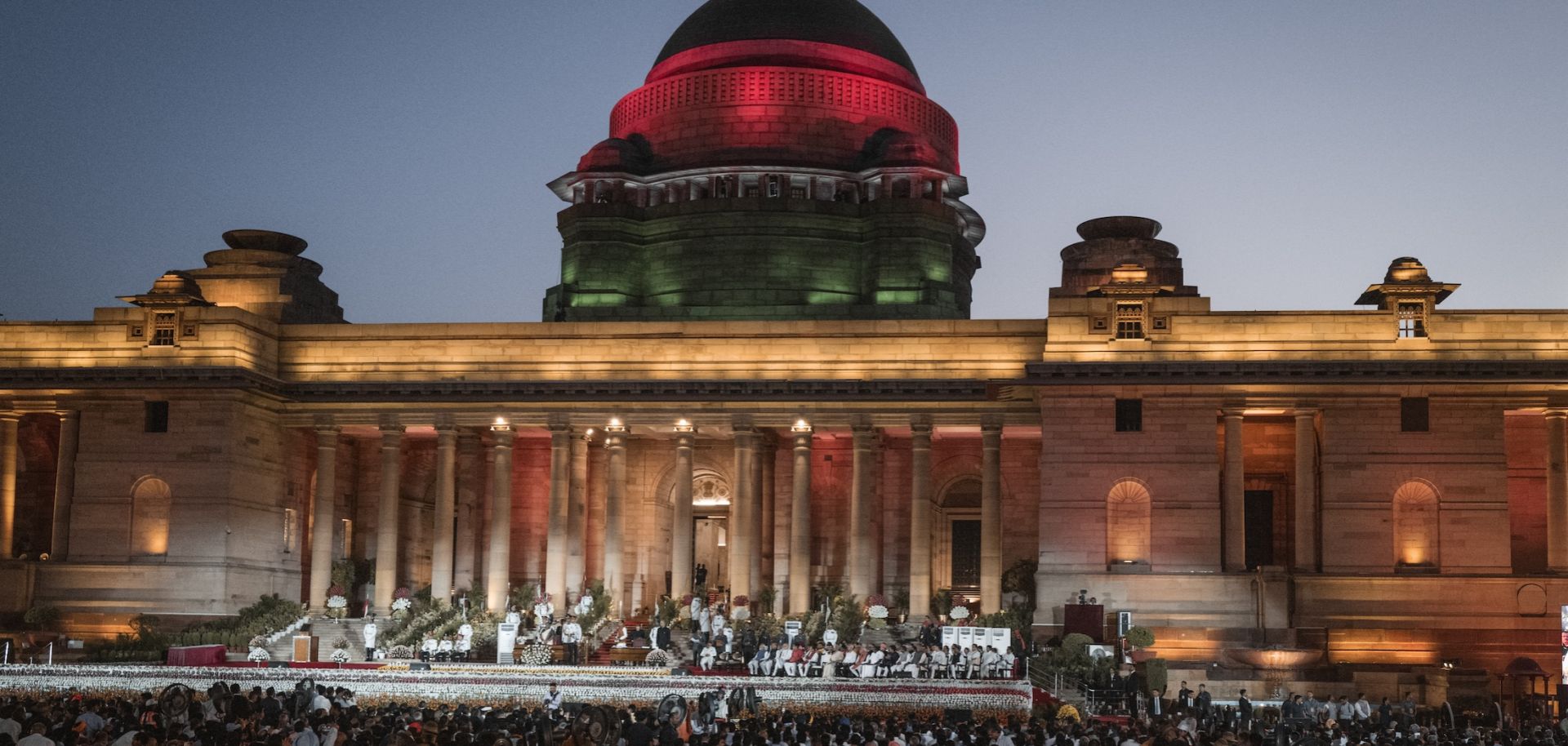
Lacking a parliamentary majority and dependent on coalition partners, India's government will maintain policy continuity on issues such as fiscal consolidation, but structural reforms will face delays due to internal disagreements. As India's Prime Minister Narendra Modi embarks on his third consecutive term following the general election that concluded on June 1, a special eight-day session of the Indian Parliament is set to commence on June 24. During this session, the newly-elected members of parliament will be sworn in, setting them up to elect a new speaker of the Lok Sabha (lower house) on June 26. The formation of the Parliament will pave the way for budget discussions in July, along with other policymaking initiatives.
- From April 19 to June 1, India held elections for the 543 seats in the Lok Sabha, which serves a five-year term, across India's 28 states and eight union territories. To secure a majority, a party or coalition needs at least 272 seats. However, Modi's Bharatiya Janata Party, or BJP, fell short with 240 seats and had to rely on its coalition partners in the National Democratic Alliance, or NDA, to form a government. After being unanimously elected as leader of the NDA, Modi met with President Droupadi Murmu on June 7 to stake his claim to form the government, which was subsequently sworn in on June 9. NDA members include the Telugu Desam Party, Janata Dal (United) and Shiv Sena, which won 16, 12 and 7 seats, respectively.
Cabinet allocations underscore the BJP's policy continuity and Modi's efforts to secure key portfolios for party members, affirming the BPJ's central governing role despite coalition dynamics. Modi was sworn in on June 9 and announced Cabinet appointments the following day, retaining key ministers in their portfolios, including Subrahmanyam Jaishankar as foreign minister, Amit Shah as home minister, Nirmala Sitharaman as finance minister, and Rajnath Singh as defense minister. BJP allies from the NDA were granted five Cabinet seats, overseeing secondary positions including ministries such as civil aviation, food processing, steel, animal husbandry and dairying, and small and medium enterprises, cementing the BJP's key role in the coalition and ensuring the maintenance of key portfolios for Modi's BJP members.
However, the regional parties within the NDA have their own priorities, which could stall the passage of legislation and prompt the BJP to temper its Hindu nationalist ideology. Both Janata Dal (United) and the Telugu Desam Party will likely push for their policy priorities, given the significance these parties hold in the stability of the coalition government. This is evident in the pushback against initiatives like the ''Agnipath'' scheme (implemented by the BJP in 2022), a recruitment drive to enlist young individuals into the Indian Armed Forces for four years. Janata Dal (United) has called for a review, advocating for reforms of the scheme to address shortcomings such as insufficient job security for young recruits and economic challenges posed by the influx of unemployed individuals back into the workforce after their tenure, particularly if employment opportunities are not scarce. Additionally, Janata Dal (United) is advocating for a caste-based census, which the BJP has periodically avoided in the past since the party promotes economic development and national identity rather than caste-based politics. Furthermore, while the BJP's Hindutva, a political ideology centered around Hindu nationalism, is likely to remain as the party seeks to consolidate and maintain its support base, the BJP will be unable to promote some of its more controversial identity-driven policies because they require constitutional amendments, which are unlikely given the BJP's lack of numbers in both the lower and upper houses. Such policies include the Uniform Civil Code and the ''one nation, one election'' initiative.
- Janata Dal (United) has already conducted a caste census in Bihar and now seeks to extend it nationwide. In contrast, the Telugu Desam Party prefers a ''skill census'' emphasizing wealth creation over subsidies. Thus, the BJP must balance these differing priorities between its two partners.
The BJP's narrow parliamentary control limits its ability to pass aggressive fiscal reforms, but the party will likely continue to maintain fiscal consolidation amid an increased risk of populist spending. Modi's decision to keep Nirmala Sitharaman as finance minister signals his intention to maintain economic policy continuity. However, the election outcome will likely make it more challenging for the BJP to pass politically sensitive economic reforms due to resistance from both NDA partners and the opposition. Reforms that will likely face resistance include labor and land reforms, privatization and efforts to streamline India's Goods and Services Tax to include key sectors like petroleum, alcohol and real estate. Additionally, the finance minister's immediate task will be to present the government's budget in July, which will provide insight into the Modi coalition's priorities going forward. Allies within the NDA may push for increased spending to fulfill their regional interests and priorities in their respective states. Though recent increases in government revenue, fueled by soaring tax income and a record-high surplus fund of $25 billion from the Central Bank of India, offer some room for additional spending, the BJP is likely to stick to its overall commitment to fiscal consolidation.
- Both houses of Parliament approved labor reforms in 2020 to simplify compliance and make it easier to do business, but their implementation has been delayed due to resistance from worker unions, which oppose the provisions for easier hiring and firing, as well as restrictions on trade unions. Land reforms may trigger disputes over land acquisition, compensation and redistribution, as well as concerns about environmental impacts and community displacement. Additionally, streamlining the Goods and Services Tax may raise disagreements within the NDA over tax rates and revenue-sharing arrangements between the central and state governments.
- Neither the BJP's manifesto nor the interim budget announced by Finance Minister Sitharaman suggested significant populist spending. In February, when unveiling the interim budget, the government established a fiscal deficit target of 5.1% of GDP, a reduction from the revised 5.6% of the previous year.
While the opposition has increased its presence in Parliament, political fragmentation and the lack of a coherent agenda will undermine its efforts to disrupt the government's plans. While the opposition INDIA alliance performed better than expected in the general election, it lacks a common ideology or policy vision. Thus, the likelihood of continued success depends on the coalition's ability to form a cohesive agenda, which will likely face constraints given the alliance's wide range of party interests. In terms of passing legislation, the NDA has a simple majority on its own, so while the opposition may push back and trigger public backlash, INDIA will remain constrained by the NDA's numbers. Though in the short to medium term NDA allies will likely remain allegiant to the BJP, INDIA could poach the BJP's partners if the ruling party does not manage coalition interests effectively, which could undermine the stability of the NDA's majority. For similar reasons, members of the opposition may also defect and join the NDA, underscoring the challenges INDIA faces in managing diverse coalition interests.
