
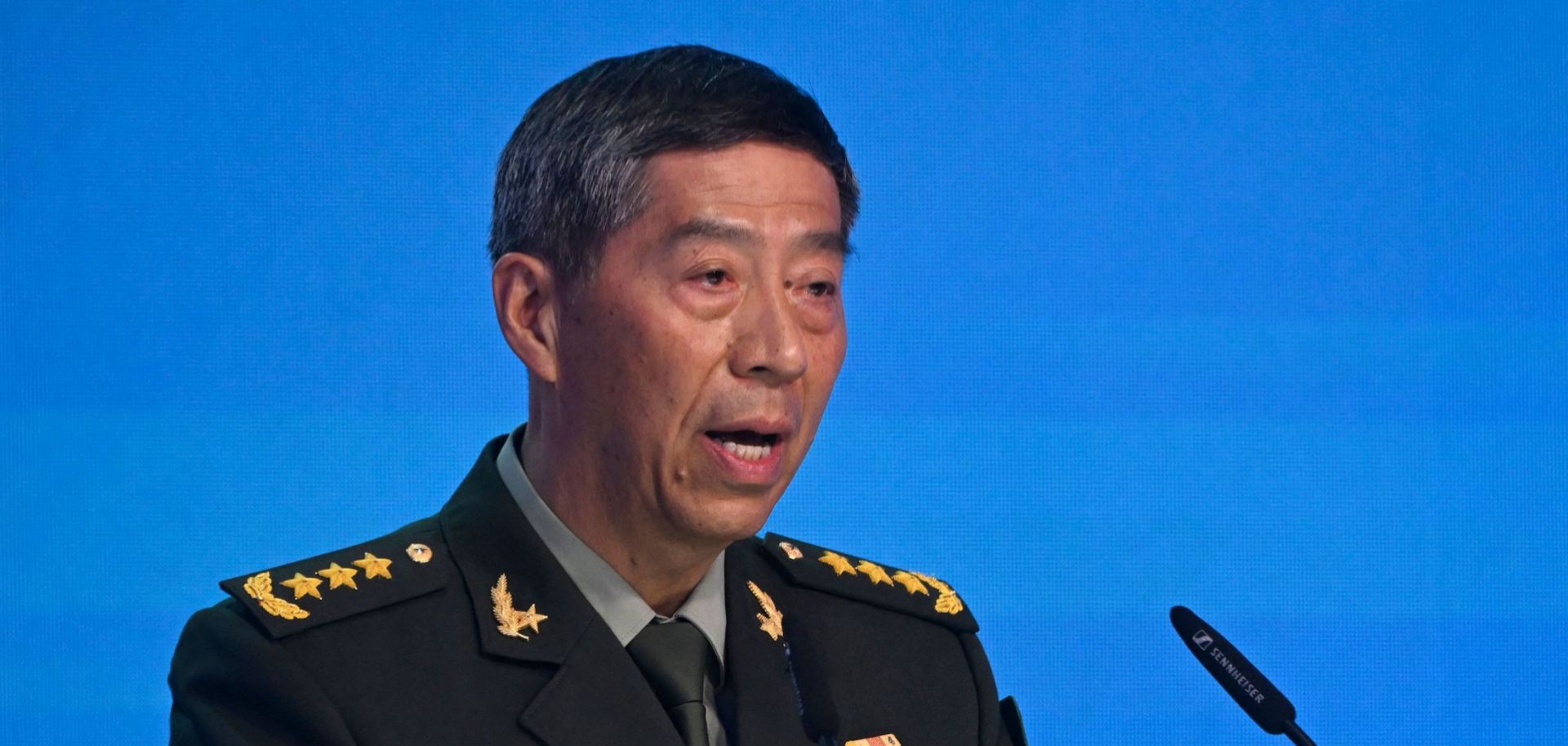
The rapid dismissal of two of China's top ministers will lead Beijing to more closely enforce discipline, and the empowerment of the Chinese Communist Party over the state could harm China's efforts at economic recovery, mending fences with the West and military modernization. The National People's Congress Standing Committee announced on Oct. 24 that Li Shangfu had been dismissed as China's defense minister. The announcement follows Qin Gang's dismissal as foreign minister in July, and both Li and Qin have been removed from their higher posts as state councilors. The Party's foreign policy chief (and former foreign minister) Wang Yi replaced Qin on July 25, but Beijing has not yet named a replacement for Li. During the months prior to each dismissal, the Party's disciplinary inspection authorities announced investigations into Li and Qin for corruption and misconduct, and both officials were largely absent from public view. Likewise, China's military leaders stayed out of the spotlight in the months leading up to Li's dismissal until Zhang Youxia, the vice chair of the Party's Central Military Commission, met with Serbian Defense Minister Milos Vucevic on Oct. 18. Zhang is below only President Xi Jinping in China's military hierarchy.
- Li is being investigated for corrupt procurement practices related to his time as head of the military's Equipment Development Department from 2017-22. In recent months, the People's Liberation Army has replaced several high-ranking officials who have connections to Li and military procurement.
- Qin's alleged offense is that he had an extramarital affair with former Chinese state news anchor Fu Xiaotian and helped her conceive via surrogacy while he was posted as ambassador to the United States from July 2021 to December 2022. Surrogacy is illegal in China, while Xi increasingly castigates infidelity; infidelity in a foreign country, where it could lead to blackmail, is particularly frowned upon.
- Though like Qin, Li's dismissal from his ministerial post was widely expected following the Party's disciplinary probe, the ouster of both Li and Qin from the State Council removes any possibility for their rehabilitation as government elites.
- Since 2012, Xi has used disciplinary inspection authorities to purge political rivals, particularly those in factions aligned with former presidents Hu Jintao and Jiang Zemin, and to consolidate Party and state power in himself and a small coterie of advisors.
Investigations of sitting ministerial officials like Qin and Li are rare in China, but when they do occur, they usually signify political power plays, egregious crimes or major risks to the Party's reputation. The Party has long prized political stability, so there needs to be a very good reason for a ministerial-level official to be dismissed, let alone two in quick succession. Furthermore, corruption is commonplace (even under Xi) in a one-party state where bribery greases the wheels of bureaucracy, and top officials are notorious within China for their philandering. Thus, when the Central Commission for Discipline Inspection targets officials with investigations, it usually means their corruption was particularly harmful to the state, their unsavory deeds were so public that the Party would lose face if it did not punish them, or Xi is purging political rivals.
- A Chinese foreign minister has not left office mid-term since the 1970s, with the exception of Li Zhaoxing, who stepped down a year early in 2007. However, by this time, Li was already beyond the Party's retirement limit of 65, and his extended tenure was attributed to his acumen in the role.
- Similarly, no Chinese defense minister has left their post mid-term since 1982, when then-Defense Minister Geng Biao was promoted to state councilor.
The context of these dismissals suggests that misconduct, not a political purge, is to blame, so Xi's core role in politics and policymaking remains strong. Qin's flouting of Xi's moral guidelines and Li's jeopardizing of China's military modernization with corruption are severe offenses in the eyes of the Party that offer ample grounds for dismissal, even without underlying political motives. Additionally, if the dismissals were part of another Xi-orchestrated political purge, Central Military Commission Vice Chair Zhang likely would have also been investigated due to his career connections to Li and higher rank that make him a prime political target. However, Zhang’s recent meeting with public officials demonstrates that he has not lost favor with Xi, strengthening the theory that the two dismissals were driven by mere misconduct. Moreover, the dismissals do not indicate that Li or Qin were members of a rumored anti-Xi political faction, though discontent with Xi's one-man rule is likely simmering in some elite circles. If the dismissals are indeed unrelated to Xi's efforts to centralize power, it would confirm that the president's grip on the Party and government remains as strong as ever.
However, the dismissals of Qin and Li in quick succession point to information gaps and poor judgment at the highest levels of power in China, which will motivate Xi to deepen Party discipline efforts, curbing the efficacy of local policymaking at a time of economic recovery. The Party relies on the Chinese populace's perceptions of its legitimacy in lieu of elections, so the Party heavily vets high-level officials for all manner of moral, political, ideological and professional shortcomings. The fact that the Party uncovered neither Qin's indiscretions nor Li's corrupt activities prior to their promotions to top posts may suggest that even as Beijing centralizes power and expands the role of the Party, information flows to top leaders are lacking. And even if their offenses were unknowable — after all, no government is completely immune to political scandals — the responsibility for bad appointments rests solely on Xi's shoulders, as he has concentrated power in himself more than any Chinese leader since Mao Zedong. Thus, these missteps will further motivate Xi to cull unworthy Party cadres before they become China's top leaders. This watchful gaze will exacerbate the fear of making mistakes already prevalent among China's city leaders and mid-ranking civil servants, hastening their policy alignment with Beijing. However, it also will impede their ability to tailor governing solutions to solve local problems, like the varied labor, real estate and cost-of-living issues associated with economic recovery in China's industrialized coastal provinces versus its poorer, rural inland provinces.
- A number of China's poorer inland city governments have in the last year reversed cuts in social spending and public services (e.g., pension pay and bus routes), originally intended to alleviate yawning budget deficits. These actions were likely due to pressure from Beijing to defuse risks of social unrest and shore up national consumer confidence, which Beijing hopes will drive China's economic recovery.
If Beijing fills leadership posts with more Xi acolytes and political experts rather than technocrats, it could constrain China's efforts to mend ties with the West, while appointees with military experience could help Beijing prepare for a potential war over Taiwan. It would be customary for Wang Yi to be relieved of his interim role as foreign minister in the coming months, as he already serves as the Party's foreign policy chief, which has a busy travel and policy portfolio. However, if he remains foreign minister, it would mark a further extension of the Party's influence over state governance. Moreover, if Beijing appoints another Party figure (like a military-political commissar) to replace Li, it would further extend the Party's control over the state and military. Such Party influence over state roles makes for leaders who are more responsive to Xi's many political and ideological dictates. But those same leaders also tend to have less administrative experience, thus inhibiting the capacity for ministers to bridge the gap between political dogma and pragmatic policy needs. Thus, even stronger Party influence could hinder China's efforts to mend fences with Europe and the United States, particularly via diplomacy and military-to-military dialogue. Furthermore, Li's replacement will inform Beijing's military priorities. If the government appoints a replacement with combat experience, it will reinforce Beijing's emphasis on making China's military ready to "fight and win wars," as President Xi's common exhortation goes, with preparation for a conflict with the United States over Taiwan top of mind. Follow-up appointments, including of the many other military officials ousted for corruption in connection to military procurement, will further indicate Beijing's comparative prioritization of combat preparation versus Party loyalty.
- The U.S. Department of Defense will send a delegation to attend China's Xiangshan Forum in Beijing from Oct. 29-31. The Chinese officials who meet with U.S. visitors may hint at China's upcoming promotions.
- China's Gen. Liu Zhenli is considered a top candidate to replace Li as defense minister. Liu is the chief of staff of the military's Joint Staff Department, where he is in charge of coordinating action among China's military branches and five geographic theater commands. Liu also has combat experience from his years fighting in the border skirmishes with Vietnam that followed China's 1979 incursion into the country.
