
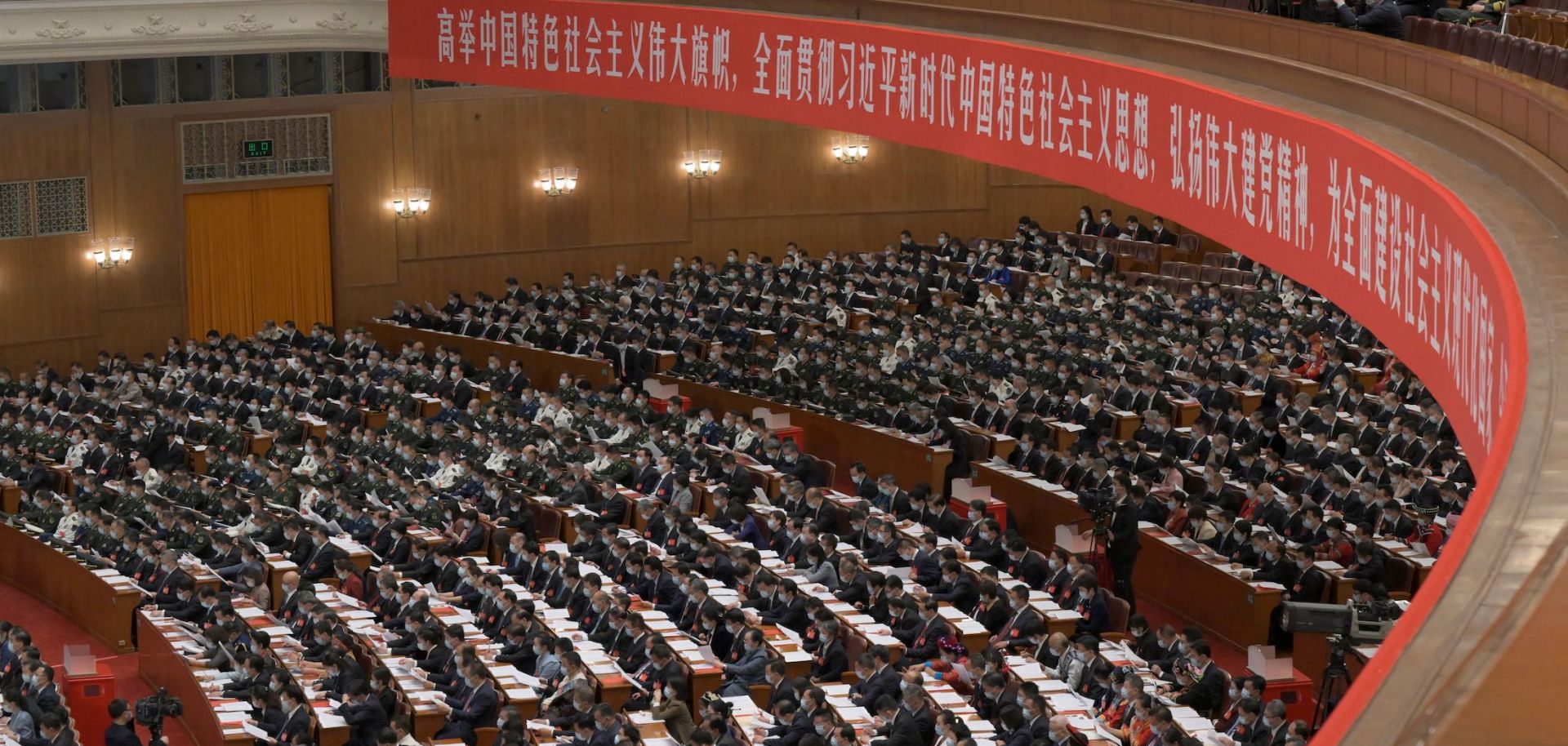
Delegates attend the closing ceremony of the Chinese Communist Party's 20th Congress at the Great Hall of the People in Beijing, China, on Oct. 22, 2022.
Editor's note: This is the third installment of a three-part series about China's economic rebalancing. Part one analyzed the problems Chinese policymakers are trying to solve, as well as those China's evolving economic model is causing. Part two offers potential solutions to these problems, and part three analyzes the impacts of possible policy failure.
Despite policymakers' best efforts, worst-case scenarios sometimes come to pass. In the case of China's economic rebalancing, this scenario would involve a deep economic crisis and/or severe financial instability that sets the country's economic growth back for years. While these outcomes remain unlikely, they could occur if Chinese policymakers do not intervene forcefully enough in the face of excess savings and insufficient investment opportunities.
The consequences of such a failure could vary widely, potentially leading to a controlled recession or an all-out economic spiral. In either case, the effects would extend beyond China, significantly impacting China’s trade partners, particularly in Asia.
The path to policy failure
Chinese policymakers are discouraging investment in the country's real estate and infrastructure sectors, which is slowing economic growth. For this slowdown to remain only a short-term speed bump, China must support domestic demand, especially household consumption, and create new investment opportunities in the real estate sector's place to absorb the excess savings due to lower investment in the sector. However, in a low-probability, high-risk scenario, policymakers would fail to ensure that these alternative opportunities materialize.
A lack of productive investment opportunities would lead to an excess of savings with few profitable outlets. This would cause interest rates to fall, lowering financial returns. Decreased returns would weigh on financial institutions' earnings, hurting their capitalization levels and even long-term financial health, as happened in Japan in the 1990s and 2000s. Moreover, decreased investment would slow economic growth even further and could depress prices.
China's government has many powerful policy levers that could help prevent this scenario from spinning out of control. For example, the central government has enough fiscal space and financial firepower to implement a large-scale debt restructuring, leading to a period of "controlled bankruptcy." However, this option could lead to a significant fire sale of assets, which could depress prices and weigh on economic and financial confidence and growth. Additionally, tighter government control over the economy would likely lower economic confidence even more, which would make any stimulus policies less effective. For these reasons, the government may respond too slowly or not forcefully enough, thus increasing the risk of a financial crisis.
Domestic consequences
In a worst-case scenario, Chinese policymakers would lose control of the economic rebalancing and even the process of controlled bankruptcy. In the face of this uncertain economic future, Chinese households would increase their precautionary savings and companies would reduce investment, which could bring about economic stagnation. If this leads to price deflation, including of assets, the value of debt will rise in real terms, further compounding financial stress. This stress could lead both companies and households to save even more in order to pay off their debts or maintain their targeted net worth, exacerbating the above issues and leading to what economist Richard Koo has called a balance sheet recession.
Additionally, slow economic growth would make it difficult for debtors to repay their debts, raising the specter of a vicious debt-deflation cycle. It is worth noting, however, that China does not have an external debt problem. As a result, the government could forcefully intervene to stabilize the financial situation and impose a wide-ranging, if messy, restructuring of domestic debts.
Most importantly, a debt-deflation scenario could lead investors, including banks, to incur substantial financial losses in the context of low profitability due to lower interest rates. Additionally, if asset prices decline sharply, the nominal value of household savings would erode, and a slowing economy could also cause unemployment to rise. As Chinese citizens increasingly feel the pinch of this economic stagnation, the risk of social and political discontent will rise, possibly leading to protests.
Global impacts
If China enters a debt-deflation spiral of falling prices and depressed growth, even if it manages to avoid a financial crisis, the global impact will be serious. For instance, economic stagnation would lead to reduced consumption, including for foreign goods and services. China is the largest trading partner of around 120 countries, so reduced demand would negatively impact their economic growth.
Additionally, deflation would make Chinese goods cheaper in global markets, leading to higher Chinese exports and larger trade surpluses. This could quickly become a major source of international tension, possibly raising the specter of another U.S.-China trade war following the 2024 U.S. presidential elections. Protectionist tariffs, retaliation and counter-retaliation between the world's two largest economies would negatively impact global economic and investor confidence.
Looking forward
These potential domestic and international consequences of slow economic growth show how important it is for Chinese policymakers to create profitable investment opportunities and increase consumption. However, the complicated nature of forward-looking structural reform means nothing is guaranteed. Therefore, even if Beijing successfully rebalances the economy away from real estate sector investment, Chinese policymakers will have to muster all their skills to keep China's economic growth from declining further over the medium to long term.
