
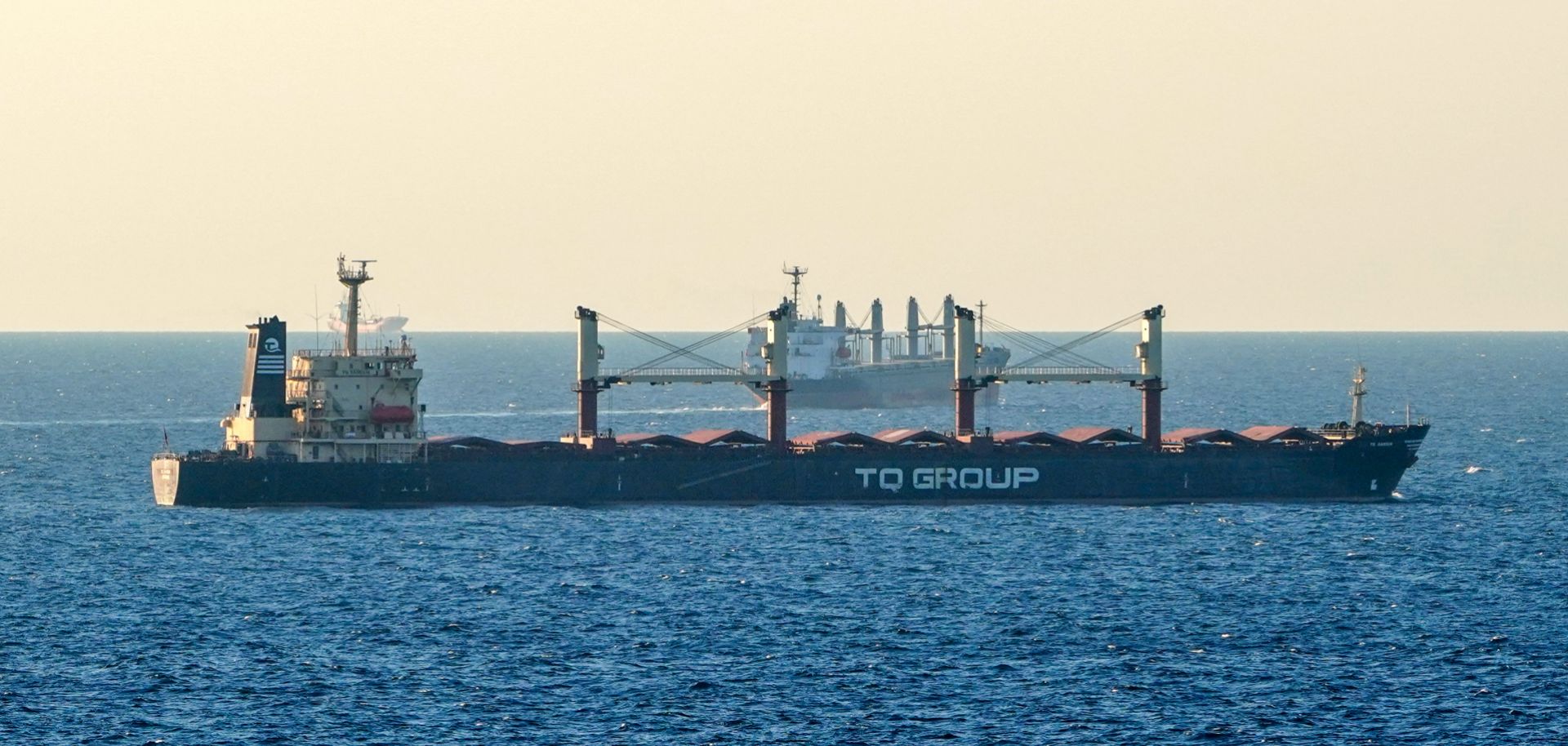
Despite failing to achieve a new grain deal, Turkey and Russia will retain their pragmatic relationship due to economic benefits and weakening competition in other areas of foreign policy. But if Ankara's political imperative to lower food prices at home increases, it could take stronger steps to push back against Moscow. On Sept. 4, Russian President Vladimir Putin rejected Turkish President Recep Tayyip Erdogan's attempts to mediate a restoration of the U.N.-brokered Black Sea Grain Initiative that Russia withdrew from in July 2023. Russia claimed that Western sanctions against it violated the agreement, and demanded further action to facilitate Moscow's export of agricultural products and fertilizer. But the West appears unlikely to provide those assurances, with Germany calling Russia's remarks ''cynical'' and the United States refuting Moscow's claims by saying that Russian wheat exports actually increased during the period of sanctions in 2022-23 from July to June. This development marks a notable setback for Erdogan's diplomatic push to restore the landmark deal that his country helped broker last year, which brought Ukrainian and Russian grain to the world's markets amid Russia's invasion, along with accolades for Turkey's role as an international mediator.
- Between its signing in July 2022 and Russia's withdrawal a year later, the Black Sea Grain Initiative helped offset the global food price shocks brought on by Russia's February 2022 invasion of Ukraine and subsequent blockade of Ukrainian wheat exports, which hit countries in the Global South particularly hard.
- Following the agreement's collapse in July, Turkey has been trying to mediate a Russian return to the U.N.-brokered grain deal to ease domestic food prices itself and boost Ankara's global standing with a significant diplomatic achievement. But Moscow has been reluctant to return to the deal, seeing it as enabling Ukrainian wheat exports and thereby boosting Ukraine's economy and stiffening Ukrainians' resolve to fight.
- For Turkey, the grain deal has domestic considerations as well, as high food prices, combined with a struggling lira, have impacted Turkish citizens' standard of living. Erdogan's ruling Justice and Development Party (AKP) is keen on mitigating these challenges before Istanbul and Ankara hold municipal elections in March 2024, which are seen as key to solidifying the AKP's chances at victory in Turkey's May 2024 presidential and parliamentary elections.
For now, Russo-Turkish relations will likely remain pragmatic, in part because of ongoing, mutually beneficial trade and defense ties, and in part because of the diminishing threat Russia poses to Turkish interests in conflict zones like Syria and the Caucuses. Despite the setback in failing to achieve a new grain deal, Turkey has many reasons to maintain a working relationship with Russia. In an Atlantic Council analysis, Turko-Russian trade increased 93% year over year from 2021 to 2022, as Russian trade, impacted by Western sanctions, shifted to alternative trade partners like Turkey. Moreover, while Turkey has attempted to enforce certain applicable sanctions in its financial sector when pushed to do so by Western governments, Turkey has not formally joined Western sanctions. This is because Turkey benefits from access to Russian food and energy exports, which are reaching Turkey at a discounted price at a time of high inflation. These dynamics highlight why Ankara's pragmatic relations with Russia will likely continue, especially with the West hesitant to push Erdogan too hard for fear of sending Ankara toward Moscow. Meanwhile, though Russia and Turkey continue to back opposing sides in Syria and the Caucuses, Russia's interests in those regions are shifting to be less diametrically opposed to Turkey's interests. In Syria, Russia is now focused on consolidating the Syrian government's control rather than expelling Turkish forces and its allies directly, partially because of military constraints but also because Ankara is signaling an openness to normalizing with the Syrian government in the future. And in the Caucuses, the Russian military's focus on Ukraine has reduced its ability to play a key role in defending its ally, Armenia, against Turkey's ally, Azerbaijan, which has also increasingly seen Russia let the United States spearhead diplomatic efforts aimed at resolving the decadeslong Azerbaijan-Armenian conflict.
- In Syria, Russia and Turkey are also partially aligned in their interest in reducing the U.S.-aligned Syrian Democratic Forces' (SDF) control of the northwest. Russia wants to see the SDF folded under the Syrian government's control, while Turkey wants to weaken the SDF's ability to support the Kurdish militant group, the Kurdistan Workers' Party, from Syria.
- In the Caucuses, Russia's traditional ally, Armenia, is increasingly signaling its desire to break from Russia given its reluctance to more forcefully intervene on Armenia's behalf in its dispute with Turkey-backed Azerbaijan. In response, Moscow has increasingly backed Azerbaijan's vision for a peace settlement, which would entail greater alignment between Turkish and Russian visions for the future of the region and motivate them to avoid increased conflict.
But over time, Turkey may become more confrontational with Russia over its blockade of Ukrainian wheat exports if food prices continue to affect Ankara's domestic politics. This could potentially see Turkey shift its diplomatic strategy toward pressuring Moscow to return to the deal and/or providing intelligence and defense systems to make Ukrainian exports more viable. Turkey's inflation rate, which is now hovering near an annual 60%, is still a notable political obstacle for the government, and bringing it down is a priority ahead of next year's municipal elections. Should the lack of a Black Sea grain deal be seen as hampering this political objective, the Turkish government may move away from coordinating with Russia and start overtly blaming Moscow for the rise in food prices, a move that would weaken Russia's diplomatic standing in the Global South and strengthen the West's narratives against Moscow. To lower food prices, Turkey might also try to help Ukraine find alternative ways to export its grain and circumvent Russia's blockade. Ankara could, for example, provide intelligence for Ukrainian grain vessels; it could also accelerate the pace of arms exports to Ukraine that might be used to deter Russian naval activity and weaken its blockade in the Black Sea. That said, there is a limit to this as Turkey will still seek to avoid any actions that could trigger a direct military confrontation with Russia in the Black Sea, which will deter Ankara from using its own navy to escort ships through the area.
- For the Ukrainian military, Turkey's Bayraktar TB2 drones have become a less valuable asset on the battlefield, in part because Russia has become more effective in deterring and destroying them. But such drones can nevertheless be utilized to attack Russian naval assets, as indicated by an open-source video found on X (formerly known as Twitter) on Sept. 4 that suggested a TB2 had been used to destroy a Russian patrol boat in the Black Sea.
