
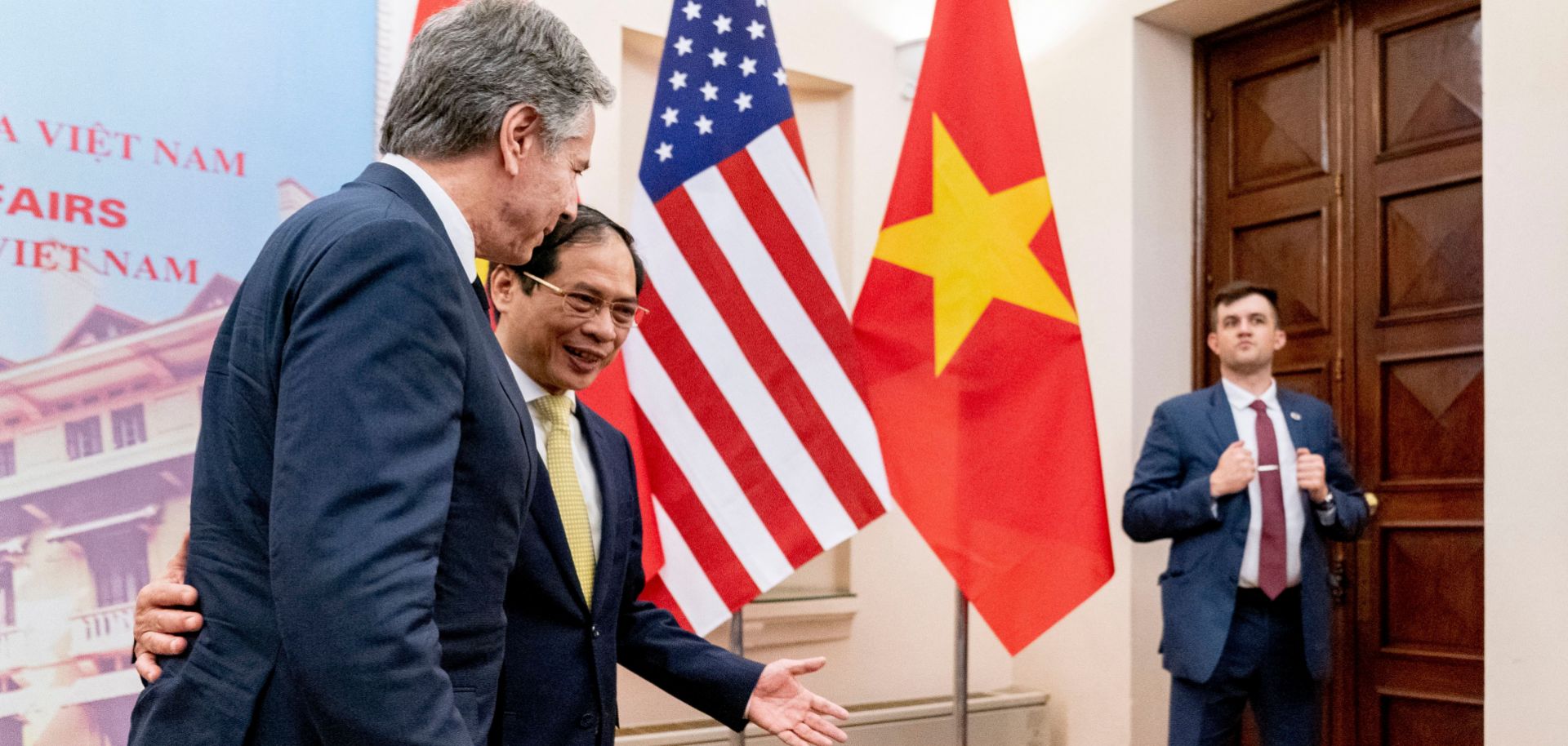
Facing heightened tensions with China, Vietnam is considering upgrading its security ties with the United States, even if some members of the Southeast Asian country's political elite remain skeptical. U.S. President Joe Biden suggested on July 31, Aug. 8 and again on Aug. 10 that the United States and Vietnam are poised to upgrade their bilateral relations from a "comprehensive partnership" to either a second-tier "strategic partnership" or first-tier "comprehensive strategic partnership," employing the terms Hanoi uses to classify bilateral partnerships. Biden said that he will be visiting Vietnam "shortly" to lay the groundwork for the formal upgrade before its possible signing on the sidelines of the September G-20 summit in India.
- The United States has courted Vietnam with a series of high-level visits in recent months, including that of Vice President Kamala Harris in November 2022, Secretary of State Antony Blinken in April and Treasury Secretary Janet Yellen in June.
- In March, Biden and Vietnamese Communist Party (VCP) chief Nguyen Phu Trong held a phone call to discuss possibly upgrading their countries' relations.
- Vietnam categorizes its bilateral partnerships in a three-tiered structure: "comprehensive strategic partnerships," (tier 1); "strategic partnerships" (tier 2); and "comprehensive partnerships" (tier 3). Vietnam currently maintains first-tier "comprehensive strategic partnerships" with China, Russia and India, but has no formal military alliance with any of these countries.
The ongoing U.S.-Vietnam conversations are taking place in the wake of the most recent maritime standoff between Vietnam and China. Despite consistently claiming to share the United States' desire to upgrade relations, Vietnam has not acted with any urgency to do so in recent years because it would inevitably strain its relations with Russia and China. But changing geopolitical winds could be altering the calculus in Hanoi, as evidenced by the recent month-long standoff with Chinese vessels in Vietnam's exclusive economic zone (EEZ) from May 7 to June 6. In 2019, when Vietnam also had a naval standoff with China, both Russia and the United States backed Vietnam. But by May 2023, Russia was deeply ensconced in its "no limits" partnership with China, preventing it from overtly crossing Beijing. At the same time, at least back in May, Washington was undertaking efforts to lower tensions with Beijing, and thus did not speak out in Vietnam's favor (in contrast to 2019 when then-Secretary of State Mike Pompeo condemned China's actions). With these differences in foreign reactions to standoffs with Beijing in mind, there are several strategic reasons behind Vietnam's changing calculations. One of them is regime survival: If the VCP cannot protect the nation's sovereignty vis-a-vis China, Vietnamese citizens might start questioning its legitimacy. In addition, Vietnam has few means to militarily oppose China on its own, which explains Hanoi's growing interest in closer ties with the United States. Vietnam is also feeling increasingly encircled amid China's deepening ties with Laos and Cambodia, over which the VCP historically exercised significant influence. Finally, Vietnam is concerned about Russia, which has long been its main political and security partner. But Russia's "no limits" partnership with China likely means that in a conflict scenario, Beijing will leverage its influence over Moscow to Vietnam's severe detriment, further suggesting that some Vietnamese leaders would be interested in gaining stronger support from Washington as a counterweight. For the United States, closer ties with Vietnam would contribute to its strategy of containing China, with the potential added bonus of reducing Vietnam's reliance on Russian arms.
- On May 7, a Chinese survey vessel with an armed escort of around a dozen littoral ships entered Vietnam's EEZ in the disputed South China Sea. Vietnamese coast guard vessels trailed the armed Chinese research mission but ultimately opted not to directly confront it for fear of escalating the situation. Notably, Chinese maritime activities in Vietnam's EEZ temporarily disrupted joint Russian-Vietnamese oil and gas projects in the area during the research mission. On May 25, Vietnam issued a public demand for the Chinese vessels to leave its claimed waters, which the vessels did over a week later on June 6. The Chinese incursion into Vietnamese waters was the largest since 2019, which also centered around a joint Russian-Vietnamese gas exploration block.
Despite the recent increase in diplomatic engagement, some members of Vietnam's political elite will push against a rapprochement with the United States for fear that it could expose their country to U.S. attempts to undermine Vietnam's one-party government system. As part of its traditional hedging strategy, Vietnam seeks to maintain equidistant ties with the world's great powers, particularly the five permanent members of the U.N. Security Council (China, France, Russia, the United Kingdom and the United States). Elevating ties with the United States would upset the current balance and imperil Vietnam's relations with Russia and China, especially if Hanoi and Washington upgrade their relations to the first-tier variant. Nonetheless, the prospect of Hanoi continuing to dangle the prospect to Washington without following through risks losing U.S. support, particularly from U.S. lawmakers already skeptical of Vietnam's human rights record. Further delaying a decision on the matter would thus also risk deteriorating its relations with the United States, putting Vietnam in a delicate position. Moreover, a strand of VCP leadership has consistently worried that the United States is seeking to depose Vietnam's one-party authoritarian political system through gradual cultural changes or even social unrest akin to the pro-Western "color revolutions" that swept the post-Soviet world in the 1990s and 2000s. As a result, some in the VCP's upper echelons will view a closer relationship with the United States with suspicion and as a hazard to the regime's long-term survival prospects. But despite these concerns, Hanoi will likely ultimately decide that mitigating the very tangible threat posed by China is currently more urgent than mitigating this theoretical threat posed by the United States.
- Human rights have long been a sticking point in U.S.-Vietnam relations, but the extent to which Washington is willing to overlook alleged Vietnamese abuses directly correlates with Hanoi's willingness to act as a security partner in U.S. efforts to counter China in the region.
- In 2018, Vietnam's Defense Ministry published a paper warning that 'hostile' Western forces sought to change Vietnam from the inside and thus threatened the regime's survival.
But Vietnam's inability to confront China and the dearth of international support in the most recent standoff may ultimately motivate Hanoi to finally commit to upgrading its relations with the United States, which would likely benefit Vietnam's intelligence-gathering capabilities and arms diversification efforts. Vietnam's failure to expel the Chinese vessels that entered its EEZ this summer showed that public international support is not something Hanoi can consistently take for granted. It also highlighted Hanoi's inability to protect its maritime territory, let alone its claimed waters around the Spratly and Paracel Islands. This is likely driving Hanoi to seriously consider elevating its ties with the United States, which is the only country with both the means and willingness to counter China in the disputed waters. Such a U.S.-Vietnam agreement would open up new potential avenues of cooperation in sensitive areas such as technology transfers and intelligence sharing, the latter of which would help Vietnam track Chinese maneuvers in the South China Sea. It could also bolster the Vietnamese economy by facilitating greater U.S. collaboration in infrastructure development and green energy, as well as help reduce Vietnam's dependency on Russian arms by providing greater access to more U.S. hardware. Indeed, both the U.S. government and U.S. defense contractors have openly expressed a desire to boost arms sales to Vietnam, which has so far been mostly limited to small coastguard vessels and training aircraft.
- As of April, Vietnam's arsenal was still around 70% Russian-made, but this number is dropping as Hanoi seeks to diversify its arms partners.
- During a high-profile defense expo hosted by Vietnam in December 2022, U.S. defense contractors Lockheed Martin and Boeing reportedly entered talks with the Vietnamese government to sell high-tech assets like drones and helicopters.
