
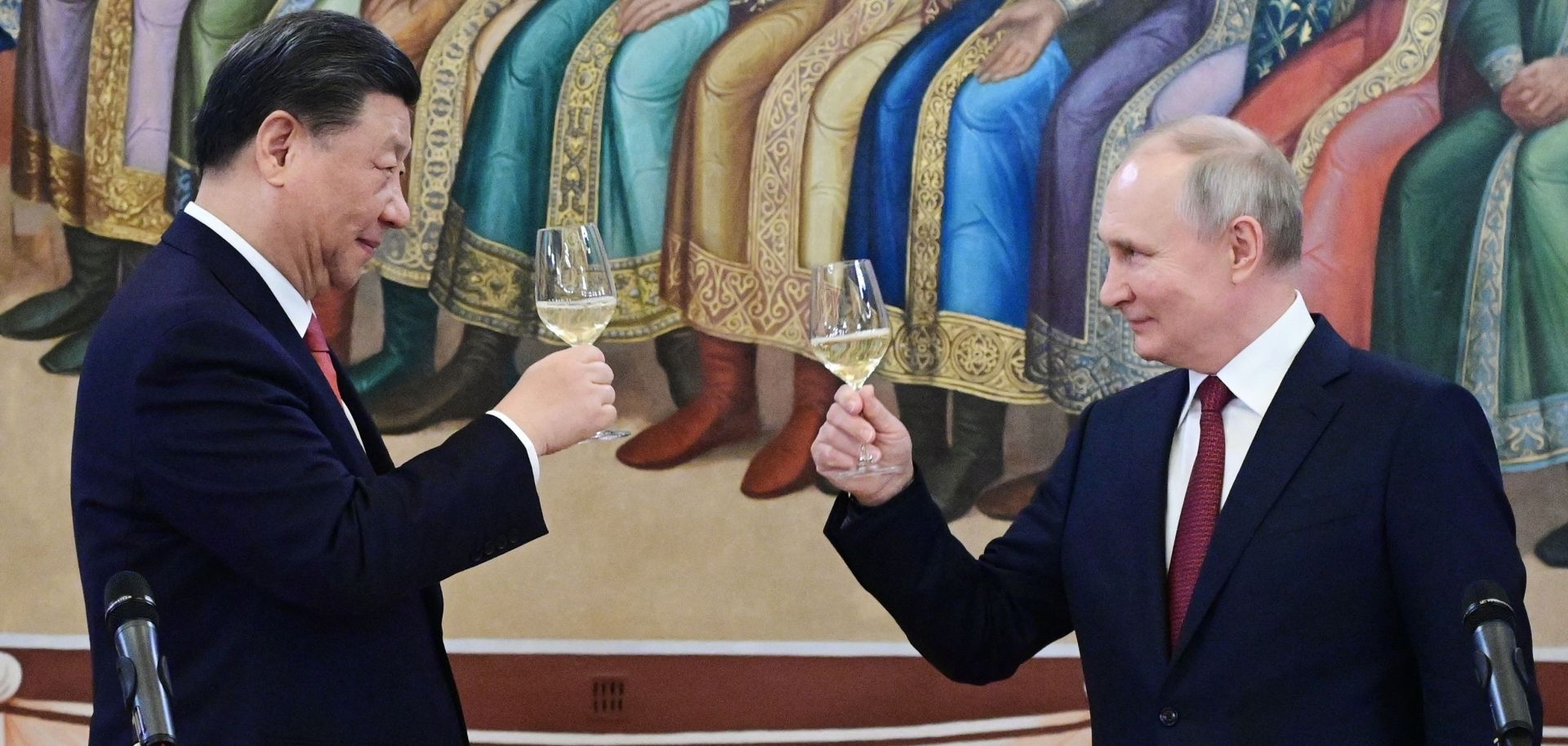
China will remain committed to its partnership with Russia after the paramilitary Wagner Group's uprising, and the incident will also lead Beijing to strengthen its efforts to prevent similar developments in China. After the private security company Wagner Group rebelled against the Russian military on June 23-24, a number of Russian partners, including Iran and Turkey, voiced their full support for President Vladimir Putin's regime. The statements released by China's Foreign Ministry and the official newspaper of the Chinese Communist Party's Central Committee seemed subdued by comparison, prompting international media to question the health of the Sino-Russian partnership. However, a lengthy border, reliance on mutual political stability, authoritarian governance models, anti-Western ideologies, Chinese President Xi Jinping's close personal relationship with Putin, and mutually beneficial energy deals will ensure that Beijing remains committed to Putin's continued leadership. Instead, China's mild response (in comparison to Russia's other partners) confirms Beijing's deep-seated fear of political overthrow, as well as its opposition to interference in the ''internal affairs'' of its partners.
- China's various statements and articles called the ''Wagner Incident'' Russia's internal affair and outlined China's support for Russia's national stability. They also reiterated Russia's claim that the ''enemies of China and Russia'' were behind the mutiny and that Western attempts to use this story to attack Russia were futile.
- The Chinese Communist Party views the fall of the Communist Party of the Soviet Union as a timeless cautionary tale for its own regime longevity. It is also ever watchful of Western-led overthrows of authoritarian systems and domestic rebellions weakening the central authority of governments, informed partly by history (e.g., the NATO-led bombing of Libya) and partly by Marxist theory on the predation of capitalist powers.
- Meanwhile, Beijing is sending all of the support signals it needs to Moscow in backroom meetings, with the Chinese Foreign Ministry saying as much in its press briefing on June 26.
If Putin were ousted, China would still be interested in keeping close ties with Russia, but the ideology of the new Russian leader would influence the scope and depth of the bilateral relationship. China's interest in Russia's stability means that Beijing will continue to support Putin, even if he conducts a bloody crackdown to restore his grip on power. In the low-likelihood, high-impact scenario in which Putin is ousted and a new government takes over, China would still be interested in keeping close ties with Russia, though it would probably take some time for Beijing and the new government in Moscow to return to their current levels of cooperation. The bilateral relationship would also depend on the ideology of the new Russian president, as an anti-China and/or pro-West Russian leader would push Beijing to recalibrate its relationships with Russia and the United States to ensure that it does not face two anti-China fronts. In the short term, this scenario could even convince Beijing to de-escalate its economic competition with the United States in order to balance the U.S.-China-Russia geopolitical triangle, although the long-term prospects of any new economic agreements between Washington and Beijing would still be in doubt. However, if a pro-China Russian nationalist comes to power, little would change in the China-Russia relationship; in fact, Beijing could increase its diplomatic engagement with Russia to establish the foundation of Xi's ties with the new leader, exacerbating Western fears of a Sino-Russian axis.
Domestically, the ''Wagner Incident'' will drive Beijing to continue its internal security- and national security-focused policy agenda, inhibiting creative solutions to Beijing's myriad economic issues and making it hard for China to reach a partial rapprochement with the United States. Beijing views internal political chaos in neighboring countries with an acute sense of dread. This has been the case in many regional political uprisings (including the January 2022 protests in Kazakhstan), to which Beijing has reliably responded with statements of support for the ruling regime and accusations of Western government-fueled ''color revolutions.'' Thus, the Wagner mutiny will confirm the Party's ongoing efforts to secure political and military loyalty within China. This will mean persisting low levels of trust for political dissenters and a focus on ideological and policy unity, creating minimal room for creative solutions to China's mounting economic problems, which include the ailing real estate sector and ongoing tech competition with the United States. Furthermore, the Wagner incident will bolster the Party's emphasis on national security in all policy spheres, such as its efforts to insulate supply chains from Western sanctions, root out threats of espionage (real or imagined), and enforce the Party's control over data sovereignty. These security-focused policies will reinforce U.S. and European ''de-risking'' strategies toward China in the realms of trade and investment, as well as Washington's commitment to economic restrictions on China — all done on the basis of Western national security concerns. They will also make it even less likely that China's nascent diplomatic talks with the United States yield any concrete agreement to limit strategic competition, whether along economic or military dimensions.
