
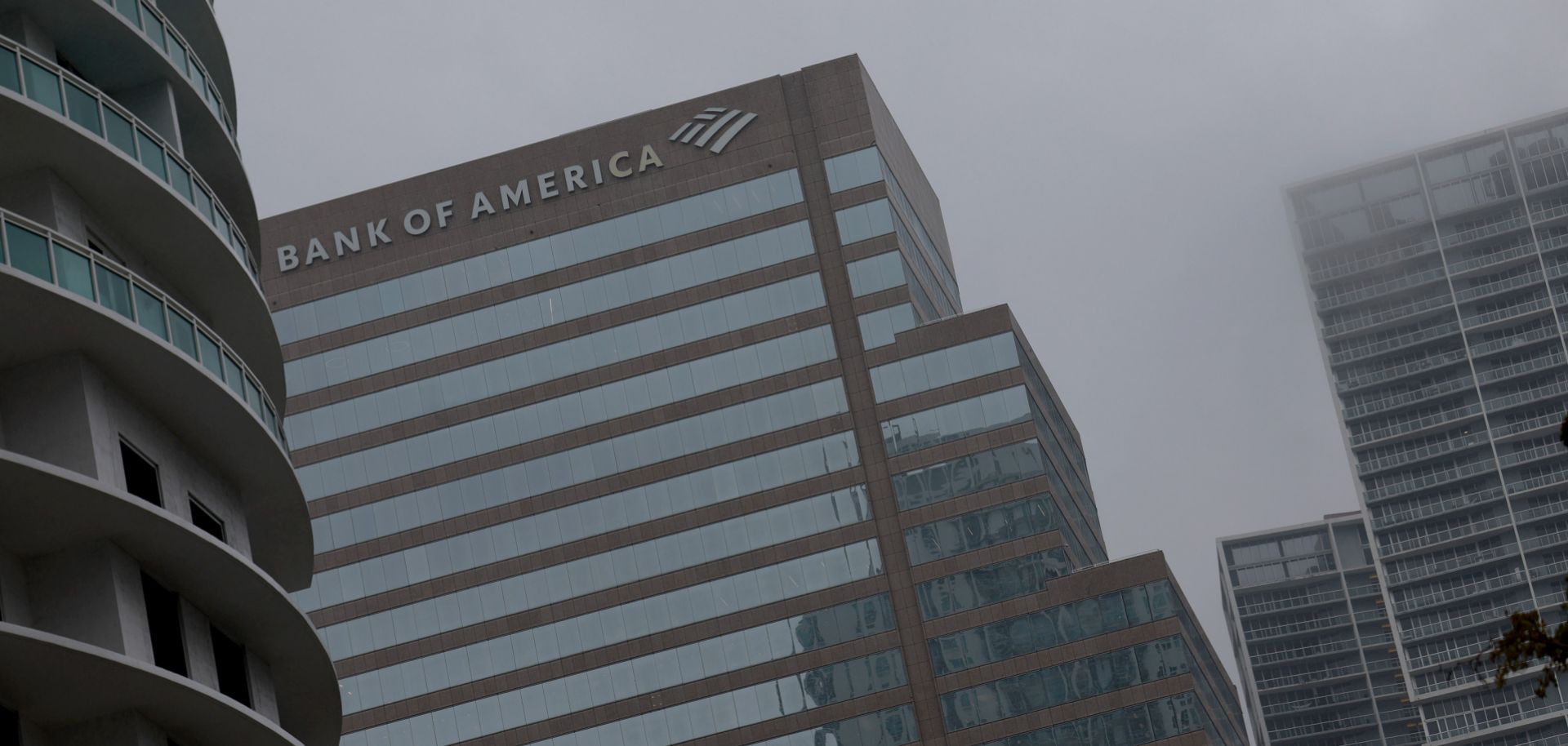
Buildings are seen on a rainy day in Miami, Florida, on April 10, 2023.
While tight global financial conditions and a deteriorating economic growth outlook are unlikely to get major U.S. banks into serious trouble, smaller and mid-sized banks face non-negligible risks connected to their exposure to commercial real estate portfolios. Global interest rates have risen substantially over the past year, leading to tighter financing conditions, falling asset values and greater investor risk aversion in the United States (and elsewhere). Sri Lanka and Ghana defaulted on their sovereign debt in May 2022 and December 2022, respectively. From late September through much of October, a massive uptick in volatility in U.K. government bond markets forced the Bank of England to intervene to avoid a larger crisis. The crypto exchange FTX collapsed in November. Two mid-sized U.S. banks (Silicon Valley Bank and Signature Bank) then collapsed in early March, prompting U.S. authorities to intervene forcefully and guarantee all deposits. And on March 19, authorities in Switzerland oversaw the merger of two global, systemically important financial institutions — Credit Suisse and UBS — to prevent a European (and possibly global) banking crisis. Moreover, several developing and emerging economies — most prominently Argentina, Egypt and Pakistan — are facing significant financial challenges, as evidenced by high inflation, foreign-exchange rationing and very high yields on their international debt. The World Bank and the International Monetary Fund estimate that a full third of developing economies, including 60% of low-income countries, either have unsustainable debts or are in danger of seeing their debt become unsustainable.
- The U.S. Federal Reserve has raised its main policy rate from 0-0.25% to 4.75-5% since March 2022.
- The European Central Bank has raised its main policy rate from -0.5% to 3% since July 2022.
After more than a decade of ultra-low interest rates, the tightening of global financial conditions has begun to expose financial vulnerabilities. Last month's collapse of Silicon Valley Bank (SVB) and Signature Bank was directly related to the sharp rise in U.S. interest rates. The Fed's policy lifted banks' deposit rates and hence financing costs. This forced SVB and Signature Bank to realize losses on the sale of long-term, fixed-rate assets and led to deposit outflows, precipitating their financial collapse. The financial problems in many low-income developing economies are also best explained by higher global and U.S. interest rates and higher financing costs in the context of prior excess borrowing and the COVID-related surge in government outlays. The broader problems faced by many crypto companies are at least in part related to higher interest rates, which make many speculative crypto investments less attractive. In some cases, such as the recent collapse of the FTX cryptocurrency exchange and hedge fund, the worsening financial climate exacerbated pre-existing issues. The volatility in U.K. government bond markets this past fall was also related to greater risk- and yield-seeking by pension funds in the context of very low interest rates, which subsequently led to financial instability once U.K. interest rates increased sharply. By contrast, the near-collapse of Switzerland's Credit Suisse last month was a consequence of declining profitability, mounting losses and a broader loss of confidence in the international investment bank.
The main financial risk over the next few months will be connected to small and mid-sized U.S. banks' exposure to commercial real estate and pressure on their deposit base. Unlike the developing market debt crisis of the early 1980s, a wave of defaults in low-income countries today would not risk causing a global banking crisis because international banks currently have very limited exposure to these countries. A systemic banking crisis similar to the 2008-2009 subprime crisis is also unlikely because large, systemically important U.S. and European banks (like JPMorgan, Chase and UBS, Credit Suisse) currently benefit from much higher capital and liquidity buffers than they did 15 years ago. A systemic banking crisis also appears improbable due to much better regulation and higher capital levels in both Europe and the United States. Finally, a sovereign crisis in any of the major advanced economies, similar to the eurozone crisis of the early 2010s, looks unlikely for now, judging by spreads on credit default swaps, long-term yields and debt dynamics. Moreover, surprise inflation has helped reduce debt levels, if perhaps only temporarily. In fact, the main concern in the short-to-medium term stems from U.S. banks' exposure to commercial real estate, which will come under pressure amid falling asset values, slowed economic growth, and reduced lending by liquidity-constrained banks. Once again, this will prove particularly challenging for small and mid-sized U.S. banks, which are much more dependent on this type of lending compared with larger financial institutions. Large U.S. banks also benefit from substantial fee-related income. Second- and third-tier U.S. banks will thus be most at risk.
- Commercial real estate prices in the United States are coming under pressure, which will reduce the value of loan collateral. U.S. office vacancy rates are high at close to 20%, compared with less than 7% in Europe, according to the Financial Times.
If U.S. mid-sized and small banks incur major losses on their commercial real estate portfolios, while liquidity constraints reduce lending to the sector, weakened capitalization levels may then reduce these banks' willingness and ability to extend credit, which would weigh on U.S. economic growth. If significant financial distress emerges in the banking sector, the U.S. Treasury and the Fed may intervene just enough to prevent a broader crisis. But because of political constraints, U.S. financial regulators may not do enough to fix the financial damage quickly. Beyond the imminent risk of a broader banking crisis, ongoing instability could thus weigh on the United States' medium-term economic outlook by leading banks to reduce credit to the real economy. Similar to Japan in the 1990s, weakened U.S. banks may also prefer to roll over doubtful loans, thereby creating so-called zombie companies (or companies that are effectively unable to service their debt and do not generate economic growth), which will translate into a misallocation of capital and lower economic growth. If this happens, the U.S. government would then need to intervene and force banks to clean up their balance sheets and recapitalize in order to strengthen their ability to extend credit and finance economic growth. Again, this would mostly be an issue for small and mid-sized regional banks. Using Japan's experience as guidance, U.S. authorities will be eager to act in a forward-looking way to avoid the emergence of systemically undercapitalized small and mid-sized banks. But politically, the Fed and the Treasury's hands may be tied due to gridlock in Congress, which may limit the speed with which they will be able to address a weakened banking sector.
