
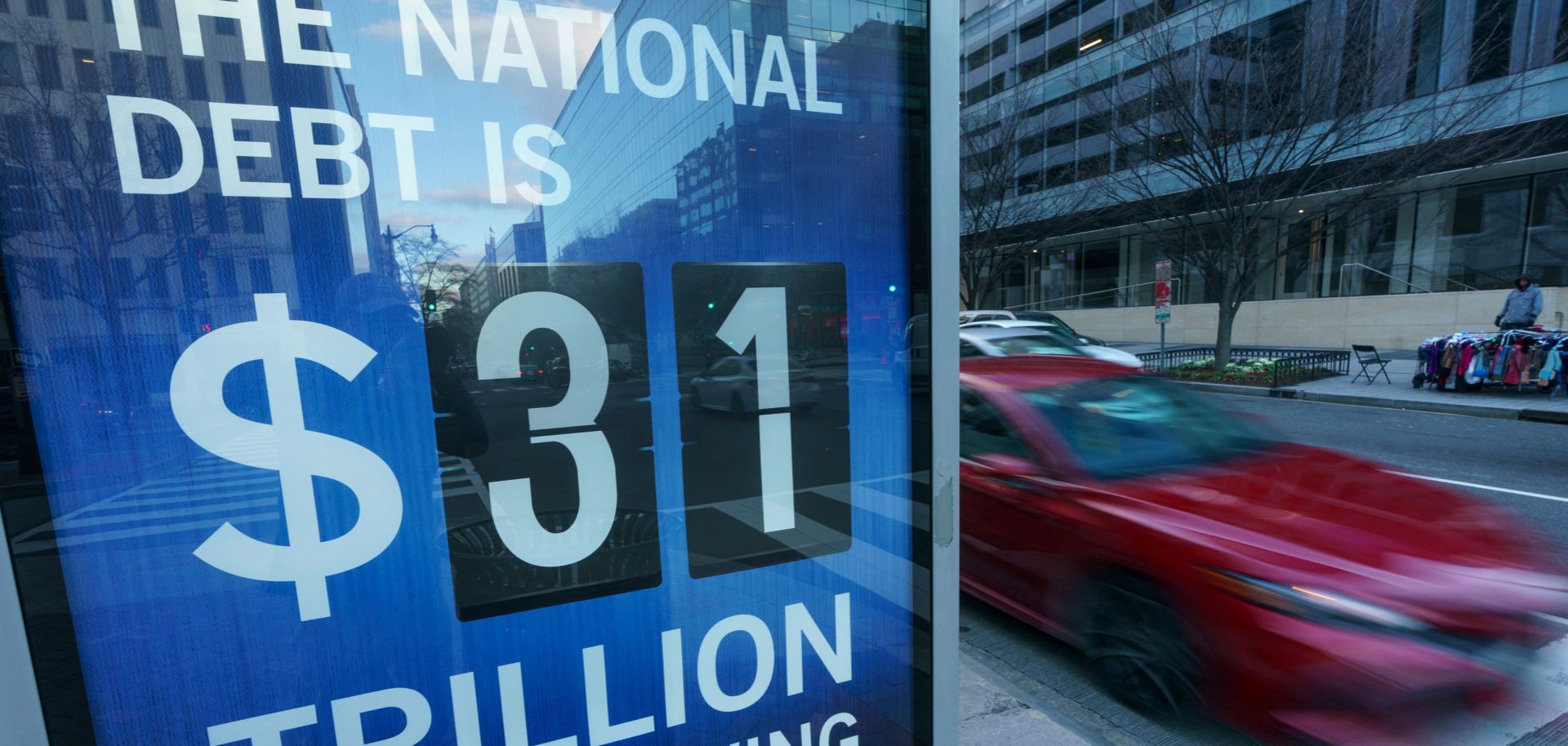
A sign at a bus shelter shows the national debt in Washington, D.C., on Jan. 20, 2023.
If the U.S. government fails to raise its debt ceiling in a timely manner, economic and financial uncertainty will increase, raising the specter of a U.S. debt default that could trigger a recession. After registering a deficit of $1.4 trillion in the fiscal year 2022, the U.S. federal government on Jan. 19 reached its debt ceiling, which establishes the maximum amount of debt the federal government is allowed to issue. The Treasury Department subsequently began to take so-called extraordinary measures, including the sale of existing investments and the suspension of reinvestments of various government-related pension funds, such as the Exchange Stabilization Fund, as well as the suspension of the Treasury's issuance of State and Local Government Series securities, which help state and local governments comply with federal tax laws and IRS regulations. The Treasury estimates that these measures will keep the government from breaking through its debt ceiling until June, but the Treasury's tendency to err on the side of caution means that its funds will likely last until the end of the third quarter of 2023, depending on the evolution of tax receipts. However, market nervousness will increase as the Treasury's June deadline approaches, especially if the government does not look close to raising the debt ceiling.
The U.S. government will struggle to raise the debt ceiling, increasing the risk of potentially severe financial instability. In the coming months, political debate in the United States will center around ways to raise the debt ceiling and prevent the federal government from running out of money to service federal debt, which would lead to a debt default. However, an ongoing standoff between Republicans in the House of Representatives, who are demanding significant spending cuts in exchange for lifting the debt ceiling, and the White House, which refuses to accept any conditions related to these efforts, will make it difficult for the government to reach its goals. Compounding the issue, the new speaker of the House of Representatives, Kevin McCarthy, has promised to support Republican demands for spending cuts, as he must appease the Freedom Caucus and right-wing conservatives who facilitated his election at the beginning of January. And even if McCarthy decides to push for a compromise with the White House, his weak position in the House of Representatives (due to concessions to right-wing lawmakers) and Republicans' small majority in the House mean his efforts might be ineffective.
- McCarthy was forced to offer three seats on the House Rules Committee — which decides what legislation advances to the House floor, what structure a debate takes and what amendments are admissible — to members of the Freedom Caucus and other very conservative members of his delegation. If the three conservatives on the committee join up with Democrats, they can effectively block bills from reaching the floor. Moreover, McCarthy had to agree to a change of rules that makes it easier for the House to unseat the speaker, weakening his ability to keep Republicans in line and push through legislation.
- There are congressional maneuvers that might enable centrists on both sides of the aisle to get around the House Rules Committee, such as the "discharge petition." But this is typically a lengthy and complicated process that may come too late in the midst of a fast-approaching financial meltdown.
- More speculatively, right-wing House Republicans will look at the 2011 standoff, which led the Obama administration (under which current President Joe Biden was vice president) to agree to spending cuts, and conclude that playing hardball with the Biden administration may succeed. However, Biden may view the 2011 compromise as a mistake that his administration will not repeat.
The Treasury may resort to legally gray actions to avert a default if it exhausts extraordinary measures before Congress raises the debt ceiling. Once the Treasury runs out of sufficient cash to meet all its payments, it could seek to prioritize principal and interest payments by withholding other mandatory payments, such as social security and public sector salaries. However, this would create a drag on economic demand, as well as lead to increased risk aversion and financial market volatility. The Treasury could also try to mint a $1 trillion coin, deposit it with the Treasury, and ask the Treasury to use it to pay government obligations, which would be legally questionable. Additionally, some legal scholars have suggested that the 14th amendment, which states that "(t)he validity of the public debt of the United States authorized by law (...) shall not be questioned," may provide a legal basis for the Treasury to simply ignore the debt ceiling altogether. All these executive maneuvers would be legally gray and subject to court challenges, and they would do little to calm markets unless investors believe the Treasury is simply buying the House of Representatives and the White House time to settle the debt ceiling dispute. Therefore, these emergency measures could fail to stave off a financial crisis and concomitant economic downturn.
However, the Federal Reserve has various options to limit the fallout if there is a technical default. To counter the risk of a broader destabilization of the financial system, the Fed could allow banks to count defaulted debt toward their capital requirements, be lenient toward banks that experience a temporary drop in their regulatory capital ratios, and direct banks to give distressed customers leeway regarding their credit. The Federal Reserve could also buy defaulted debt (limiting the direct impact of a default on financial institutions), lend against defaulted debt, and/or enter into repurchase agreements with banks and selected non-financial institutions (especially money market funds) to limit the fallout in terms of financial losses and defaults. However, these moves may not help stave off a systemic meltdown, and much will depend on whether markets believe a default would be remedied quickly, as well as whether investors believe such legally questionable intervention will survive legal challenges.
- The Federal Reserve is already raising interest rates and introducing quantitative tightening. These measures are increasing concerns about financial stability and the fragility of the U.S. treasury market (which seized up twice in the past five years), further increasing the risk of financial distress.
A U.S. debt default would risk pushing financial markets into a potentially major crisis and the economy into recession. If the government misses a payment on its debt, it would lead to a sharp increase in risk aversion in U.S. and global financial markets and a selloff of risk assets (such as equities, high-yield corporate debt and leveraged loans), and it might lead to a significant reduction in bank lending and credit in the economy. A default would also force $1.5 trillion in spending cuts this year and $14 trillion in spending cuts over the next decade, according to the Congressional Budget Office. Such a massive reduction in spending would push the economy into a major recession, and some estimates have the United States' output loss at minus 5% and job losses at 3 million. A default would also destabilize global financial markets in the short term, and it would boost the longer-term prospects of other international currencies, including the euro and the yuan.
