
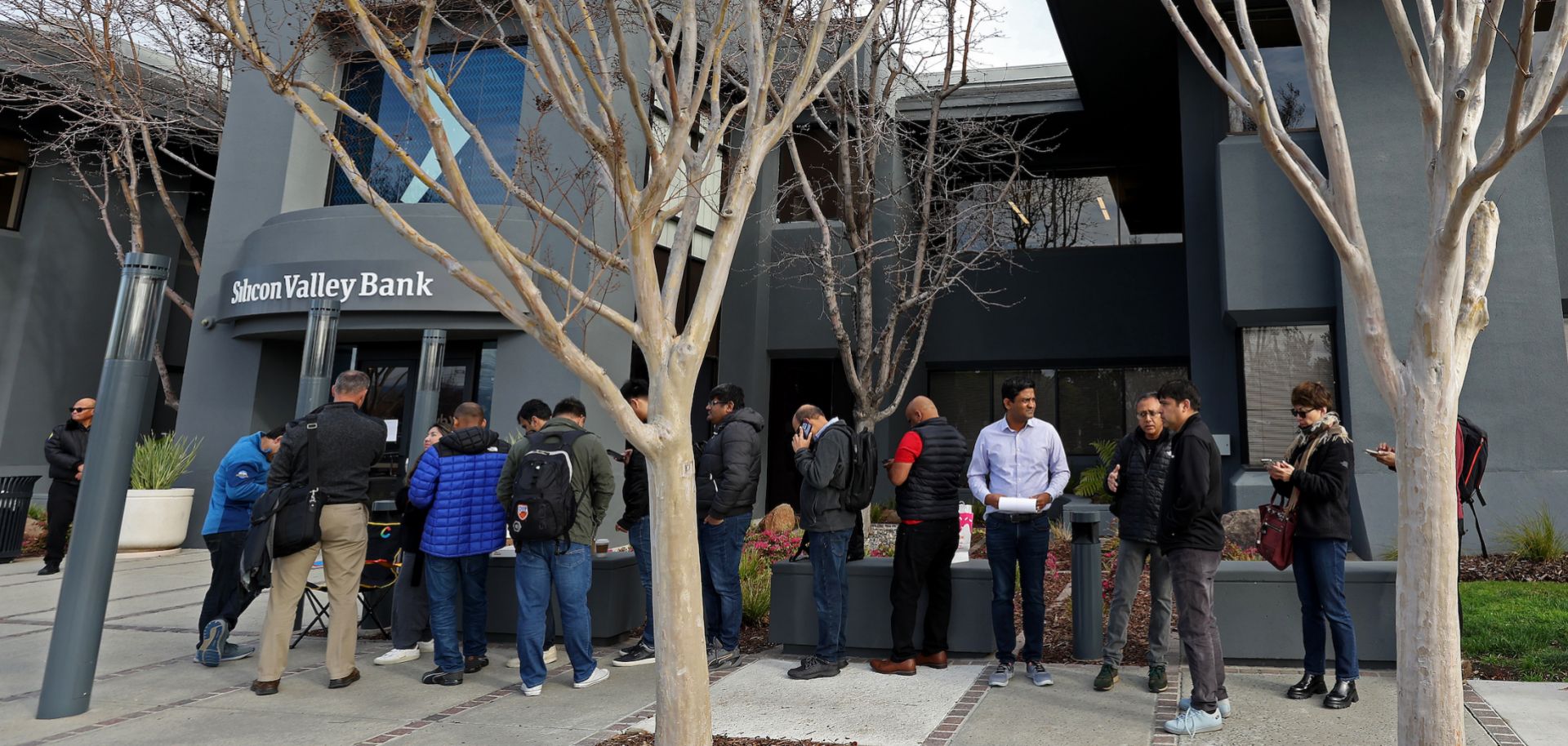
People seeking to retrieve their funds from the failed Silicon Valley Bank line up outside of the bank's offices in Santa Clara, California, on March 13, 2023.
In the United States, authorities' forceful and preemptive intervention after the failure of two prominent banks significantly reduces the risk of a broader destabilization of the U.S. banking and financial system. Since March 10, the U.S. Federal Deposit Insurance Corporation (FDIC) and state regulators have taken over California-based Silicon Valley Bank (SVB) and New York-based Signature Bank. Authorities have also taken additional measures to prevent a broader run on bank deposits following SVB and Signature Bank's failures, which were the second- and third-largest bank failures in U.S. history, respectively. This included invoking a systemic risk clause that allowed U.S. authorities to guarantee all deposits in the two banks beyond the regular $250,000 insurance cap guaranteed by the FDIC, which was meant to soften the impact of the bank failures on the U.S. economy and signal to those with deposits in other banks that their funds were safe. To ease funding pressure and prevent broader financial contagion, the U.S. Federal Reserve also established a new lending facility that provides banks access to liquidity against eligible collateral, but without the need to take a haircut.
- Other mid-sized U.S. regional banks have also come under pressure over concerns about rising financial losses, but so far no other banks have turned insolvent. Meanwhile, large, systemically important U.S. banks (like JPMorgan, Chase and Bank of America) have seen their share prices drop in the wake of the SVB collapse, though much more modestly than mid-sized banks — reflecting concerns about future financial profitability, rather than concerns about solvency or liquidity risk.
The SVB and Signature Bank failures were the result of the banks taking advantage of previous ultra-low interest rates to load up their balance sheets with large amounts of long-term, fixed-rate assets in a search for yield — a strategy that has begun to cause financial losses in the context of the Fed's recent interest rate hikes, which has increased funding costs, and deposit withdrawals. The Fed's monetary tightening over the past year has finally begun to expose financial vulnerabilities. The U.S. central bank kept interest rates at historic lows following the 2008 global financial crisis, and then slashed those rates even further between March 2020 and March 2022 to counteract the economic fallout from the COVID-19 pandemic. During this period, U.S. banks like SVB benefited from huge tech-related deposit inflows and decided to invest a large share of these inflows into long-term, fixed-rate bonds. But that strategy unraveled once the Fed began hiking interest rates last year to combat rising inflation. The combination of higher interest rates and increased deposit outflows forced SVB to sell its long-term assets at a loss. This, in turn, led to solvency concerns and a run on deposits, as SVB clients scrambled to withdraw their funds for fear of financial losses if the bank folded. Surprised by SVB's sudden unraveling over the weekend, investors began taking a closer look at the balance sheets of other U.S. banks. And in doing so, they found that other mid-sized U.S. banks may have also taken on excessive financial risks during the pandemic-era period of ultralow interest rates, thus prompting the sell-offs of their stocks in recent days. But investors also found that the United States' larger, systemically important banks are not at significant risk, as they are more diversified, sit on more (insured) retail deposits, have greater access to wholesale funding, and have structured the asset side of their balance sheet more intelligently compared with their mid-sized counterparts — explaining why the recent sell-off of large banks' stocks have been much more modest.
- Only 3% of SVB's deposits were $250,000 or less, meaning most of its deposits were uninsured. SVB also held 55% of its assets in securities, far higher than any other U.S. bank.
- Compared with mid-sized banks, large U.S. banks hold far fewer of their assets in securities. A far larger share of their deposits is also insured. Bank of America, for example, holds 28% of its assets in securities and only 33% of its deposits are uninsured.
More mid-sized U.S. banks may face financial difficulties, but a broader systemic banking crisis is unlikely since larger U.S. banks have much stronger balance sheets than their mid-sized peers and authorities are taking multiple steps to prevent contagion. A broader run on deposits could create a domino effect by leading to further bank failures, which in turn could lead to even more bank failures — impacting the willingness of U.S. banks to extend credit in an attempt to maintain sufficiently large liquidity buffers. This is precisely why it is crucial to intervene early and decisively at the beginning of any potential banking or financial crisis, which is largely what U.S. authorities have done so far in response to the SVB collapse. If more banks are faced with unmanageable deposit outflows, President Joe Biden and other top officials have indicated the U.S. government will intervene to prevent broader panic among depositors. Moreover, the larger U.S. banks are well-positioned to take over smaller banks that may get into trouble. This means the system-wide fallout should be manageable, even in the likely case that more mid-sized banks' balance sheets come under increased pressure in the coming days and weeks. The banking wobbles will also likely prompt the Fed — and potentially its EU counterpart, the European Central Bank (ECB) — to ease up on monetary tightening during the remainder of the first half of the year, and may even lead the Fed to cut interest rates at some point during the second half of the year, which should help alleviate concerns about a further decline in the value of bank assets (which tend to fall as interest rates rise). Taken together, all of this suggests that the risk of a systemic banking crisis in the United States remains manageable — not least because, unlike the 2008 financial crisis, the systemically important banks remain in relatively good shape this time.
- Prior to the bank failures, the Fed was expected to raise interest rates by another 50 basis points next week to combat stubbornly high inflation, but the U.S. central bank will now likely either leave rates on hold or raise them by only 25 basis points at its next meeting this month. The ECB will likely still raise rates by 50 basis points this week, though it may now soften its guidance and leave the open door for a 25 basis point rise before mid-year (instead of the 50 basis point hike it was initially expected to signal).
- On March 14, Moody's Investors Service downgraded its outlook for the U.S. banking sector to ''negative'' amid the fallout from the deposit runs at SVB and Signature Bank. But this reassessment does not necessarily indicate future trouble, given that Moody's and other rating agencies' views are generally backward-looking.
- As of the close of trading on March 14, the Dow Jones U.S. Banks Index had fallen approximately 15% since March 6. JPMorgan — a proxy for large, systemically important U.S. banks — is down a little more than 6% in the same timeframe, while a proxy measure of the value of mid-sized U.S. regional banks (SPDR S&P Regional Banking ETF) has experienced a 22% decline.
