
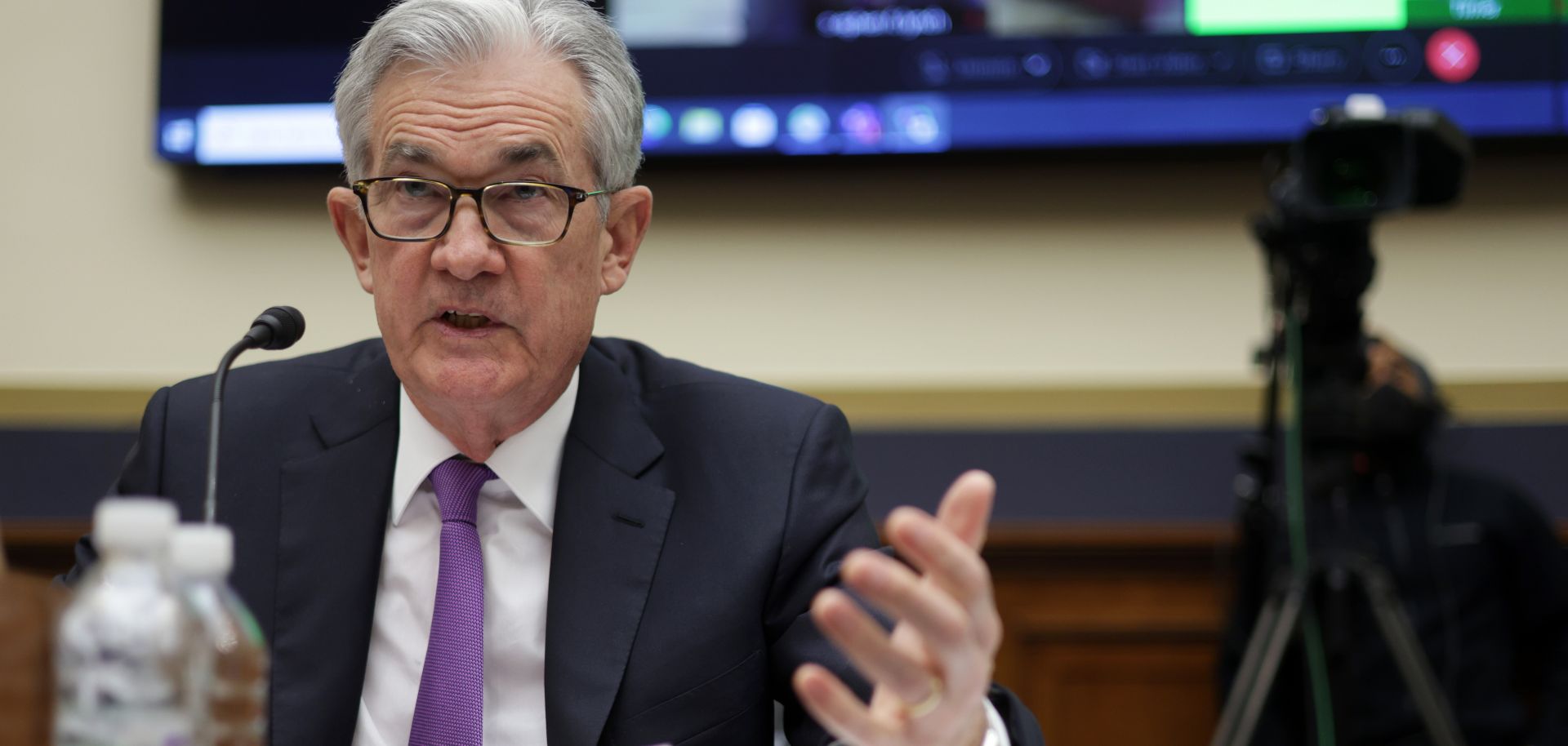
Federal Reserve Chairman Jerome Powell listens to lawmakers during a House Financial Services Committee hearing on Capitol Hill in Washington on Dec. 1, 2021.
The U.S. Federal Reserve’s announcement that reducing inflation is now more pressing than reducing unemployment suggests the central bank will probably accelerate its winding down of asset purchases, increasing the probability of interest rate hikes in 2022 that would slow the U.S. economy and tighten financial conditions globally. Fed Chairman Jerome Powell told the Senate Banking Committee on Nov. 30 and the House Financial Services Committee on Dec. 1 that the mandate on inflation now took precedence over the mandate on employment. The announcement came ahead of the Dec. 14-15 meeting of the Federal Open Market Committee (FOMC). Powell would probably not have indicated the shift and acceleration of a wind-down of the Fed’s asset-purchasing program (known as quantitative easing, or QE) unless he already had broad support within the FOMC.
- There were no dissents among the 11 FOMC voting members when it announced a scaling back of QE on Nov. 3. Several have since indicated support for accelerating the pace of a wind-down, including Vice Chairman Richard Clarida and two current voting regional Fed presidents.
- The Fed is under increasing pressure to control inflation with lawmakers on both sides of the aisle urging in congressional oversight committees for finishing the taper early by the end of March or April.
Scaling back the Fed’s asset-purchasing program is not a tightening of monetary policy but a diminution of monetary policy accommodation, which has maintained substantial liquidity in the U.S. and global economies. The winding down of QE could enable the Fed to increase its main policy interest rate, the federal funds rate (which is currently 0-0.25%), as early as the spring of 2022, if necessary. Real interest rates, however, will still be negative as long as inflation exceeds the nominal rate with continued monetary stimulus to the economy. It could also still be some time before interest rates reach the so-called “neutral” level that supports the U.S. economy at full employment/maximum output while keeping inflation constant.
- The Fed will roll over maturing securities it owns and not reduce the size of its balance sheet, which exceeds $8.7 trillion and is directly tied to the size of the money supply. The balance sheet has more than doubled in size since March 2020 when the COVID-19 pandemic was declared, growing at $120 billion per month from purchases of U.S. Treasury securities ($80 billion) and mortgage-backed securities ($40 billion).
- The Fed has said repeatedly that an end to QE was a prerequisite to raising interest rates to avoid a policy conflict.
The Fed is unlikely to change course in response to a few new data points, though unexpected bad news on employment or reductions in inflation could derail an accelerated taper. While It is still too early to assess the economic impact of the new omicron variant of COVID-19 discovered in Africa, there is now widespread recognition it could worsen the supply-chain bottlenecks that are driving up prices. The U.S. labor market, meanwhile, is already tight and increasing demand for goods is unlikely to have immediate effects on increasing employment, although it would add to wage pressures. The other major risk is a failure by Congress to increase the federal debt ceiling, which could panic the U.S. Treasury securities market (the largest financial market in the world) and require the Fed to provide additional emergency liquidity to the economy. Congressional leaders may agree on a temporary extension of the debt ceiling, but this would still leave open the potential for political gridlock continuing to delay a permanent fix.
- While the U.S. Labor Department’s monthly payrolls report released on Dec. 3 showed a smaller-than-expected increase in the number of jobs in the U.S. economy, it was mainly due to labor shortages and a drop in the unemployment rate. The November consumer price index (CPI), which is scheduled to be released on Dec. 10, will likely also be insufficient to change what the Fed now sees as the current economic trend. The Fed’s preferred inflation measure, the Index of Personal Consumption Expenditures (PCE) increased by 5% in October (the latest reading).
- The Fed’s “Beige Book” of anecdotal evidence of economic conditions from all 12 regional Fed districts, released Dec. 1, showed supply-chain and labor shortages slowing growth but maintained an overall positive economic outlook, with strong demand allowing businesses to pass on “moderate to robust” price increases.
Over the longer term, the Fed is demonstrating new flexibility in responding quickly to economic circumstances that could burnish its credibility as an economic risk manager. Signaling accelerated tapering less than a month after the original schedule was announced was a bold move. It was also somewhat out of character for the Fed — a slow-moving, consensus-driven central bank that has pushed a story of temporary, slight increases in inflation for most of the past year.
- Unlike in the case of the 2013 QE tapering, the Fed seems to have avoided a market “tantrum” in which interest rates increase precipitously over a very short period. The Fed’s easy-money policies, while supporting the economy with liquidity, have effectively underwritten elevated asset prices (especially for equities), with the Fed as the buyer of last resort.
- By abandoning the word “transitory” to describe inflation trends, the Fed now recognizes a failure to account for supply-side constraints from the pandemic while demand was maintained through an estimated $14 trillion in fiscal support over 2020-2021 and $4 trillion in monetary actions.
- The Fed was in danger of falling behind the inflation curve since monetary policy takes 12-18 months to have real effects and potential wage-price spirals are difficult to stop. Reducing the amount of money stimulus should reduce those inflationary pressures. The Fed has bought some time, even as there will be renewed fears of the Fed acting too harshly and choking off the recovery.
