
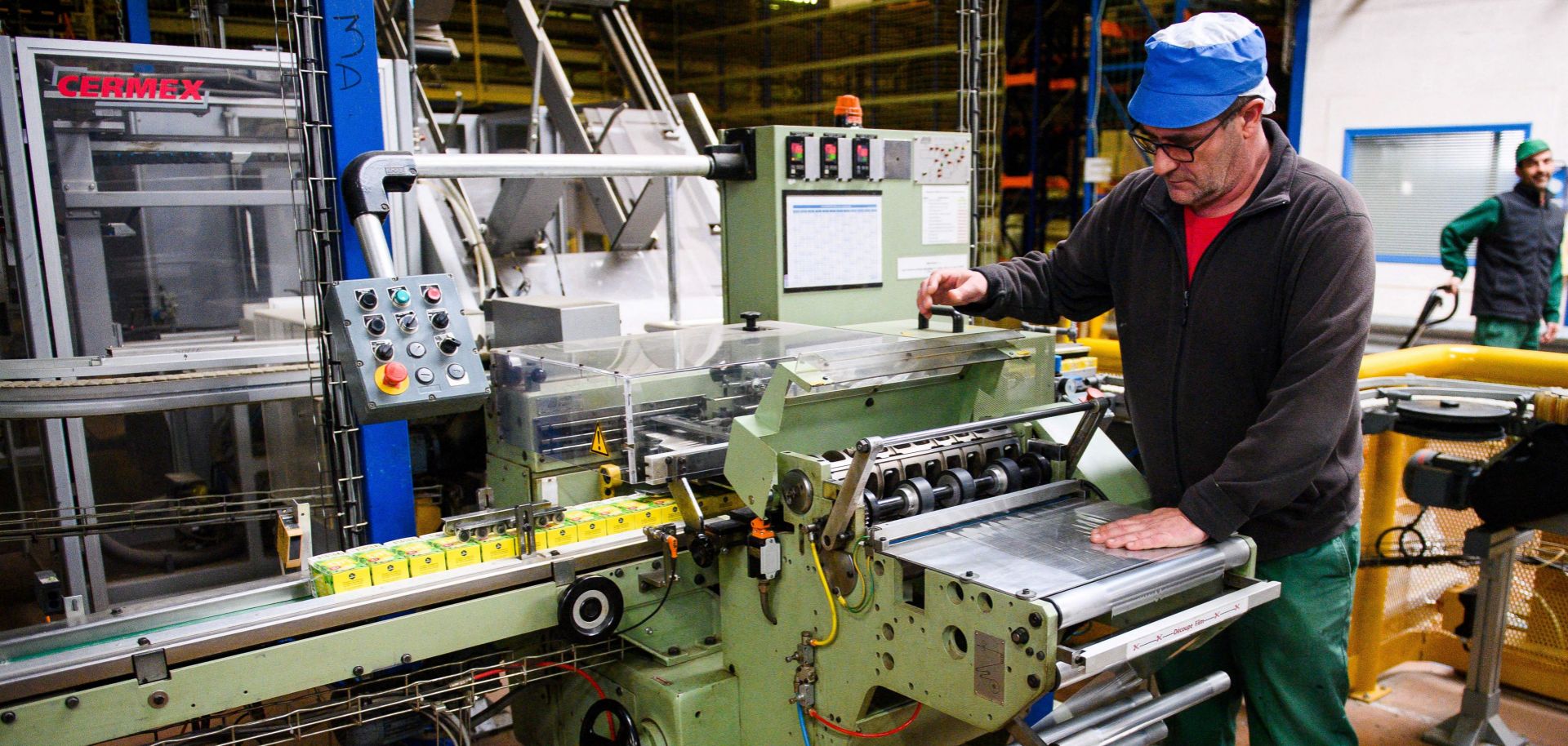
A worker from the Scop-Ti tea cooperative uses a machine to assemble tea boxes at a factory in Gemenos, southeastern France, on Jan. 4, 2023.
A tight labor market will mitigate the social impact of the eurozone's economic downturn in the first half of 2023 but may limit the currency area's recovery in the second half. Despite the economic shocks brought on by the war in Ukraine throughout 2022, labor markets across the eurozone remain exceptionally tight. Unemployment has remained stable or has fallen in most eurozone countries throughout 2022, and is currently very low across all major economies in the monetary union including Italy, France, Spain, and Germany. The jobless rate in the eurozone hit a record low of 6.5% in October, with employment rising despite sluggish growth and a downturn in global business activity in the last quarter of 2022 and a looming recession for the first quarter of 2023. Data from the S&P Global purchasing managers index (PMI) published on Jan. 2 showed that even manufacturing companies in the region continued hiring in December, despite contracting output. Overall, labor shortages have reached a near-record high in the eurozone, where about 30% of businesses have struggled to fill vacancies during the last quarter of 2022. While slowing, continued hiring amid a deteriorating economic environment starkly contrasts previous economic downturns in the currency area.
- In France, net job creation remained high in 2022 and the unemployment rate fell to a historic low of 7.3% in the third quarter of the year, according to the country's statistical body INSEE.
- In Italy, the number of unemployed people dropped below the 2 million mark for the first time since 2011 in the third quarter of 2022, with the seasonally adjusted unemployment rate dropping to 7.9%, according to the national statistics agency ISTAT.
- In Spain, the number of jobless people fell by 1.52% in December from the previous month — reaching the lowest rate since 2007, with 2.84 million people now out of work according to data from the Labour Ministry published Jan. 3. However, hiring slowed significantly in December after November's record high job creation, according to figures from the country's Social Security Ministry.
- In Germany, unemployment fell slightly in December against expectations, with the seasonally adjusted rate remaining stable at 5.5%, according to data from the country's Federal Labour Office published on Jan. 3. Figures from the Federal Statistical Office (Destatis) published on Jan. 2 also show employment in Germany was at the highest level in 2022 since the country's unification in 1990, with roughly 45.6 million persons employed throughout the past year.
- The European Commission's latest economic forecast published in November 2022 sees the eurozone and most of the bloc's member states experiencing a contraction in economic activity in the last quarter of 2022 and first quarter of 2023, with GDP growth for the whole region reaching only 0.3% in 2023.
Lingering COVID-related mismatches between supply and demand, along with companies' expectations for a relatively short-lived recession in 2023, will keep labor markets in the eurozone unusually robust throughout the next year. A combination of factors can explain the apparent disconnect between the overall eurozone economy and the resilience of the region's labor market. One key driver for such unusually strong employment compared with previous downturns may be the reluctance among companies to let workers go in light of the challenges many have experienced in rehiring during the post-pandemic recovery. The assumption that this specific downturn will be relatively short-lived is also contributing to convincing businesses to retain staff. This is particularly true in the eurozone, where the recession is linked to the region's energy crisis and where companies may expect a rebound after the winter as Europe's energy crisis eases. But current labor shortages are also due to mismatches between supply and demand largely brought on by the COVID-19 pandemic, which impeded workers' ability to relocate for in-demand jobs by disrupting intra-EU cross-border mobility. Many people who lost (or left) their jobs during COVID-19 have also since changed their careers or have remained out of the workforce altogether.
- The eurozone's labor market remains solid despite losses in energy-intensive manufacturing, where several companies have announced job cuts and large-scale restructurings as a result of increased energy costs.
- Mismatches in the labor market are caused by uneven trends in job creation over the course of the pandemic, which saw increased hiring in sectors like healthcare and IT, along with layoffs in sectors like arts and recreation, retail and hospitality. Since COVID-19, more people have switched careers to less affected sectors. This has created gaps in the labor market as the hardest-hit sectors are now starting to hire again.
- The eurozone's active population (i.e. employed and unemployed persons that are able to work) has shrunk by 0.7% since the end of 2019, according to Eurostat. The decline is mostly among people aged 25-54, which saw a 1.8% drop compared with the fourth quarter of 2019. The number of older people (over the age of 54) in the labor market has actually increased over the past three years, which suggests that many Europeans are also delaying retirement amid the continent's cost of living crisis.
Low unemployment in 2023 will mitigate the social fallout from the eurozone's looming recession, but continued labor shortages and wage hikes will also impede the post-downturn economic recovery in the second half of the year by driving up inflation and pressuring the European Central Bank (ECB) to keep hiking interest rates. Some European countries will start seeing limited increases in unemployment in the coming months, as hiring intentions among European businesses have started to fall in light of this winter's expected economic contraction. But overall, labor markets in the eurozone will remain unusually robust throughout 2023, as businesses will seek to preserve their workforce to avoid shortages once the downturn ends. This will reduce the social implications of the eurozone's upcoming downturn, as fewer people will lose their jobs compared with previous economic contractions. However, this also suggests labor shortages will remain a key factor limiting production and, consequently, a drag on the post-downturn recovery in the second half of 2023. Secondly, a tight labor market increases fears of high wage growth that would add to inflationary pressures in the eurozone as companies increase salaries to compensate workers for soaring prices, and as labor shortages grant unions more leverage to secure higher wage deals. Headline inflation in the currency area has started to decline in recent months amid easing supply chain bottlenecks and falling energy prices. But core inflation (which reflects underlying price pressures more closely by not taking energy and food prices into account) is expected to remain at the current high level of 5%. The ECB is thus likely to announce more significant interest rate hikes throughout 2023, despite the risk of prolonging the eurozone's recession. Finally, a robust labor market despite the dramatic slowdown in economic activity suggests labor shortages could become more structural and remain an issue in the coming years — particularly in light of emerging demographic challenges as Europe's aging and shrinking active population could have long-term effects.
- By exacerbating the eurozone's inflation crisis, wage growth as a result of tight labor market conditions could prompt the ECB to further increase interest rates. During the bank's latest meeting in December, ECB President Christine Lagarde said that wages across the currency area would continue to increase on the back of robust labor markets, keeping inflation above the ECB's target until at least 2025.
- In a Jan. 9 article published in the bank's Economic Bulletin, the ECB said it expects historically ''very strong'' wage growth in the coming quarters, building up the case for more rate hikes throughout 2023. The article specifically called out ''robust labor markets that so far haven't been substantially affected by the slowing of the economy,'' along with ''increases in national minimum wages and some catch-up between wages and high rates of inflation.''
- Markets are currently pricing in a 50 basis points hike from the ECB in February, which would add to the benchmark deposit rate currently set at 2% following the large hikes the bank has enacted since June in response to skyrocketing inflation (which slowed to 9.2% in December, down from 10.1 % in November and after reaching a record-high 10.6 % in October).
