
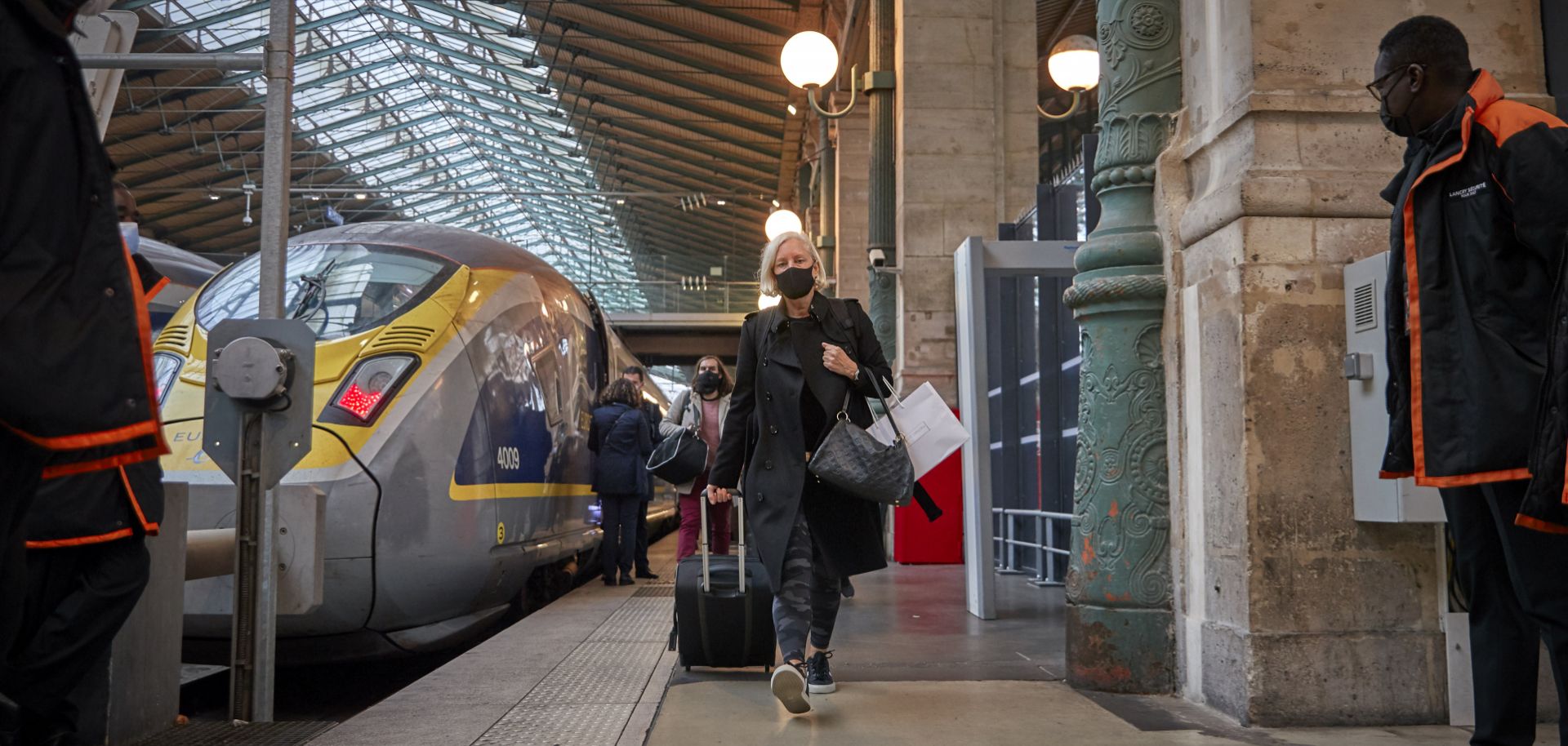
Passengers from London arrive at a Eurostar terminal in Paris on Dec. 16, 2021, shortly before France restricted travel to and from the United Kingdom in response to the omicron variant of COVID-19.
A new wave of travel restrictions and stricter social distancing rules in Europe will increase uncertainty for the services sector, further slow down economic growth and prompt governments to reintroduce economic support measures. In recent days, several European countries have introduced additional travel restrictions and stricter social distancing measures in order to contain the spread of the omicron variant of COVID-19. While in most cases these measures are not as strict as in previous phases of the pandemic, they are happening at a time when Europe’s economy is slowing down due to issues including supply chain disruptions, rising energy costs and labor shortages. This means that, even if not as intense as restrictions seen in 2020, they could still have a significant economic and societal impact.
- On Dec. 14, Italy announced that people entering the country will need to present a negative PCR test, even if they have been inoculated with EU-recognized vaccines. Greece announced the same measure on Dec. 15. Both decisions go against an unofficial EU agreement to allow vaccinated EU citizens to travel hassle-free within the continental bloc. On Dec. 16, France suspended all non-essential travel to and from the United Kingdom, as Britain is facing an acceleration of omicron cases.
- In recent weeks, most EU member states have tightened restrictions for the unvaccinated in an attempt to convince them to get a jab. The United Kingdom, meanwhile, on Dec. 8 introduced COVID-19 passes showing proof of vaccination or a recent negative test to access many indoor spaces, mirroring efforts seen in many EU member states.
- While most of the latest restrictions in Europe particularly target the unvaccinated, broader restrictions that affect wider society cannot be ruled out if infections continue to rise. In fact, Austria introduced a temporary lockdown for the entire population between late November and early December.
The impact of these measures will be particularly negative for the tourism and hospitality sectors, as governments will seek to prioritize the protection of manufacturing and supply chains that are seen as more essential. So far, most of the stricter travel and mobility restrictions imposed by European governments have affected “non-essential” activities (such as tourism and business travel) and not freight or trade in an effort to minimize the impact on supply chains, manufacturing and exports. This trend is likely to continue as governments do not want to repeat the deep economic recessions of 2020. But increased uncertainty about travel and mobility is likely to still have a negative economic impact during the crucial holiday season, when international travel and domestic consumption tend to peak. Moreover, the fact that lockdown and travel restriction decisions are decided at the national level and with little coordination with other countries means that households and businesses (especially those reliant on cross-border activities), will be operating under constant uncertainty, which reduces their ability to plan long-term.
- According to the European Travel Council (ETC), while tourism in Europe increased significantly in 2021 compared with 2020, the sector will not reach pre-pandemic levels until 2024. The institution has called for a more coherent and integrated approach to restrictions, as opposed to fragmented, country-level decisions.
- The eurozone's economic sentiment indicator (which tracks household and business confidence in the economy) fell to the lowest level in six months in November, as consumers expressed concerns about the omicron variant.
Prolonged restrictions and pervasive uncertainty will likely force national and supranational policymakers to extend economic support measures, which would delay the tightening of fiscal policy in Europe. Many national governments across Europe were counting on a relatively strong economic recovery in 2022 to help them reduce their fiscal deficit and debt burdens, which escalated significantly in 2020-2021. However, prolonged lockdown restrictions (which are possible especially during the early months of 2022 as winter conditions are more conducive to the increase of infections) would almost certainly result in stronger social and business pressure for aid measures like furlough schemes, cheap credit and tax relief. All of these short-term measures would come at a heavy price that would result in pervasively high fiscal deficits. At the supranational level, a slowing economy is likely to cement the European Central Bank’s position that the recovery is still fragile and that stimulus measures are still necessary. While this would make credit and financing available at tolerable prices, it would also open the door to a more prolonged period of inflation that could undermine sustainable growth in the eurozone in the coming years.
- On Dec. 12, the CEOs of airlines including British Airways, Virgin Atlantic, Ryanair and EasyJet sent a letter asking the U.K. government expressing concerns about London’s “disproportionate” travel restrictions. According to a Financial Times report, the airlines will soon request an extension of cheap loans and a reintroduction of furlough schemes for the sector.
- The European Central Bank announced on Dec. 16 that it will expand regular bond purchases in 2022 after its emergency debt-buying program is phased out in March. The bank said its conventional asset-purchasing program will rise to 40 billion euros a month (from the existing 20 billion a month) starting in the second quarter of 2022, before falling to 30 billion euros in the third quarter and returning to 20 billion euros a month in the fourth quarter.
