
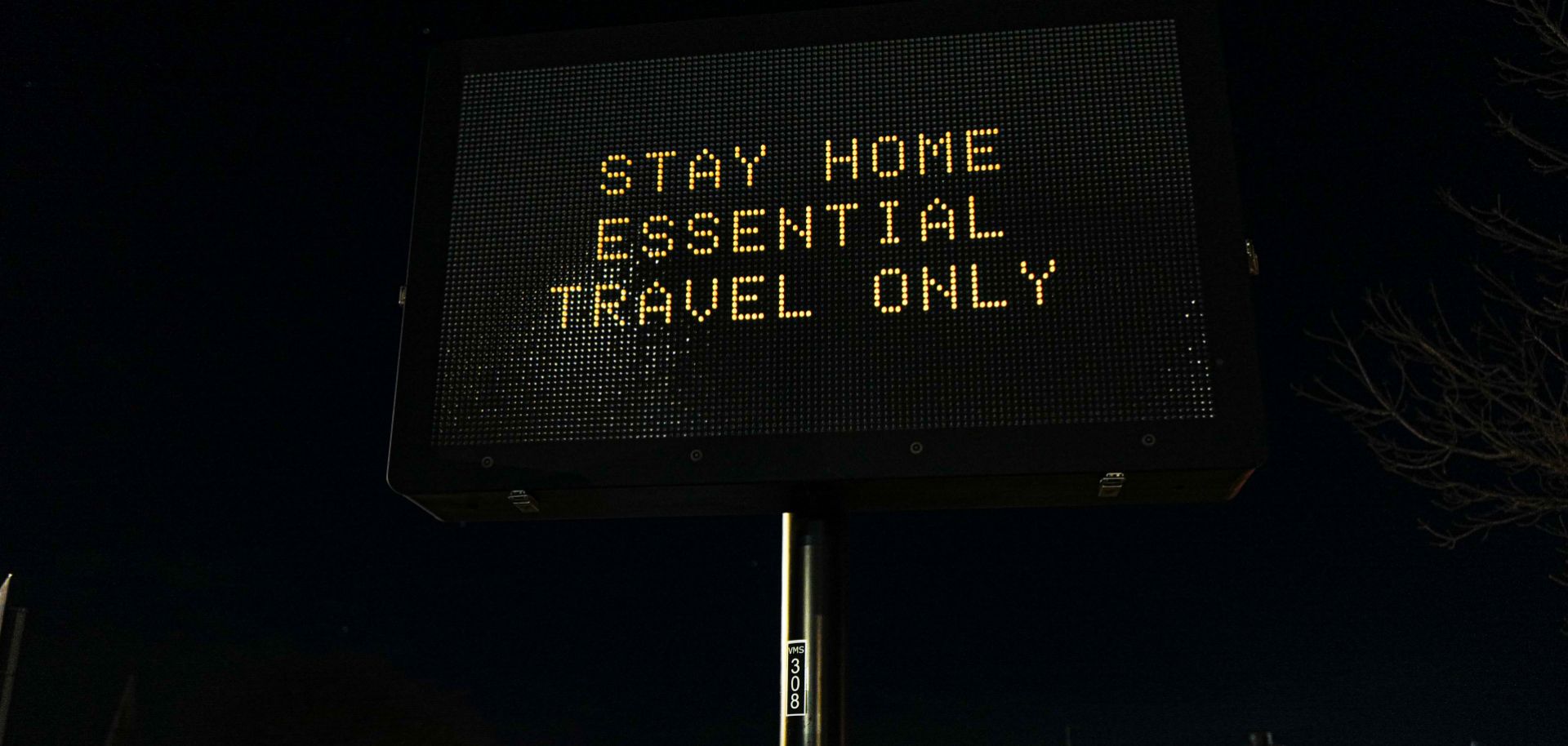
A sign advises people to follow COVID-19 restrictions on Jan. 5, 2021, in Falmouth, the United Kingdom. In a televised address on Jan. 4, U.K. Prime Minister Boris Johnson announced the country was entering its third lockdown since the onset of the pandemic in early 2020.
The United Kingdom’s decision to tighten its COVID-19 lockdown measures and introduce a new relief package for businesses is a preview of similar decisions that governments in continental Europe will introduce in the coming days. The lockdown measures will result in low, or even negative, economic growth in Europe in the first quarter of 2021, which will worsen governments’ fiscal deficit and sovereign debt levels. On Jan. 4, U.K. Prime Minister Boris Johnson and Scotland’s First Minister Nicola Sturgeon announced stricter social distancing measures for England and Scotland, respectively, to cope with the rising number of COVID-19 infections. Then, on Jan. 5, the U.K. government announced a 4.6 billion pound ($6.2 billion) aid package for companies hardest hit by the tighter lockdown measures across the country.
- Under the new lockdown measures in England and Scotland, people will be required to work from home whenever possible and all nonessential shops will be closed. Schools and universities will also remain closed.
- The Chancellor of the Exchequer, Rishi Sunak, said that some 600,000 companies in the United Kingdom’s retail, leisure and hospitality sectors will receive grants of up to 9,000 pounds.
- The U.K. government also announced that a further 594 million pounds will be available for local councils to assist businesses that are not eligible for the new payments but have also been affected by the lockdown.
- The European Union and the United Kingdom’s output may already have stalled in the fourth quarter of 2020 due to previous lockdown measures.
Governments in continental Europe are considering extensions and, in some cases, the tightening of their own lockdown measures amid a slower-than-expected vaccination campaign. Infection rates are also on the rise in continental Europe, which will force governments to tighten their lockdown measures in similar ways to the United Kingdom. While most EU members started their vaccination campaigns in late December, the process has been slower than expected due to logistical issues. Some of the problems include the lack of the necessary equipment (from protective equipment for nurses to syringes of the right capacity), the logistical difficulties of vaccinating old people in care homes, and the fact that the vaccination campaign began during the Christmas period, when some hospitals were working with reduced staff while the residents of care homes were not there.
- On Jan. 5, Germany announced that the lockdown measures that were introduced in mid-December will be extended until the end of January. Additional extensions are possible.
- Some of Spain’s most populated regions (including Madrid and Catalonia) have recently announced stricter lockdown measures.
- On Jan 5., the Italian government approved a decree that prohibits travel between regions except for health or work reasons. Bars and restaurants will only be allowed to provide takeout services.
- The French government admitted on Jan. 4 that roughly 500 people were vaccinated during the first week of the campaign, which prompted Health Minister Olivier Veran to promise that the pace of vaccinations will be accelerated.
- In Germany, the government is considering delaying the administration of the second dose of the vaccine by several weeks, so that a greater amount of people can receive the first dose.
- In Spain, densely populated regions such as Madrid and Catalonia admitted that they have vaccinated a much lower number of people than originally planned. According to the Catalan government, only 13 percent of the people who should have been vaccinated during the first week of the campaign have actually received their dose.
- So far, the European Union has only authorized the vaccine developed by Pfizer and BioNTech, which is leading to distribution problems. On Jan. 4 the European Medicines Agency (EMA) said it needed a few more days to approve the Moderna vaccine.
As long as lockdown measures are kept in place, the European Union and the United Kingdom will struggle to return to economic growth after experiencing deep recessions in 2020. In the meantime, governments will probably announce new rounds of stimulus measures to help sectors hit hardest by the lockdowns, such as retail, restaurants and hospitality. The European Commission suspended the bloc’s debt and deficit limits in 2020, which means that EU governments will not be under immediate pressure to reduce public spending and borrowing. In addition, the European Central Bank’s asset-purchasing programs are keeping borrowing costs for the eurozone at very low levels. But in the long run, financial markets and investors could become nervous about the sustainability of the bloc’s fiscal policies, especially in heavily indebted southern European countries — opening the door to debt crises.
- According to EU rules, which were suspended in 2020, member states should not have a fiscal deficit above 3 percent of GDP and sovereign debt above 60 percent of GDP.
- The 27 members of the European Union ran fiscal deficits in 2020 due to higher public spending to cope with the COVID-19 crisis. Belgium, Spain, France, Italy and Romania’s fiscal deficits all exceeded 10 percent of GDP last year.
- Seven of the 19 countries in the eurozone also had debt-to-GDP ratios above 100 percent in 2020. In Greece’s case, that ratio was above 200 percent.
- In 2020, the European Union approved a 750 billion euro relief package for the bloc, but the disbursement of funds is only expected later this year.
