
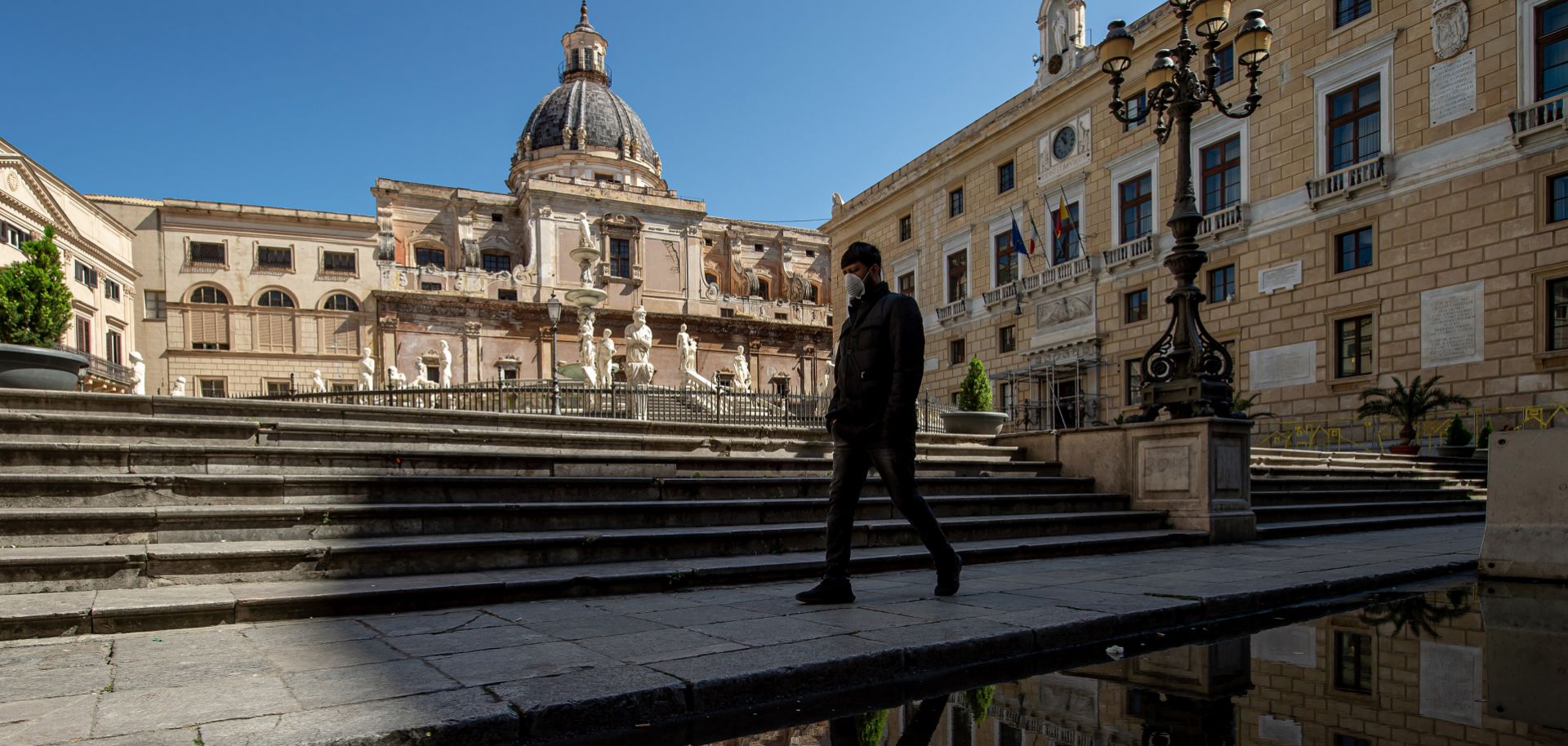
A man wearing a face mask walks in Pretoria square in Palermo, Italy, on March 11, 2020. Italy, where tourism represents 13 percent of the country's annual GDP, is under a nationwide lockdown to try to contain the spread of the COVID-19 virus.
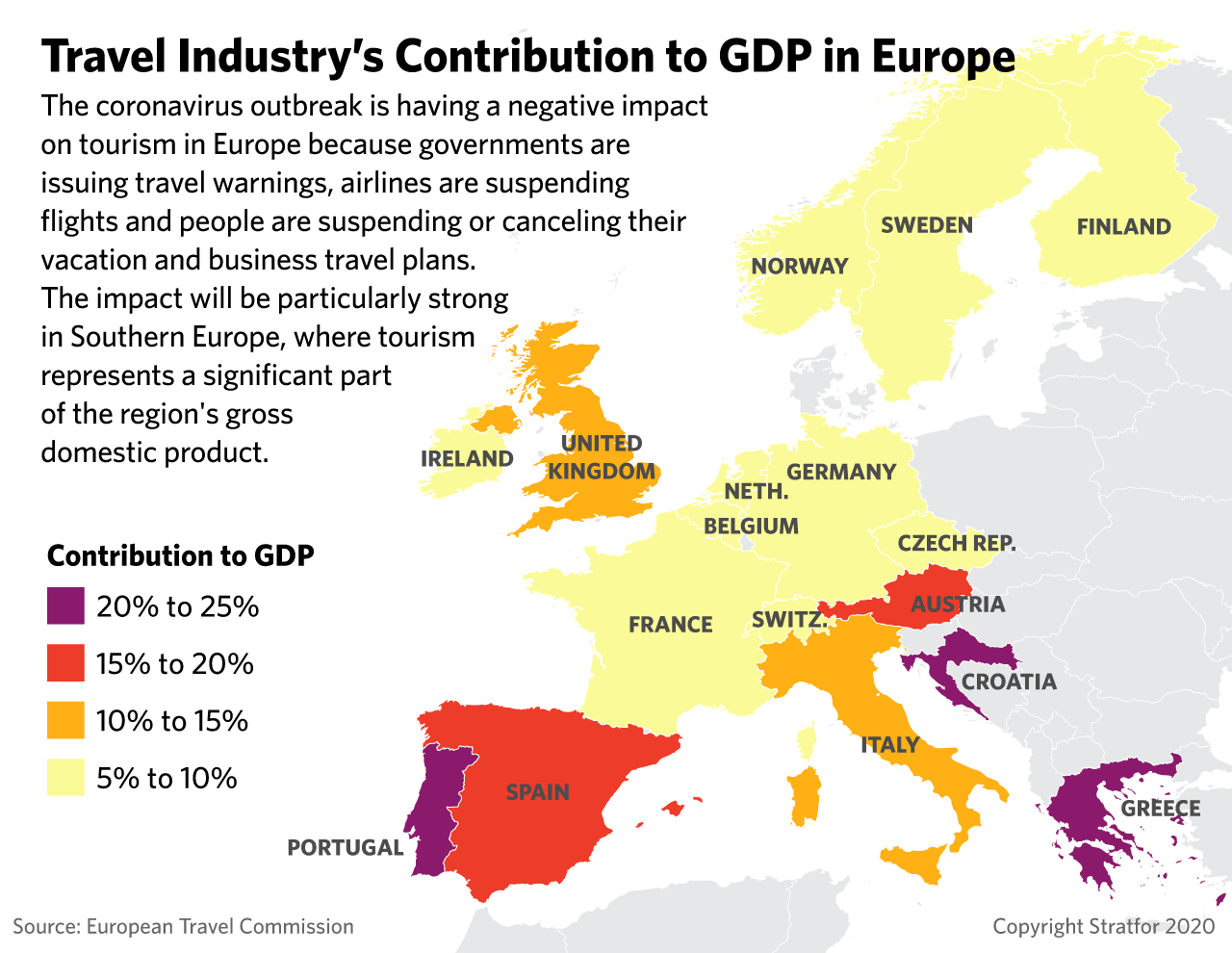
Tourism is one of the sectors of the European economy that will be most affected by the ongoing coronavirus outbreak in the Continent. The importance of tourism for Europe cannot be overstated: It represents around 4 percent of the European Union's GDP and accounts for more than 5 percent of the total workforce. Tourism is particularly important in Southern Europe because it represents around 21 percent of GDP in Greece, 16 percent in Spain, 13 percent in Italy and almost 10 percent in France. It is also a significant source of employment, both formal and informal (off-the-books activities, including irregular employment, are common in the tourism industry). The vast majority of companies in Europe's tourism sector are small and medium-sized businesses, which are particularly vulnerable to economic crises.
This means that Europe in general, and Southern Europe in particular, stands to lose a lot if the ongoing coronavirus outbreak extends into the spring when tourism activity starts to pick up. A contraction in the tourism sector when many other parts of the economy are also slowing down would hasten Europe's looming economic crisis and help push several countries close to a recession.
A Negative Quarter for Tourism
In recent weeks, governments, companies and individuals have taken coronavirus-related decisions that are having a negative impact on tourism. They include:
- Travel warnings. The United States suspended travel from 26 European countries for a month, starting on March 13. Spain, Greece, Portugal, Romania, Poland and others temporarily suspended flights to and from Italy. Several countries, including the United Kingdom, Finland and Canada, have warned their nationals about traveling to European countries with a high number of COVID-19 cases, such as Italy, France and Spain. Austria and Slovenia introduced controls in their land borders with Italy.
- Flight anxiety. Many airlines, including British Airways, Air France, KLM and Ryanair, have suspended their flights to Italy, while some others, like Portugal's TAP, have also suspended flights to Spain and France. In the meantime, anxiety over the COVID-19 outbreak is making people cancel or postpone their vacation plans, while companies across the world have suspended non-essential business travel. As a result, European airlines are facing heavy reductions in revenue. On March 5, the International Air Transport Association (IATA) warned that airlines operating in Western Europe could see a reduction in passengers of up to 24 percent this year, and a fall in passenger revenue of more than $37 billion.
- Event suspensions. Many European countries have suspended or canceled large cultural, sports and business events. For example, the International Motor Show in Geneva, the Mobile World Congress in Barcelona and the Saint Petersburg International Economic Forum have been canceled, while the Baselworld watch fair and the Milan Furniture Fair were postponed. Soccer and rugby games have been postponed or played without spectators. This is leading to significant losses for the cities holding these events, in areas beyond ticket sales that range from hotels to bars and restaurants.
- COVID-19 spread in high-profile tourism destinations. Global anxiety about the coronavirus is made worse by the fact that some episodes are taking place in high-profile and high-traffic tourist destinations. For example, hundreds of tourists were locked down for two weeks in a hotel in Spain's Tenerife island after some guests tested positive for the virus, while in Paris, the Louvre Museum (one of the most-visited museums in the world) temporarily closed its doors as employees were worried about catching the virus. In the meantime, all of Italy's tourism attractions are closed because of a nationwide lockdown, while in Spain, the iconic Fallas festival in Valencia [which according to the government, generates some 700 million euros ($782 million) for the city] has been suspended.
The Shoulder Season Test
After a difficult start to the year, the second quarter could prove a make-it-or-break-it period for Europe's tourism sector. The period between April and June is the so-called shoulder season, that is, the moment of the year when tourism activity starts to pick up in several countries before the high season arrives with the summer in the third quarter. The shoulder season has several peaks of its own, such as the Easter break in mid-April and the labor day weekend in early May. Should the coronavirus outbreak continue into early April (the concrete impact of warmer weather on the contagion has yet to be determined) it would negatively affect people's vacation plans for this season, and impose additional losses on the tourism sector that the summer season may not fully compensate for. And even if the outbreak recedes, some airlines have already canceled some routes for April.
Spain offers a clear example of these risks. The Easter holidays are particularly important for the southern region of Andalusia, with world-famous festivities taking place across the region, including a traditional religious procession in Seville. According to the Andalusian government, the Easter holidays generate some 400 million euros in revenue for Seville alone and some 100 million euros for smaller cities like Malaga. Andalusia is also one of the regions with the highest unemployment levels in Spain (around 20 percent, while the national average is around 14 percent), which underscores the importance of the Easter holidays for short-term employment in the region.
Something similar happens in Italy. Before the government announced the nationwide lockdown on March 10, the Confturismo-Confcommercio tourism lobby said the Italian tourism sector would lose some 7.4 billion euros during the period between March 1 and May 31. The reality is likely to be much worse because of the lockdown. As with Spain, the most vulnerable parts of Italy are those where unemployment is high and tourism provides some relief to a depressed economy. On the island of Sicily, for example, tourism represents a key source of formal and informal revenue for a region where unemployment is well above the national average (Sicily's unemployment rate is around 20 percent, twice the national average). According to Federalberghi, which represents Italy's lodging sector, before the country was put under lockdown Sicily was already losing around 15 million euros a month because of coronavirus-related cancellations at hotels and restaurants.
There are other touristic parts of Europe where the impact of the coronavirus so far has been more limited. The number of coronavirus cases in Greece, for example, has been lower than in places like Italy and Spain, and the tourism sector has not been particularly affected, apart from Air China deciding to suspend flights to Santorini and Athens. However, the Hellenic Federation of Hoteliers recently said that if the spread of the virus continues into April, the country would be in trouble.
Tourism in Greece could be affected in several different ways. A slowdown in economic activity in other parts of Europe could force people to cancel their vacations in Greece, regardless of the coronavirus situation in the country. In addition, there have been several episodes of cruise ships temporarily put in quarantine after some tourists tested positive for coronavirus, which could have a negative impact on Greece, where cruise ships are an essential part of tourist activities. To make things worse, the ongoing disputes between the European Union and Turkey could result in an increase in the arrival of asylum seekers on the Greek islands, which could discourage tourists from visiting them. The recent detection of a coronavirus case in the island of Lesbos, which is home to thousands of asylum seekers who live in crowded migration camps that provide a fertile ground for mass contagion, means that the number of cases in Greece can escalate in the coming weeks.
What's Next for Tourism in Europe?
In the coming weeks, governments and companies in the tourism sector will react to the coronavirus outbreak in different ways. Some of the reactions will likely involve:
- Special offers for travelers. Many of the companies in Europe's tourism sector are likely to come up with special offers to attract customers. Some of the options that are currently being considered include offering free cancelations for hotels and flights so that customers can book them without the fear of being penalized if the coronavirus outbreak continues and forces them to cancel their vacation plans.
- State help. Countries like Italy, Spain and Germany have already announced tax benefits and delayed tax payments for the sectors of the economy that were negatively affected by the coronavirus outbreak, which includes tourism. National governments and EU institutions such as the European Central Bank are working on cheap loans for companies that took a hit because of the outbreak, while private banks in countries like the United Kingdom are also offering cheap funding for small and medium-sized businesses. The European Union, for its part, will soften a rule according to which airlines lose some of their flight slots if they do not use them enough. Still, some struggling companies connected to the tourism sector will probably go bankrupt because of the fall in demand (this is already happening in the airline sector).
- Domestic tourism. The coronavirus outbreak could lead to an increase in internal tourism, as people may decide to go on vacation domestically because they are afraid to fly or because they want to be in their own country in case they get infected. This will probably not be enough to compensate for a decline in international tourism (Spain, for example, received roughly 84 million visitors last year, in a country of 47 million, while Greece receives 33 million visitors a year in a country of 11 million), but it may offer some relief for an industry that faces a very negative year.
The coronavirus outbreak reached Europe at a time when most of the Continent's economies were starting to slow down. The economic disruptions created by the virus could turn the slowdown into a proper recession, particularly in countries like Italy. During previous economic crises in Europe, the tourism sector proved to be one of the few areas that showed some resiliency, and in cases like Spain or Greece, it was one of the few sectors that remained strong and continued to create jobs despite the overall economic slowdown. But now tourism is becoming one of the main casualties of the coronavirus outbreak, which will deprive Southern Europe of a key safety net to cope with the upcoming economic downturn.
