
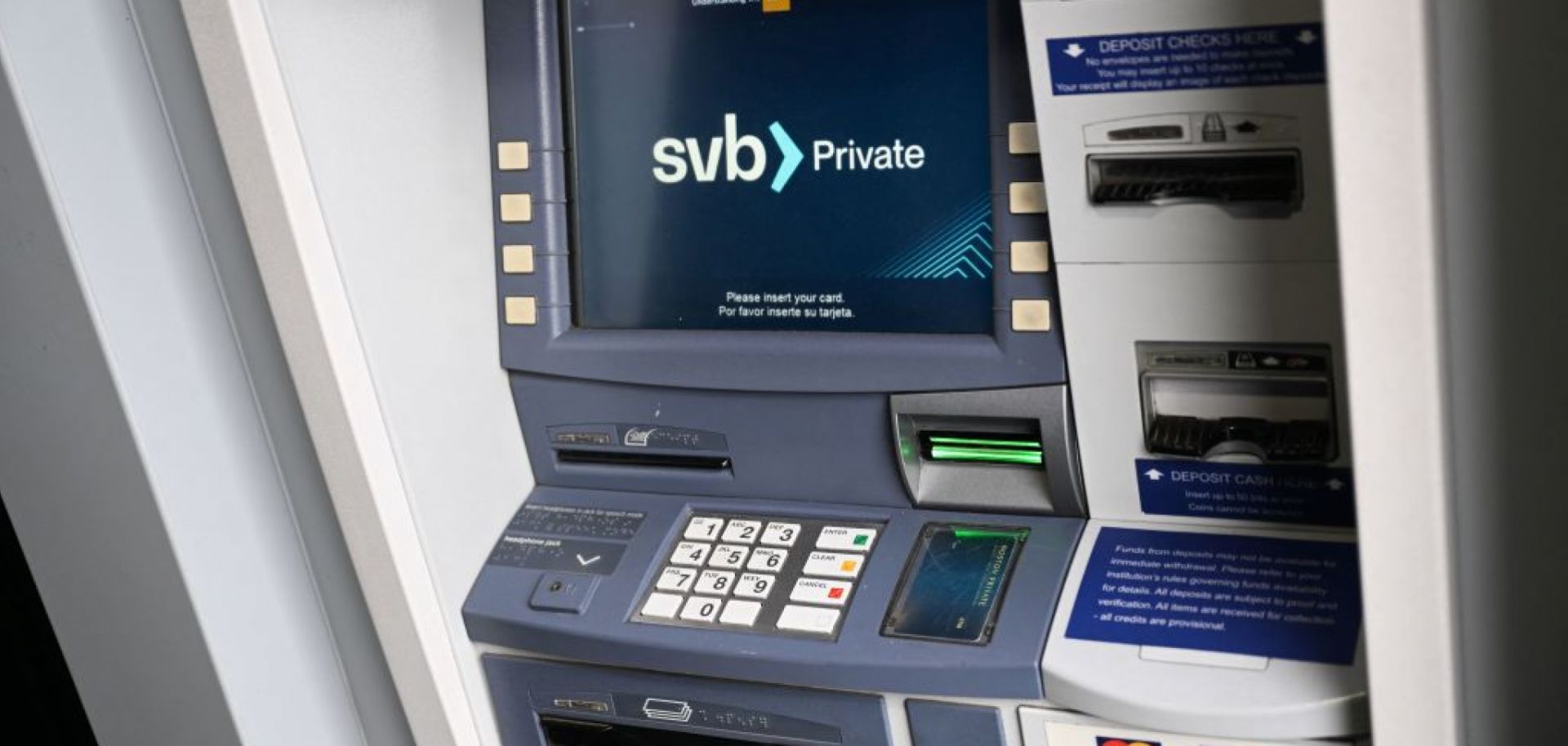
An SVB Private ATM outside of a Silicon Valley Bank branch March 20, 2023, in Santa Monica, California.
Government intervention in the United States and Switzerland has helped limit the risk of an imminent systemic banking crisis, but investor sentiment remains fragile and financial sector risks remain, which will likely force central banks to ease up on, and in some cases even reverse, monetary tightening this year. Over the past three weeks, U.S. and Swiss authorities have intervened in their respective banking systems with enough force and speed to preempt the immediate risk of systemic financial instability. In the United States, the Federal Deposit Insurance Corporation (FDIC) on March 12 and March 20 took over two mid-sized banks, Silicon Valley Bank (SVB) and Signature Bank, and guaranteed all of their deposits. The U.S. Federal Reserve also established a new lending program that provides liquidity-constrained banks with more favorable access to funding. Meanwhile, in Switzerland, authorities on March 19 engineered the UBS takeover of Credit Suisse, a systemically important global financial institution that was facing imminent collapse on the back of a loss of confidence. To get the deal done, Swiss authorities offered UBS financial incentives and unexpectedly wiped out an entire class of bondholders — highlighting the extent to which they were keen to keep Credit Suisse from going under for fear of triggering a Swiss (and possibly global) financial crisis.
- U.S. authorities invoked a so-called systemic risk exception to guarantee all deposits in SVB and Signature Bank, including uninsured deposits in excess of the FDIC's $250,000 insurance cap (which represented the bulk of both banks' deposit funding). The new lending program established by the Fed allows banks to borrow against the face value of eligible collateral rather than requiring haircuts on the value of the collateral.
- The UBS-Credit Suisse merger imposed 16 billion Swiss francs (about $17 billion) in losses on some holders of Credit Suisse's tier 1 capital. As part of the merger, Swiss authorities also provided $108 billion in funding to UBS and a $9.7 billion loss guarantee, which will kick in only after UBS absorbs the first $5.4 billion of losses.
Against the backdrop of significant global monetary tightening, SVB and Signature Bank's poor risk management and Credit Suisse's poor profitability and financial losses led to the collapse of investor confidence in all three cases. At SVB and Signature Bank, a large share of uninsured, potentially flighty deposits was invested in long-term, fixed-rate bonds. Fed interest rate hikes increased the banks' funding costs and, in the face of accelerating deposit outflows, forced them to sell their long-term assets at depreciated values. This resulted in large losses and ultimately a run on SVB and Signature Bank's deposits. Although the assets in SVB were highly rated (i.e. they had a very low credit risk), the mark-to-market losses forced on the two mid-sized banks by deposit outflows led to their failure. In Switzerland, Credit Suisse had suffered several financial scandals and years of low profitability and financial losses, accelerating outflows and the loss of support of the major strategic investor. In that sense, the drivers of instability in the U.S. and Swiss banking sectors differ. In the United States, the collapse of mid-sized banks and the possibility of a broader run on bank deposits forced the authorities to intervene. In Switzerland, it was the imminent collapse of a global systemically important financial institution that forced authorities to step in to not only avoid a collapse but actually find a buyer for Credit Suisse. Judging by UBS's share price following the announcement of the merger, markets appear confident that the Credit Suisse rescue has resolved immediate financial instability risks. Parts of the U.S. banking system, however, remain under pressure following SVB and Signature Bank's collapse.
- UBS's share price increased from $18.2 on March 17 (just before the UBS merger was announced) to $21.1 on March 20 (the day after the deal was announced), and has since dropped to $20.1 as of March 29.
- In the United States, small and mid-sized banks with a balance sheet structure similar to SVB remain most at risk of financial instability. California-based First Republic Bank remains under pressure with its share price having fallen almost 90% since early March, despite the provision of $30 billion worth of deposits by large U.S. banks.
- According to the Financial Times, U.S. money market funds have seen $286 billion of inflows since the beginning of March, while small and mid-sized U.S. banks have suffered large outflows. Outflows from small and medium-sized banks amounted to $100 billion during March 8-15 alone, according to the Federal Reserve, while large U.S. banks actually saw an inflow of deposits.
The risk of a deposit run on larger, systemically important U.S. banks remains low, but constraints on more aggressive government interventions and further failures of mid-sized banks could prove destabilizing if it leads to a broader run on second- and third-tier banks. To prevent self-fulfilling bank runs, U.S. authorities will continue to intervene preemptively to prevent the uncontrolled collapse of financial institutions. The U.S. government will want to do whatever it takes to prevent a systemic banking crisis, not least because such a crisis could wreak havoc on other parts of the U.S. financial system (including the all-important treasury market), which would reverberate across the global economy and financial system. However, U.S. financial regulators need to carefully balance their words and actions to reassure markets that the crisis remains under control, without going so far as to provide a risky blanket guarantee. The U.S. Treasury and even the Fed face legal, strategic, political and budgetary constraints in terms of the extent to which they can provide guarantees for more forceful action. Burnt by the political blowback following the 2008-09 banking crisis, authorities are loath to be seen as using taxpayers' money to bail out banks. And, depending on the rescue measures required to prevent systemic instability, the Fed and the Treasury may sometimes require lawmakers in Congress to authorize an intervention, depending on its size, the additional necessary budget.
- In the wake of the SVB collapse, no major U.S. bank has so far experienced significant financial pressure as reflected in their funding costs or their share price. In fact, systemically important U.S. banks (like JPMorgan, Chase and Bank of America) have seen deposit inflows since early March. These systemically important banks account for around two-thirds of U.S. banking sector assets. Financial fragility is concentrated in the remaining third, namely in small and especially medium-sized banks (like SVB).
- The U.S. (and, in turn, global) financial system is critically dependent on a functioning U.S. treasury market, which is worth $22 trillion. As banking sector instability increased, trading increased sharply. While there were some problems, the market has continued to function better than during the COVID-induced instability in March 2020 as many countries went into lockdown.
- At the end of 2022, the FDIC had enough funds to cover 1.3% (or $130 billion) of insured deposits, which accounted for 43% of all deposits in the U.S. banking system at the time. The FDIC sold large parts of SVB and Signature Bank to First Citizens and New York Community Bank, and expects to suffer $20 billion and $2.5 billion in losses, respectively, as a result. The loss associated with the SVB rescue is the largest in FDIC history.
- Extending deposit insurance to all deposits would require congressional action. But U.S. authorities can extend the guarantee to uninsured deposits by invoking a systemic risk exception, as they did following the recent failure of SVB and Signature Bank.
Continued concerns about banking sector instability will weigh on bank lending, the economic outlook and central bank monetary tightening, and this might lead the Federal Reserve to cut interest rates before the end of the year in light of slower growth and worries about bank sector fragility. For now, Europe's apparently more solid banking sector affords the European Central Bank greater leeway to tighten monetary policy, even though it has signaled it will keep an eye on financial stability before deciding on interest rates May 4. The Fed meanwhile foresees only one more 25 basis point hike this year. Banking sector instability will negatively affect credit and may weigh on consumer confidence, lowering demand, economic growth and inflationary pressure. The 20-25 largest banks, which face far less financial pressure than smaller banks, account for two-thirds of all bank credit. But small- and mid-sized banks are the major providers of credit to local economies, and especially small- and medium enterprises as well as households, including commercial mortgages. The Federal Reserve has downgraded its economic growth forecast and polls of leading economists point to a U.S. recession later this year, pointing to the possibility that the Fed could lower interest rates before the end of 2023.
- As of March 27, financial markets indicate that central bank policy rates in the United States and Europe have peaked. In the case of the Federal Reserve, markets even expect rate cuts before year end. Even U.S. futures markets are attaching a two-thirds probability that the Fed will not raise rates at its next meeting May 3.
- According to a poll of leading academic economists, the Initiative on Global Markets at the University of Chicago Booth School of Business, conducted March 15-17, 49% of economists surveyed expect the Federal funds rate to reach 5.5-6.0% from 4.5-4.75%. Equally important, 70% now do not expect the Fed to cut rates before 2024. The sharply divergent views of economists and markets point toward increased uncertainty.
- In its latest Summary of Economic Projections, the Federal Reserve downgraded its forecast of real GDP growth this year to 0.4%. The European Commission predicts euro area growth of 0.9% this year. Recession or not, risks to economic growth are weighted to the downside during the remainder of 2023.
