
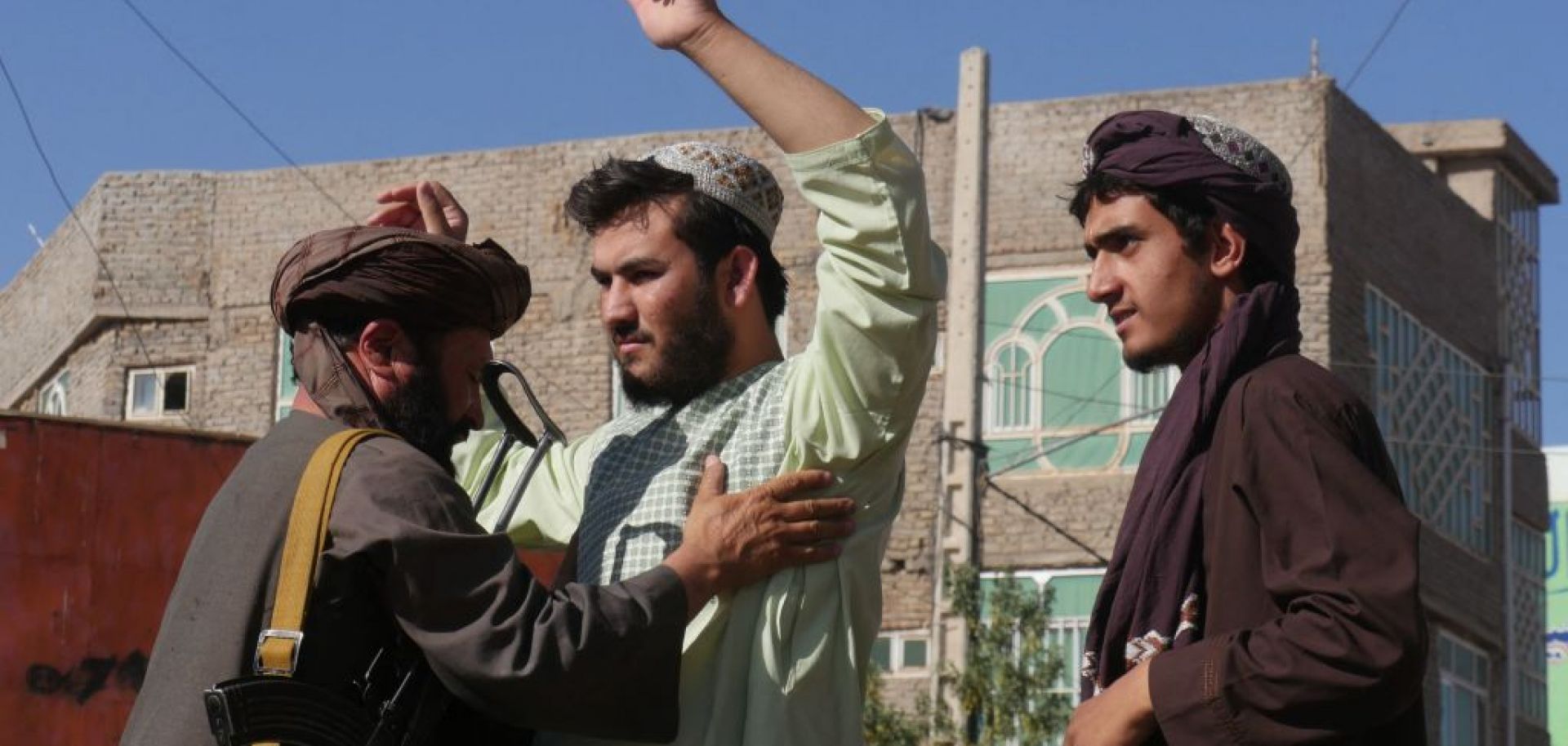
A Taliban fighter (L) frisks men at a checkpoint after a blast during Friday prayers Sept. 2, 2022, in Gazargah mosque in Herat.
By Isaia Galace
Despite the recent U.S. killing of al Qaeda leader Ayman al-Zawahiri, a survey of foreign counterterrorism action in Afghanistan over the past year demonstrates foreign states' limited abilities to counter terrorist groups in the country, which may allow for an eventual extremist resurgence. After nearly a year of ambiguity and scant reporting regarding foreign counterterrorism operations in Afghanistan, U.S. President Joe Biden confirmed Aug. 1 that the United States conducted an unmanned aerial vehicle strike the morning of July 31 that killed al Qaeda leader Ayman al-Zawahiri in Kabul. Al-Zawahiri was residing in the upscale neighborhood of Sherpur in the house of a top aide to Taliban senior leader and Interior Minister Sirajudiin Haqqani. A U.S. "ground team" was reportedly present in Afghanistan to support the operation and helped confirm al-Zawahiri's killing, though few details about its activities have been publicized. The revelations surrounding the strike support assessments by the U.N. Analytical Support and Sanctions Monitoring Team — responsible for monitoring and analyzing several militant groups — that al Qaeda remains present in Afghanistan, is close to the Taliban and provides advice and support to the country's de facto rulers. As of June, the U.S. Defense Intelligence Agency maintained "that the Taliban will probably allow legacy al-Qaeda members to remain in Afghanistan, provided they do not threaten the regime's security or autonomy."
- Though the country from which the UAV was launched has not been confirmed, the United States uses air bases in the Persian Gulf region to launch UAVs, including al-Dhafra air base in the United Arab Emirates and al-Udeid air base in Qatar, which are among the closest to Afghanistan.
- A UAV from the Gulf would likely have traveled through Pakistani airspace given restrictions on travel through Iranian airspace and the much longer route necessary to traverse Central Asian countries. Pakistan likely gave the United States permission to use its airspace to conduct the operation, potentially under a 2003 U.S.-Pakistan agreement that granted the United States permission to use Pakistani airspace to conduct flights to/from Afghanistan. This agreement has reportedly been maintained despite officially expiring after the August 2021 U.S. and coalition withdrawal from Afghanistan.
- The United States is reportedly in talks with Pakistan to establish a more durable, formal agreement for U.S. access to Pakistani airspace to conduct counterterrorism strikes. This, along with its likely having granted the United States access to its airspace to conduct the al-Zawahiri strike, suggests Islamabad will remain an important — if controversial — partner for the United States in countering extremism in Afghanistan moving forward.
Though some observers have suggested the al-Zawahiri strike demonstrates the efficacy of the so-called over-the-horizon U.S. counterterrorism strategy, several distinct conditions gave the Biden administration the unique opportunity. Rather than clearly proving that the United States can effectively counter a potential resurgence of extremism in Afghanistan without a meaningful presence on the ground, it appears more that al-Zawahiri's decision to take greater risks and use poor tradecraft provided the proximate spur for the strike. Al-Zawahiri's recording and release of video messages were notably intermittent in recent years. Though this may have partly been due to his rumored ailing health, it was also likely driven by operational security concerns, particularly after a number of senior al Qaeda figures were killed in counterterrorism operations around the globe in 2020. Al-Zawahiri began to record and issue video messages with greater regularity and frequency after the Taliban takeover, however, particularly in early 2022, indicating a more relaxed operational security posture. Al-Zawahiri also felt comfortable enough to relocate to Afghanistan's capital sometime after the Taliban takeover and to reunite with his family, extremely risky moves that ultimately rendered him vulnerable to discovery by foreign intelligence services.
- According to a senior Biden administration official, U.S. intelligence agencies verified al-Zawahiri's presence in the capital "through multiple streams of intelligence," suggesting the United States maintains some intelligence capabilities in Kabul, likely including human assets and technical collection methods. U.S. intelligence capabilities inevitably became much reduced since the Taliban takeover of the country, and likely even weaker in more rural areas — where many extremist groups operate — due to their being less populated and typically more religiously conservative and supportive of the Taliban.
- The apparent continuation of al-Zawahiri's more relaxed behavior after his arrival in Kabul contributed to his demise. Unlike Osama bin Laden, who took several strict measures to prevent his discovery, al-Zawahiri apparently felt comfortable enough to establish a consistent routine that involved standing on a balcony in plain view despite being among the most wanted men in the world.
The fact that it took the United States nearly a year after its withdrawal to execute its first reported counterterrorism strike in Afghanistan suggests the Biden administration has a lower tolerance for risk. Compared to its predecessors, the Biden administration appears to have a higher threshold for conducting lethal operations in Afghanistan out of concern for preventing civilian casualties. Many in the administration likely recall the strong backlash triggered by the Obama administration's reliance on UAV strikes, which resulted in high numbers of civilian casualties. The Trump administration's relaxation of U.S. rules of engagement — amid other policy changes — drove an even steeper increase in U.S. strike activity and civilian casualties. The Biden administration likely shares concerns that civilian casualties from UAV strikes alienate populations, which some have argued makes strikes counterproductive to countering terrorism. The UAV strike intended to target a suspected Islamic State Khorasan Province bomber that instead killed 10 civilians in the final days of the U.S. withdrawal from Afghanistan undoubtedly underscored this risk. These concerns appear to have driven the reportedly painstaking deliberation regarding the al-Zawahiri operation, which involved months of intelligence gathering on al-Zawahiri, his suspected residence and the surrounding area, as well as the reported use of a special munition that lacked an explosive warhead to prevent collateral damage.
- Demonstrating the dramatic change in policy under Biden, the United States conducted 42% fewer strikes in Afghanistan, Iraq, Syria, Yemen and Somalia in his first year in office compared to Trump's last year in office, according to data obtained by Voice of America.
- Suggestive of the Biden administration's lower risk tolerance, the U.S. Defense Department on Aug. 25 announced its intent to implement unprecedented changes to how it conducts operations to reduce risks of civilian casualties. The corresponding memorandum outlined a number of directives intended to influence a cultural change in which risks to civilians would be assessed throughout the planning and execution of U.S. military operations.
Aside from a more hesitant strike posture, significantly degraded U.S. intelligence capabilities post-withdrawal have and will continue to reduce the U.S. ability to conduct counterterrorism operations in Afghanistan. While the al-Zawahiri strike demonstrates some U.S. intelligence capability in Afghanistan and its ability to conduct strikes against high-value targets in the country under certain circumstances, a number of challenges will likely continue to constrain U.S. counterterrorism efforts. First, though satellites are undoubtedly being used to collect intelligence, the distance from which they operate and their more limited maneuverability necessitates additional collection methods that are more flexible and closer to a target to establish a more comprehensive intelligence picture. This is a challenge because the U.S.' human intelligence network in Afghanistan remains significantly limited after last summer's withdrawal, and is likely particularly reduced in the more rural areas where many extremist groups operate. In addition, assuming that the United States is launching UAVs from air bases in the Persian Gulf, fuel constraints limit how long they can loiter and collect intelligence, and create potential diplomatic challenges with nearby countries over the use of their airspace. CNN reported in August that the Defense Department's Over-the-Horizon Counterterrorism Task Force — a group created shortly before the withdrawal dedicated to managing counterterrorism strikes in Afghanistan — "hasn't sent a single proposed target to the Pentagon for approval," largely due to degraded U.S. intelligence capabilities in the country. Even if a target were verified and a UAV strike operation were approved, numerous further limitations exist.
- Fuel constraints limit UAVs' ability to wait for more ideal conditions or to alter an operation as necessitated by events on the ground, potentially reducing the probability of mission success and the ability to limit civilian casualties. They also limit the ability to conduct a comprehensive post-strike assessment and determine resulting casualties.
- The ostensibly nonexistent (or extremely limited) U.S. ground presence also constrains its ability to support strike operations and to collect intelligence at the target of a strike. The latter challenge could limit the longer term counterterrorism impacts of future operations given that the United States exploits intelligence collected during raids to understand extremist groups' organizational dynamics and inform future counterterrorism action — as it did with the bin Laden raid in 2011.
Compared to the United States, Pakistan has been more assertive in conducting counterterrorism operations in Afghanistan since the Taliban takeover, but those efforts appear to have done little to diminish the threat of cross-border militancy. The withdrawal of U.S. and coalition forces and the Taliban's takeover of the country triggered a surge in anti-Pakistan extremist activity from groups based in Afghanistan. Persistent attacks over the past year by Tehrik-i-Taliban Pakistan (aka the "Pakistani Taliban") and Balochi separatist groups based in Afghanistan have triggered lethal responses by Pakistani security forces, which generally have demonstrated a high tolerance for civilian casualties. Pakistani security forces have reportedly used artillery, mortars and small arms to fire back or retaliate against TTP militants based in Afghanistan who fire at troops in Pakistan, resulting in the bombardment of villages in eastern Afghanistan where the TTP allegedly operates. Most notably, Pakistan conducted airstrikes against alleged TTP militants in April in eastern Afghanistan, which reportedly resulted in dozens of civilian casualties. Unconfirmed local reports have also highlighted attacks against senior TTP leaders in Afghanistan by suspected UAV strikes and in some cases, roadside bombs, which Pakistan is suspected of carrying out given its long-running conflict with the group. Pakistan is currently negotiating a cease-fire with the TTP mediated by the Afghan Taliban in an attempt to provide a more durable reduction in militant violence against the country, but negotiations have reportedly reached a stalemate. Judging from past precedent and fundamental disputes between the TTP and the Pakistani government, any potential cease-fire would likely eventually fail, sustaining the potential for a resurgence in TTP attacks in Pakistan.
- Pakistan also claims that Balochi separatists based in Afghanistan support their fellow militants' operations in Balochistan province targeting Pakistani security forces and Chinese nationals. Additionally, the Afghanistan-based ISKP remains active in Pakistan's Khyber Pakhtunkhwa province; in March, ISKP claimed a bombing of a Shiite mosque in the provincial capital of Peshawar, which killed dozens.
Other countries which have thus far avoided lethal action also face threats from militant groups in Afghanistan and may eventually be forced to take action. Some of the most prominent examples of violent threats that could worsen, and eventually spark further foreign counterterrorism intervention in Afghanistan, are listed below.
- ISKP conducted a suicide bombing Sept. 5 at the entrance of the Russian Embassy in Kabul, killing two embassy staff members, including a Russian diplomat. ISKP has previously threatened Russia, including in a propaganda booklet it released in July in which it characterized Russians as "the murderers of Chechen Muslims" and urged supporters to "cast fear into the hearts of the sons of Putin and Russia, kill them with cars and knives."
- ISKP also has increasingly threatened China since the Taliban takeover. In the 13th issue of its Voice of Khorasan propaganda magazine published Sept. 2, ISKP devoted a section to comprehensively criticizing China for its abuse of Uyghur Muslims in Xinjiang, its relationship with the Taliban and what ISKP characterizes as Beijing's imperial ambitions. The group has also actively sought to recruit Uyghur Muslims, and has claimed to have used Uyghurs to conduct attacks in the past, including in an October 2021 attack on a Shiite mosque in the northeastern Afghan city of Kunduz.
- ISKP claimed cross-border rocket attacks against Uzbekistan and Tajikistan in April and May, respectively. Neither country has reportedly retaliated against ISKP. According to unconfirmed reports, however, Uzbekistan scrambled military aircraft following the April rocket attack, suggesting retaliatory strikes remain possible.
- The Islamic State has also long threatened Iran given the group's anti-Shiite sectarianism. The group conducted attacks in Tehran in 2017, and has criticized Iran for its relationship with the Taliban; among other things, Iran and the Taliban have previously coordinated on countering ISKP near Iran's border.
Growing concerns over terrorist attacks emanating from Afghanistan mean that the aforementioned counterterrorism challenges could allow for a resurgence in extremist threats from the country. Based on intelligence provided by several U.N. member states, the U.N. Monitoring Team has assessed that since the Taliban takeover, extremist groups in Afghanistan "enjoy greater freedom than at any time in recent history." Besides al Qaeda, ISKP and the TTP, other groups including the Uyghur extremist East Turkistan Islamic Movement/Turkistan Islamic Party and the Tajik extremist Jamaat Ansarullah are present in the country. The U.N. monitoring team and U.S. intelligence community have reported these groups are actively rebuilding and developing their capabilities, and many have threatened foreign attacks; several are reportedly collaborating to augment their capabilities. Within this context, Gen. Kenneth McKenzie Jr., commander of U.S. Central Command, stated in March that "resultant reductions in consistent [counterterrorism] pressure potentially could enable [extremist] groups to pose increased threats to the United States and our allies, assuming the Taliban is unwilling or unable to do so itself." To this end, the Taliban's enduring relationship with such groups, combined with the Taliban's struggles to effectively counter ISKP, indicate that the Taliban cannot be relied upon to combat a resurgent threat from the country. The burden will thus fall on foreign countries to prevent such a resurgence, but degraded intelligence capabilities and the lack of a substantive, reliable presence or partner on the ground will challenge the efficacy of such efforts, raising the risk of future Afghanistan-based extremist threats.
- The U.S. Defense Department in March 2022 assessed that ISKP could establish an external attack capability in 12 to 18 months, and potentially sooner, while it has assessed al Qaeda likely requires 12 to 24 months to do the same. Meanwhile, the U.N. Security Council has reported that ETIM/TIP has procured more weapons, expanded its operating area and even reestablished a number of strongholds in the country in a bid to strengthen its ability to target Chinese interests in the region.
