
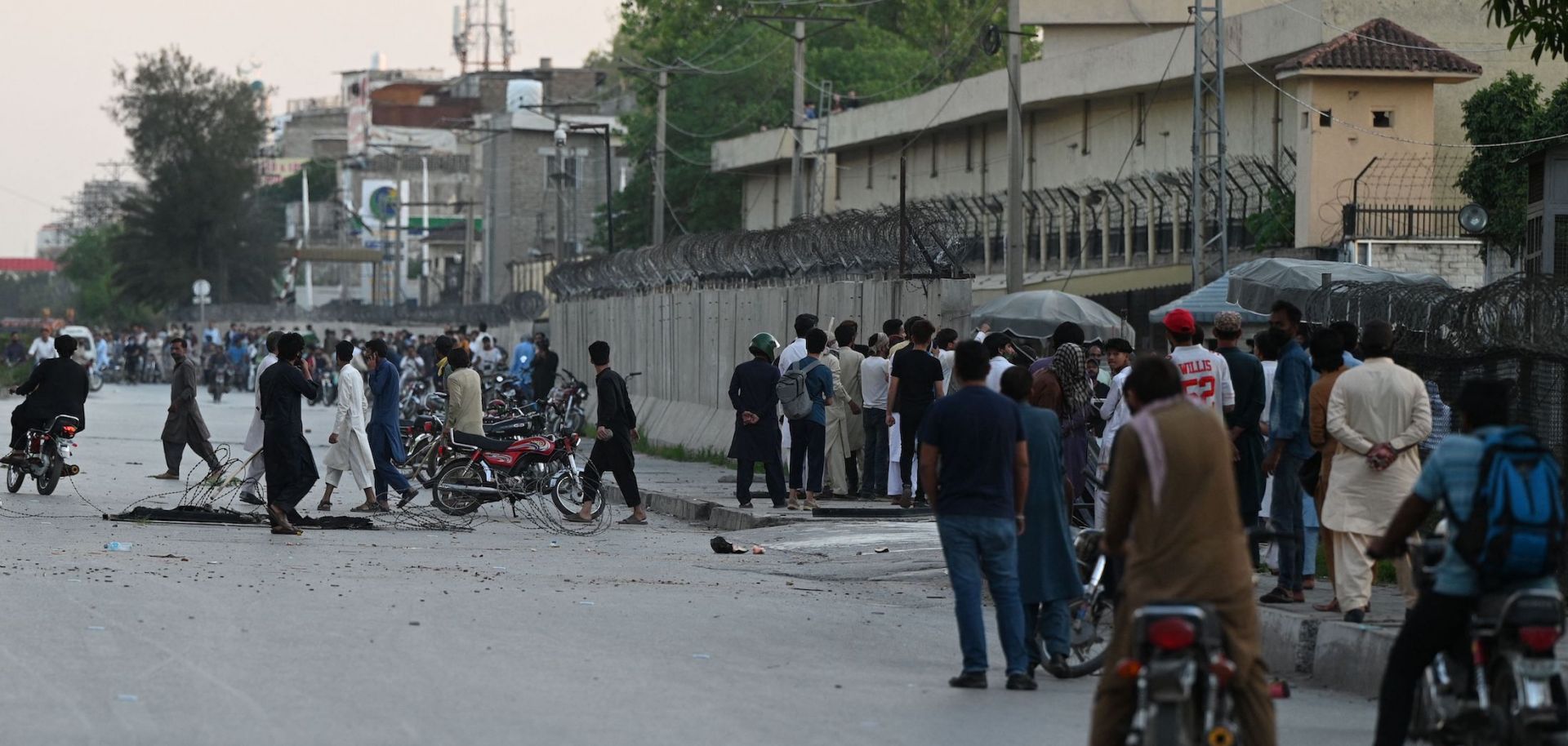
A protest May 9, 2023, in Rawalpindi, Pakistan, against the arrest of former Pakistani Prime Minister Imran Khan.
In Pakistan, the arrest of former Prime Minister Imran Khan raises risks of social unrest and has significantly worsened political instability. On May 9, Khan was arrested at the Islamabad High Court by officials from the anti-corruption National Accountability Bureau (NAB) and paramilitary Rangers in relation to an anti-corruption inquiry. Protests subsequently erupted in multiple cities, including the capital of Islamabad; Rawalpindi, where unconfirmed reports suggest protesters may have breached part of the Pakistan army's headquarters; Lahore; Peshawar; and Karachi. In multiple areas, protesters have reportedly clashed with security forces, disrupted major thoroughfares and vandalized property. In some areas, authorities have imposed restrictions on large gatherings — including in Islamabad and throughout the provinces of Punjab and Balochistan — and also suspended mobile internet and access to social media platforms. Interior Minister Rana Sanaullah has warned that those "who create law and order situations or block roads" would be dealt with "strictly."
- Reported statements from individuals who were present at the time of Khan's arrest, in addition to videos circulating on social media, indicate the Rangers broke windows and the court's main gate as well as used batons and pepper spray. Scuffles were also reported between Khan's supporters and police outside the court.
- The chief of the Islamabad High Court initially criticized the arrest, calling on several government and law enforcement officials to explain its details and questioning its legality; however, the Islamabad High Court later declared the arrest legal. The arrest also prompted widespread condemnation from officials of Khan's Pakistan Tehreek-e-Insaf (PTI) party, with senior leader Fawad Chaudhry calling the arrest an "abduction."
Khan's arrest officially relates to a corruption case, though it also comes a day after Pakistan's military rebuked Khan for reiterating long-standing accusations against a senior counterintelligence official. According to Islamabad's police chief, the inquiry for which Khan was arrested relates to the Al-Qadir Trust case, in which Khan and his wife allegedly obtained billions of rupees from a real estate firm in exchange for protecting the company in a money laundering case. In a press conference following Khan's arrest, Sanaullah said that the NAB had notified Khan of various corruption cases against him and requested his presence for the investigation, which Khan legally challenged. Sanaullah maintains that Khan's legal challenges failed, and amid Khan's alleged continued refusal to present himself, prompted the NAB to seek his arrest. Sanaullah added that the government did not have authority over the NAB and had not attempted to influence its decision to seek Khan's arrest. Notably, Khan's arrest also comes a day after Pakistan's military rebuked Khan for reiterating his long-standing accusation that Deputy-General of Counterintelligence Maj. Gen. Faisal Naseer was involved in the November 2022 shooting that injured Khan, which Khan has characterized as an assassination attempt. The Pakistan military's media wing labeled Khan's allegations as "fabricated and malicious," but Khan repeated the allegations in a video message released on the morning of his arrest, in which he also stated "if someone has a warrant, come to me directly [...] I am prepared to go to jail."
- Khan and his PTI party have been locked in a political standoff since Khan was removed from office following an April 2022 no-confidence vote in Pakistan's parliament. Most recently, the PTI has sought to pressure the government into conducting fresh national elections by prematurely dissolving two provincial assemblies. The dissolutions aimed to force the government to spend excess resources conducting those two provincial elections earlier than, and prior to, the general and other provincial elections expected later in 2023.
- Amid a subsequent disagreement between the Supreme Court (which has ordered Punjab's provincial election be held May 14) and the Election Commission of Pakistan (which previously set Punjab's provincial election for Oct. 8), the PTI and the government have in recent weeks been negotiating a mutually agreed-upon date and plan for provincial and general elections.
- The political standoff comes as Pakistan is also suffering from dire economic conditions amid stalled efforts to restart a bailout program from the International Monetary Fund. Moody's stated May 8 that while it expects Pakistan to make its external payments through the end of June, the country subsequently risked default barring an IMF bailout amid weak foreign exchange reserves.
The arrest will trigger nationwide protests and travel disruptions, which will likely persist for days and potentially longer. PTI Secretary-General Asad Umar has tweeted that a six-member committee would be formed to determine a comprehensive plan of action following Khan's arrest. The planned head of the committee, PTI Vice Chairman Shah Mahmood Qureshi, has said he will fight to secure Khan's release, though it is unclear how long Khan will be detained. Regardless, the PTI and Khan's supporters have consistently pledged to engage in large-scale protests and unrest in the event Khan is arrested or killed. This suggests such activity will likely persist in the near term, and that later developments could sustain or intensify it. Protests and authorities' restrictions will likely prompt broad disruptions to life in many parts of the country, with protesters particularly likely to target government and military buildings; unconfirmed reports suggest this has already happened in some areas. Based on past experience and the interior minister's statements, authorities will likely forcefully crack down on protests and unrest. This could include extending or imposing further restrictions on large gatherings, and perhaps curfews to prevent unrest from worsening. Such actions could restore stability, but Khan's supporters have also previously disobeyed such restrictions and clashed with security forces regardless, suggesting disruptive activity could continue for a prolonged period.
Politically, Khan's arrest will likely bolster his popularity and deepen Pakistan's political instability (especially if upcoming Punjab provincial elections are postponed), and may worsen its economic outlook. Khan's arrest will bolster the credibility of his long-standing allegations that the government and military are intent on arresting or assassinating him to prevent his return to power. This will likely strengthen anti-government and anti-military sentiment, weakening support for the government in the run-up to various elections. It remains unclear, however, when the next scheduled election — the Punjab provincial election, which the Supreme Court ordered be conducted May 14 — will actually be held given the threat of unrest related to Khan's arrest, and given reportedly stalled negotiations between the PTI and the government. The chief justice of Pakistan's Supreme Court recently stated the court would not "sit idle" and would seek to enforce its order for a May 14 election in the event negotiations between the two parties fail. Failure to hold Punjab's provincial election May 14 would likely further intensify protest risks, particularly from PTI supporters. Meanwhile, greater political instability and waning support for the government may impact Pakistan's urgent pursuit of an IMF bailout by further eroding IMF confidence in the government's willingness or ability to implement requested policies.
