
Tehrik-i-Taliban Pakistan attacks will likely intensify over the coming months as Pakistan and the Afghan Taliban remain deadlocked on how to deal with the militant group, portending greater instability along the Afghanistan-Pakistan border and northwest Pakistan, as well as a looming threat of urban attacks nationwide. The Afghanistan-based militant group Tehrik-i-Taliban Pakistan, also known as the Pakistani Taliban or the TTP, on Jan. 5 threatened attacks on military-linked businesses and financial institutions primarily based in Pakistan's garrison city of Rawalpindi as well as civilians associated with these entities, giving individuals three months to dissociate from them. Among the entities the TTP explicitly threatened are state-owned logistics company National Logistics Corp.; military engineering group Frontier Works Organization; and Fauji Fertilizer Co. and Askari Bank, subsidiaries of the Fauji Foundation, which provides employment opportunities for former servicemembers. The statement appears to threaten an expansion of the TTP's official rules of engagement, which the group's current leader Noor Wali Mehsud tightened in 2018 to focus on Pakistan's security forces and limit civilian casualties, as well as consequent backlash from the public and other Islamist extremist groups. The threat follows Pakistan's Dec. 24, 2024, airstrikes reportedly on high-value TTP targets in Afghanistan — namely several senior militants, including the head of the group's media arm. Local reports indicate the strikes did not kill any of the targeted militants but killed dozens of civilians, many of whom were women and children. Days-long border clashes subsequently erupted, with both the TTP and the Afghan Taliban firing on or assaulting several Pakistani border outposts before clashes eased around Dec. 28 following reported communication between Pakistan and the Afghan Taliban.
- The TTP has been at war with the Pakistani state since the group's formation in 2007, and it aspires to follow the Afghan Taliban's example by overthrowing Pakistan's government and replacing it with an Islamic state. The TTP has remained intransigent on its more near-term demands, which include Islamabad reversing its 2018 merger of the Federally Administered Tribal Areas with broader Khyber Pakhtunkhwa province in Pakistan's northwest and permitting its members to return and have some degree of autonomy there. Former Prime Minister Imran Khan's administration has been the most willing Pakistani government to negotiate and compromise with the TTP in recent years, but talks ultimately failed to realize a sustainable agreement and subsequent governments have appeared more skeptical of negotiations.
- The TTP's Mehsud tightened the group's official rules of engagement to unify its various factions and stem the backlash that resulted from its December 2014 attack on the Army Public School in northwest Pakistan. That attack killed nearly 150 people, including 132 schoolchildren, and wounded some 114 others. The TTP has since focused on attacking Pakistan's security forces, though some dissenting TTP factions and splinter groups have occasionally attacked officially prohibited targets. Unsanctioned attacks include the deadly January 2023 suicide bombing of a mosque in the heavily secured Police Lines area of Khyber Pakhtunkhwa's provincial capital Peshawar, which killed dozens of people and injured more than 200 others — many of them security personnel attending midday prayers.
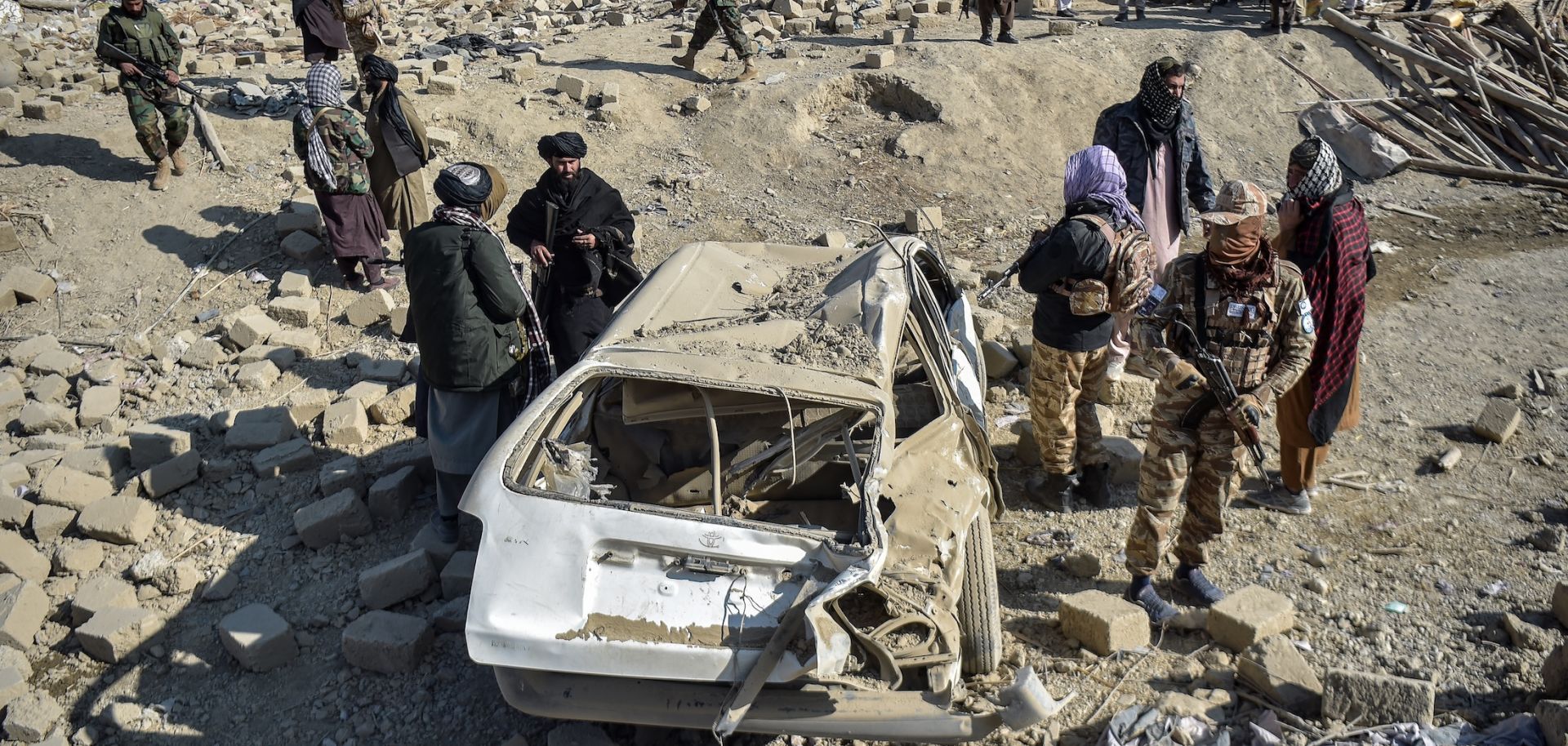
- Pakistan's Dec. 24, 2024, strikes were at least the third round of airstrikes the country has carried out in recent years against Afghanistan-based militants and appeared larger-scale than prior strikes. Pakistan carried out the strikes in response to a Dec. 21, 2024, TTP attack on a security checkpoint in northwest Pakistan that killed upward of 16 Pakistani soldiers and wounded 12 others, marking one of the deadliest attacks the country had seen in months.
The TTP's threat and the surge in tensions between Pakistan and Afghanistan follow years of persistent attacks in Pakistan, many carried out or supported by Afghanistan-based militants. Tensions have simmered between Pakistan and the Afghan Taliban for years as Pakistan has experienced frequent and increasingly brazen attacks by Afghanistan-based militants, particularly the TTP. After the Afghan Taliban retook Afghanistan in August 2021, Pakistani officials believed Pakistan's historical support for the Afghan Taliban would make the group responsive to the country's security concerns; however, Afghanistan's de facto rulers have proven largely unresponsive and have instead sought to distance themselves from their historical links to Islamabad. Much of the Afghan Taliban's indifference to Pakistan's pleas is likely driven by support for the TTP, particularly within the Afghan Taliban's senior ranks, given the TTP supported the Afghan Taliban and sheltered its fighters during the war in Afghanistan. The Afghan Taliban also likely views the TTP as a useful coercive force to leverage against Pakistan with relatively limited cost given Pakistan has only conducted a few rounds of limited airstrikes in Afghanistan in response to years of incessant TTP attacks. Against this backdrop, Pakistan is running out of lower-cost, non-kinetic options for stemming the TTP's attacks: Islamabad previously attempted to negotiate ceasefires with the TTP mediated by the Afghan Taliban, but of the few that were finalized, most did not completely stem attacks by TTP-linked groups, and all these agreements eventually collapsed. In late 2023, Pakistan intensified pressure on the Afghan Taliban to constrain the TTP by beginning mass deportations of Afghan nationals, sending hundreds of thousands of them over the border into Afghanistan, which was already experiencing severe humanitarian challenges. However, significant assistance from regional partners like China and international aid organizations has enabled the Afghan Taliban to weather this challenge while militant attacks in Pakistan continue. Given these failures, Pakistan's latest airstrikes — which follow similar cross-border strikes in March 2024 — suggest Islamabad increasingly believes kinetic action is necessary and a potentially more effective way of responding to major TTP attacks.
- The U.N. Security Council Analytical Support and Sanctions Monitoring Team's January 2024 report on the Islamic State, al Qaeda and associated groups included several details on assessed links between the Afghan Taliban and the TTP. The report states the Afghan Taliban is ''generally sympathetic to TTP aims,'' with some Afghan Taliban members ''perceiving a religious obligation to provide support.'' This support has included, among other things, assisting TTP forces in cross-border attacks, supplying them with weapons and equipment, as well as providing militants and their families with aid packages.
- Recently released reports from Islamabad-based research groups underscore the severity of militant attacks in Pakistan. The Center for Research and Security Studies on Dec. 31 reported that Pakistani security forces in 2024 had suffered their highest casualties in nearly a decade, with attacks killing upward of 685 security personnel and more than 900 civilians, based on its analysis of open sources. Another research organization, the Pakistan Institute for Conflict and Security Studies, also released a report on Dec. 31 claiming militants had killed 527 security force personnel and 489 civilians in 2024 based on data it had collected and assessed. Pakistan's military spokesperson previously said 383 soldiers had been killed fighting insurgents in 2024, but official data has often failed to align with that reported by open sources, and Pakistan's security services do not regularly verify casualties among their personnel.
- China's ambassador to Afghanistan on Jan. 5 said China was ready to assist the Afghan Taliban in resettling Afghan returnees in Afghanistan who are being expelled from Pakistan and other regional countries. The statement underscores China's partnership with the Afghan Taliban and its important role in helping the group — alongside other regional countries and foreign relief organizations — manage Afghanistan's varying crises to stem broader regional instability. That said, China has also reportedly increasingly pressured the Afghan Taliban to address cross-border attacks on its interests in Pakistan, including by threatening to make further Chinese investment in Afghanistan contingent on such efforts.
Though neither Pakistan nor the Afghan Taliban want full-blown conflict or to sever bilateral relations, they are unlikely to resolve their differences over the TTP for the foreseeable future, portending more militant attacks in Pakistan. Despite the poor state of bilateral relations in the wake of Pakistan's airstrikes and subsequent border clashes, both Pakistan and the Afghan Taliban have signaled their disinterest in unmitigated escalation and war. This is likely because for Pakistan, economic and domestic political constraints would severely challenge its ability to carry out a major military campaign, especially a protracted one, or one that requires seizing and occupying some sort of buffer space in Afghanistan. And even if Pakistan had the resources and will to mount a more ambitious offensive, like a deeper invasion or effort to overthrow Afghanistan's de facto authorities, the country likely sees few preferable alternatives to the Afghan Taliban, let alone any that would easily and successfully replace it. Meanwhile, the Afghan Taliban — which just returned to power after nearly two decades of war — would not want to provoke any conflict or major military action that threatens the group's broad territorial control and authority, nor would it want to sever ties with such an important strategic and trading partner as Pakistan, however challenging bilateral relations may be. That said, the factors responsible for the Afghan Taliban and the TTP's continuing links have thus far weathered significant Pakistani pressure, and Pakistan's recent airstrikes have only bolstered the two groups' partnership and anti-Pakistan sentiments among Afghans more broadly. This will make the Afghan Taliban even less likely to disavow the TTP for the foreseeable future, paving the way for further attacks in Pakistan.
- Pakistan and Afghanistan have recently made statements seemingly intended to stem further escalation between the two countries. Pakistan's foreign office spokesperson on Dec. 26 underscored it has prioritized diplomacy with the Afghan Taliban, likely to convey that Islamabad was not committed to dealing with the issue of the TTP militarily. Days later, the head of the Afghan Taliban's political office in Qatar made similar statements, saying the group did not ''intend to escalate'' but would respond with ''measured retaliation'' should Pakistan conduct similar attacks in the future.
- Suggesting Pakistan's airstrikes have only bolstered relations between the Afghan Taliban and the TTP, the Afghan Taliban's information minister said days after the strikes in a speech aired by Taliban-controlled media that ''We must honor the Afghan nation's commitment to safeguarding these guests,'' seemingly referring to the TTP. The statement appeared to be a rare public acknowledgment of the Afghan Taliban's harboring the TTP, which the former has outwardly denied.
The TTP will likely hesitate to target civilians regularly again regardless of their alleged links to Pakistan's military establishment, but the group's Jan. 5 threat still portends an uptick in attacks, likely including in places beyond the TTP's main operating area in northwest Pakistan. TTP chief Mehsud and other senior leaders will probably be reluctant to expand the group's limited official targeting parameters, which alongside other changes have improved unity among the group's many factions and facilitated its regrowth. Therefore, the TTP's threat may be more intended to discourage further Pakistani strikes than necessarily representing a new goal for the group. Supporting this idea, the TTP threatened to attack entities that former Prime Minister Khan's opposition Pakistan Tehreek-e-Insaf party recently criticized, which is in line with the TTP's years-long effort to exploit popular anti-government sentiment fueled by the standoff between Pakistan's military establishment and Khan. The TTP also specifically chose to threaten economically important entities as Pakistan continues to experience severe economic challenges and tries to ease Chinese concerns of worsening insecurity, underscoring the TTP's potential intent to pressure Islamabad to reconsider further cross-border strikes and perhaps even the group's broader demands. However, even if the TTP's threat is largely rhetorical, its escalatory nature still suggests the group will ramp up attacks on security forces over the coming months; these incidents will probably still focus on northwest Pakistan but also occur more frequently in major cities like Karachi, Lahore and Rawalpindi, which in recent years have only seen sporadic TTP attacks. Major attacks and those that inflict numerous casualties on Pakistani forces, such as upward of a dozen deaths, will likely prompt Pakistani airstrikes on alleged TTP targets in Afghanistan. Successful strikes on high-value targets may prompt weeks-long disruptions to TTP attacks; however, as seen in recent years, cross-border strikes are unlikely to meaningfully and durably degrade the TTP's capabilities, will often kill civilians, and will very likely prompt days of border clashes and weeks of subsequent retaliatory attacks.
- The potential that the TTP's Jan. 5 threat was more rhetorical than sincere may also be supported by the fact that the group has repeatedly threatened to attack the ruling Pakistan Muslim League-Nawaz party and its politicians over their support for military operations against the TTP, but has yet to follow through. This may indicate disinterest or aversion to reviving its regular targeting of civilians — even those responsible for ordering and helping organize military operations against the group.
- Even if the TTP does not officially sanction the regular targeting of civilians, Pakistan's security may worsen should the Afghan Taliban work more closely with the TTP to facilitate attacks. One way Afghanistan's de-facto rulers may do so would be by loosening its official restrictions on Afghan Taliban fighters directly participating in attacks on Pakistan. The Afghan Taliban's spokesperson reported in August 2023 that the group's leadership had issued a fatwa, or Islamic decree, barring its fighters from conducting attacks outside Afghanistan, deeming such activity illegitimate jihad. The decree appeared intended to ease Pakistan's concerns but seemingly did little to dampen militant attacks. Any loosening of the reported restriction would ostensibly enhance collaboration between the Afghan Taliban and the TTP, portending deadlier and/or more frequent attacks on Pakistan.
While less likely, the TTP may follow through on its threat should it perceive Pakistan's current weakness as ideal for more aggressively pursuing the group's objectives, or should Pakistan begin frequently targeting its militants in Afghanistan. The TTP's years-long expansion under Mehsud, alongside its growing return to northwest Pakistan and support from the Afghan Taliban, have facilitated its ability to carry out frequent and lethal attacks and endure Islamabad's fairly limited retaliation. This suggests the group has become highly confident in its current position and perceives Pakistan as relatively weak, especially as Islamabad continues to face severe economic difficulties and high levels of popular discontent. Against this backdrop, the TTP may believe now to be the ideal time to intensify its threat to Islamabad and more aggressively pursue its near-term objective of returning to northwest Pakistan, as well as more broadly challenging the country's government and military. This is particularly possible as Islamabad also faces an intensifying threat from Baloch separatists, with whom the TTP has reportedly increasingly worked in recent years. Alternatively, the TTP may initially avoid regularly targeting civilians but eventually decide to do so should Pakistan significantly ramp up cross-border strikes on TTP militants in Afghanistan. Such a scenario would likely see TTP militants and their family members killed in strikes, which the group may perceive as threatening more severe disruptions to the TTP's capabilities, prompting the group to escalate attacks in retaliation and to discourage further Pakistani strikes.
- The Afghan Taliban's influence over the TTP's strategy and aggression is likely limited. However, Afghanistan's de-facto authorities may support (or at least turn a blind eye to) the TTP expanding its targeting in Pakistan to pressure Islamabad to halt attacks. The Afghan Taliban would be particularly likely to do so if Pakistan begins to strike Afghanistan frequently and/or is otherwise perceived as violating Afghanistan's sovereignty, which the Afghan Taliban has in recent years sought to uphold.
Should the TTP officially condone targeting civilians again, it would significantly worsen direct and indirect personal safety risks for individuals in major cities, and it would heighten the likelihood of Pakistan taking major military action domestically and/or in Afghanistan. As the TTP has specifically threatened multiple entities based in Rawalpindi, and as the group has proven capable of carrying out brazen attacks in major cities beyond Pakistan's northwest, the TTP would likely seek to revive regular attacks in major cities like Karachi, Lahore and Rawalpindi alongside hiking its activity in northwest Pakistan if it chooses to realize its Jan. 5 warning. In such a scenario, the TTP would likely also ramp up collaboration with Baloch separatists to facilitate more attacks on Chinese nationals and investment projects to worsen Islamabad's challenges. Such severe circumstances would be more likely to prompt Islamabad to dedicate all available resources, however limited, to countering the militant threat through more substantial kinetic operations domestically and/or in Afghanistan. Potentially with financial and other assistance from partners like China, a kinetic response probably would see Pakistan carrying out better-resourced and more sizable military operations in militant hotspots in Pakistan's northwest and southwest, and/or regular strikes on Afghanistan-based militants. Pakistan probably would also be willing to conduct at least periodic cross-border raids on alleged militant targets in eastern Afghanistan, though it would likely lack the resources for a protracted and/or much larger campaign. Stability in Pakistan and the broader region would significantly worsen, portending refugee flows and insecurity that would challenge regional countries and potentially attract limited Western support to beat back militants.
- Assuming the Afghan Taliban does have some influence over the TTP's decision-making, the former probably would not take significant issue with the TTP intensifying collaboration with Baloch separatists and ramping up attacks on Chinese interests in Pakistan so long as these links are relatively low-profile and do not attract intense Chinese scrutiny of the Afghan Taliban. Should the two groups' links become more prominent and the Afghan Taliban be increasingly perceived as directly facilitating threats to Chinese interests, China would grow more likely to increase pressure on the Afghan Taliban, such as by withholding investments and other pledges unless the Afghan Taliban takes action against the TTP. But while such pressure may prompt the Afghan Taliban to reconsider its stance on the TTP, the group's Supreme Leader Haibatullah Akhundzada has consistently prioritized hardline policy and governance over foreign relations, meaning even Chinese inducements or pressure may be insufficient to weaken Afghan Taliban-TTP links.
