
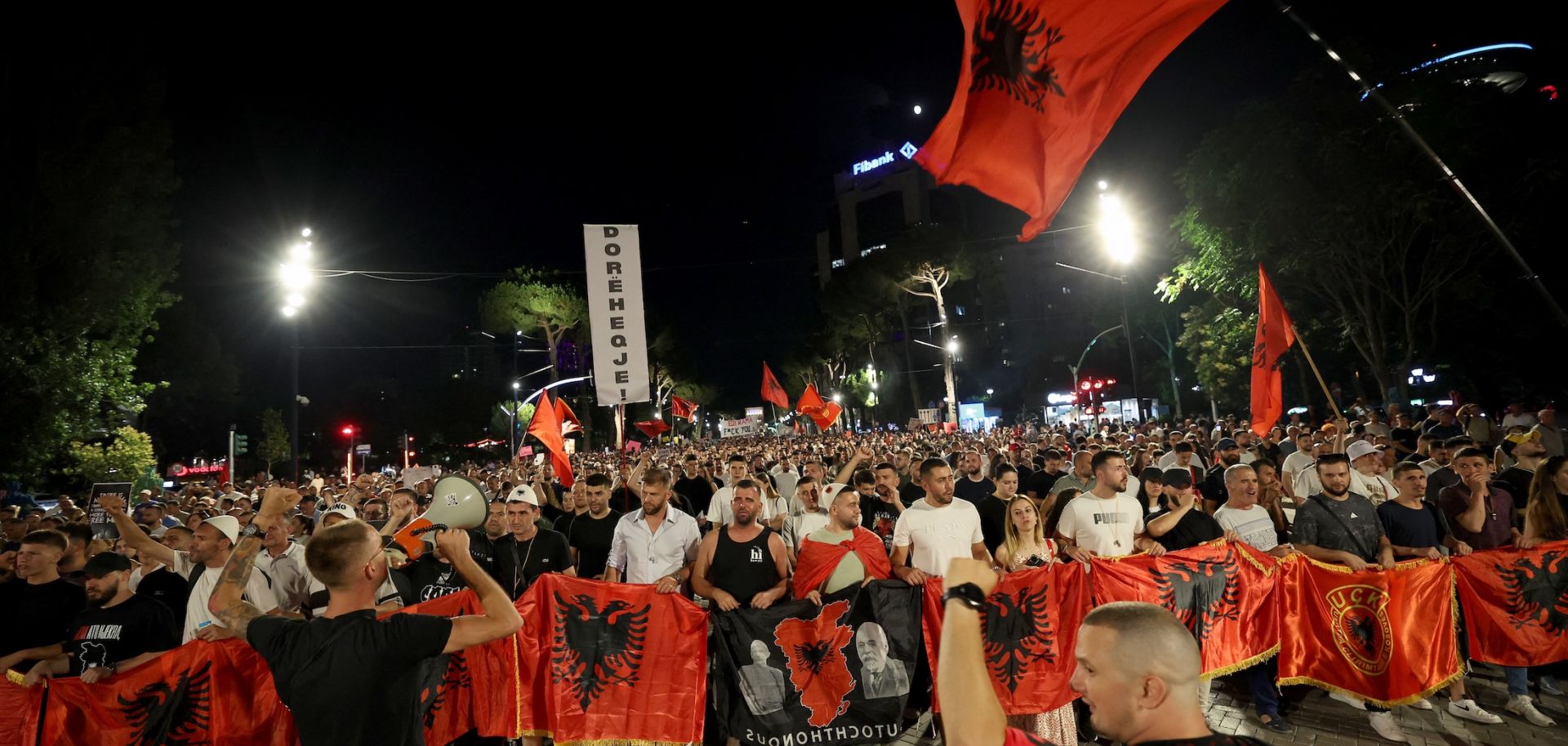
Protestors hold national flags as they gather outside Albania's prime minister's office to oppose the construction of luxury resorts, in Tirana on June 25.Protestors hold national flags as they gather outside Albania's prime minister's office to oppose the construction of luxury resorts, in Tirana on June 25.
(Adnan Beci / AFP via Getty Images)
Protestors hold national flags as they gather outside Albania's prime minister's office to oppose the construction of luxury resorts, in Tirana on June 25.

Sustained protests in Serbia and Albania are unlikely to force immediate changes of government, but will continue to erode political stability and complicate EU accession efforts, while other countries in the Western Balkans may see episodic social unrest. In recent weeks, Serbia and Albania have seen large anti-government protests. In Serbia, demonstrations initially triggered by the collapse of the Novi Sad railway station canopy in 2024, which resulted in 16 deaths, have developed into the most significant challenge to President Aleksandar Vucic in more than a decade. In Albania, protests that started in May have evolved from opposition to a controversial coastal development by a private equity firm led by Jared Kushner into a wider critique of corruption, governance and political concentration of power under Prime Minister Edi Rama. Although the two movements are not organizationally linked and have arisen from different immediate triggers, they reflect common structural grievances, including perceptions of entrenched corruption, declining trust in public institutions, economic frustrations and limited political accountability. As these factors are common across the entire Western Balkans, the rest of the region faces the risk of a period of elevated vulnerability to episodic social unrest.

  • The largest singular mobilization of the ongoing protest wave in Serbia took place on March 15, 2025, in Belgrade, with civil society organizers estimating turnout between 275,000 and 325,000 people (though the government claimed around 107,000). This year's largest rally took place in Belgrade on May 23, drawing an estimated 180,000 to 190,000 protesters. 
  • In June, major rallies in the Albanian capital, Tirana, drew between 150,000 and 250,000 protesters, according to local organizers. As a proportion of Albania's population of about 2.7 million, this turnout represented one of the largest civic mobilizations since the fall of the communist dictatorship in the early 1990s. 

Serbia is likely to remain the region's primary source of political instability, with sustained anti-government protests likely to continue over the coming weeks, while an early general election may be held in the coming months. The protest movement has broadened from grievances around the 2024 accident into a campaign demanding institutional accountability, transparency and systemic reform. Unlike many previous demonstrations, the movement has been led primarily by university students and civil society organizations rather than traditional opposition parties, enabling it to attract support from academics, professional associations, farmers, lawyers and other sectors of society. Its emphasis on the rule of law has broadened its appeal and complicated government efforts to portray protesters as partisan actors. Despite the demonstrations' scale and persistence, Vucic and his ruling Serbian Progressive Party (SNS) retain substantial institutional advantages, including dominance of Parliament, influence over state institutions and the media and the continued loyalty of the police and security services. While the protests led to the resignation of Prime Minister Milos Vucevic in early 2025, there are currently no indications of elite defections or fractures within the governing coalition. Over the coming weeks, the most likely scenario is that regular large-scale demonstrations in Belgrade and other major cities continue, accompanied by symbolic marches, university actions and periodic confrontations with police and ensuing disruptions for businesses and supply chains. The government's strategy will probably continue to combine limited concessions, rhetorical attacks on protest organizers and efforts to portray the movement as politically motivated or externally influenced. Notably, the sustained mobilization could trigger a tactical pivot from the executive. On June 27, Vucic announced that he would resign from the presidency and trigger snap general elections, though no specific dates for either event were announced. Far from a capitulation, this would represent a calculated political maneuver to bypass his constitutional two-term limit as president (which expires in late 2027), allowing him to run as the SNS candidate for prime minister — and thereby remain Serbia's central political figure. By creating the fiction of a democratic reset, the government would aim to fragment the protest movement and channel public attention into an electoral process over which it retains vast institutional advantages. Nonetheless, holding an election amid unprecedented social discontent carries a high risk, as it opens the door for a unified opposition front capable of mounting the most significant electoral threat to the SNS's decades-long control of Serbian politics. And even if the SNS wins the general and presidential elections, alleged irregularities in the elections are likely to trigger new anti-government protests.

  • The ongoing political crisis and sustained anti-government protests are increasingly complicating Serbia's EU accession prospects by reinforcing concerns among several EU member states regarding democratic backsliding, rule of law and institutional resilience — especially given Vucic's relatively close ties to Russia. Recent reporting indicates that the European Commission's efforts to advance Serbia's membership process are encountering growing resistance from a number of member states, which argue that Belgrade has failed to make progress on governance reforms while domestic political tensions continue to escalate.

Albania is likely to face continued anti-government demonstrations that will sustain pressure on the government and increase scrutiny of its EU accession process. Initially centered on opposition to a proposed luxury resort development in a protected coastal area, the demonstrations have expanded into a broader anti-government campaign focused on corruption, environmental governance, transparency and the concentration of political power. The movement has drawn support from opposition activists, environmental organizations and urban civil society, reflecting dissatisfaction that extends beyond the original development dispute. However, unlike the Serbian movement, Albanian protests remain more closely connected to established opposition networks and have yet to develop the same nationwide structure. Rama's government continues to benefit from firm parliamentary control and a cohesive ruling party, and has not yet seen significant defections from state institutions or the security services. Over the next several weeks, protests are likely to continue in Tirana and may periodically expand to other urban centers or areas directly affected by the disputed development project, creating temporary disruptions in the movements of goods and people, as well as business operations in the affected areas. Some protests could turn violent if protesters grow increasingly frustrated and police respond with force. The government is likely to respond with procedural concessions, administrative reviews and efforts to characterize the demonstrations as politically orchestrated, not genuinely civic. Participation will probably gradually decline unless new corruption allegations, controversial government decisions or forceful police responses generate renewed public outrage. Even if protest numbers diminish, the movement is likely to leave a lasting political impact by reinforcing perceptions of weak institutional accountability and increasing pressure for greater transparency in government decision-making.

  • The European Union has responded cautiously to the Albanian protests, increasing scrutiny of the country's environmental and rule-of-law standards. Although Brussels has avoided endorsing the protesters' political demands, the European Parliament has explicitly linked environmental protection to Albania's accession process.

Several more Western Balkan states face the risk of localized, lower-scale social unrest as common structural grievances create favorable conditions for anti-government mobilization. Beyond Serbia and Albania, the countries most vulnerable to social unrest over the coming months are Bosnia and Herzegovina, Montenegro and, to a lesser extent, North Macedonia. Bosnia and Herzegovina possesses perhaps the greatest latent potential for instability because of its chronic political paralysis, weak economic performance, persistent corruption and widespread public frustration with dysfunctional governance. Although ethnic divisions and complex constitutional arrangements make nationwide mobilization difficult, localized protests over corruption, public services, unemployment or economic conditions could emerge rapidly and spread between municipalities. General elections scheduled for Oct. 4 may also trigger anti-government protests. Montenegro remains politically polarized following several years of unstable coalition governments. Another corruption scandal, constitutional dispute or contentious policy decision could trigger substantial demonstrations from competing political factions. North Macedonia also retains moderate protest potential, having previously demonstrated the capacity for sustained civic mobilization during periods of political crisis. Public dissatisfaction regarding corruption, governance and living standards remains significant, even if current tensions are lower than in Serbia. Crucially, any unrest in these Western Balkan states is likely to remain more localized and less disruptive than the mass mobilizations seen in Belgrade and Tirana, especially if there is not a universally unifying catalyst like the train station collapse in Serbia or destruction of protected national coastlines in Albania. Consequently, these localized flashpoints are unlikely to pose a systemic threat to business operations, supply chains or investor confidence in these countries.

  • Kosovo faces a moderate risk of unrest, though protests are more likely to be driven by domestic political disputes or developments in relations with Serbia than by direct inspiration from neighboring protest movements. 
  • Croatia and Slovenia are comparatively resilient owing to their stronger democratic institutions, EU membership and generally higher living standards, although localized protests over inflation, housing affordability or corruption remain possible. 
RANE
SUBSCRIBERS ONLY

Expert analysis when it matters most.

Get access to RANE's decision-grade geopolitical intelligence.