
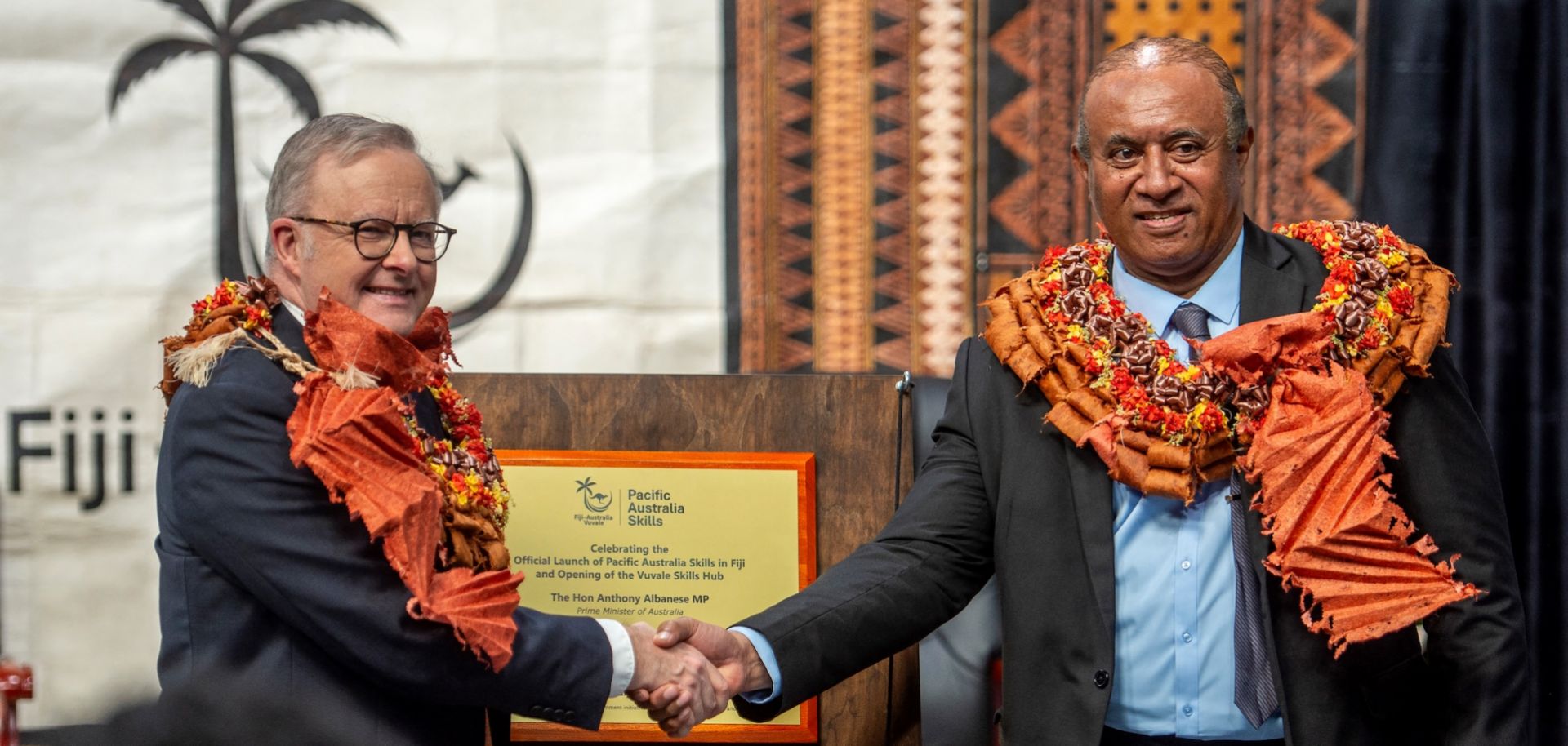
Australia's new pacts with Fiji and Vanuatu strengthen regional barriers to Chinese military access, but China's Pacific missile test shows it can project power without local basing, while island governments' financing, infrastructure and policing needs will continue giving Beijing space to build influence. On July 6, Australian Prime Minister Anthony Albanese and Fijian Prime Minister Sitiveni Rabuka signed the Ocean of Peace Alliance, committing each country to aid the other if attacked and making Fiji Australia's fourth formal military ally after the United States, New Zealand and Papua New Guinea. The treaty requires Australia and Fiji to consult on security threats, act to meet common dangers and allows other Pacific countries to join if they can advance the agreement's purposes and contribute to Pacific security. Australia and Fiji also signed the separate Vuvale Union, backed by about $693 million in Australian investment over the next decade, to expand cooperation on economic, security, migration and regional issues. On the same day as the Fiji signing, China test-fired a long-range missile with a simulated warhead from a nuclear-powered submarine into international waters in the Pacific, drawing condemnation from Australia, Japan, New Zealand and Taiwan, and reinforcing Canberra's argument that deeper Pacific security partnerships are a response to China's growing military reach. These developments came only a few days after Australia's June 29 Nakamal Agreement with Vanuatu, which made Australia Vanuatu's preferred security and policing partner, barred foreign military bases and military infrastructure on Vanuatu's territory, and required consultations with Australia on proposed third-party involvement in critical infrastructure, including ports, telecommunications, digital systems, aviation and energy, without giving Canberra explicit approval authority.

- Australia-Fiji defense cooperation was already operational, including patrol boats, training, embedded officers, infrastructure support and regional co-deployments. The treaty turns that existing military relationship into a mutual defense obligation, while the separate Vuvale Union adds consultation language around third-party activity in critical infrastructure, technology and security sectors without naming China or giving Australia explicit approval authority, similar to the Nakamal Agreement with Vanuatu.
- China's missile test followed a land-based intercontinental ballistic missile test into the Pacific in September 2024 but marks the first publicly known submarine-launched strategic missile test into the region in decades, making its sea-based nuclear delivery capability more visible in the Pacific.
- China is Vanuatu's largest external creditor, making infrastructure financing a central issue in Vanuatu's negotiation with Australia. The Australia-Vanuatu agreement was initially set to be signed in September 2025, but was delayed amid Australia's demand for veto rights over infrastructure projects in Vanuatu funded by China or other foreign partners, which Vanuatu resisted to preserve access to multiple sources of financing. The final text of the deal reflects a compromise in which Australia does not hold explicit approval authority but does hold a binding consultative role.
The Fiji and Vanuatu agreements are part of a broader effort by Australia and New Zealand to formalize Pacific security ties and limit third-party access, using mutual defense treaties, preferred partner language, policing initiatives and consultation or approval clauses to reduce potential Chinese security openings. Australia and New Zealand have increasingly tried to turn their longstanding roles as regional security guarantors into written rules on policing, military access, alliance commitments and sensitive infrastructure. The goal is to make Pacific Islands Forum (PIF) members the default security partners before Chinese financing, police cooperation or infrastructure projects can become channels for deeper regional security access. Australia first used the most restrictive version of this approach in its 2023 Falepili Union with Tuvalu and its 2024 agreement with Nauru, which require mutual agreement or approval for specified third-party security or critical infrastructure engagements, effectively giving Australia at least a partial veto over those countries' dealings with China. Canberra then moved into formal alliance building with Papua New Guinea through the October 2025 Pukpuk Treaty, which requires each side to aid the other if attacked and obliges both to refrain from entering into agreements or engaging in activities that would compromise the treaty's implementation. With the Fiji alliance, two of Australia's four formal military alliances have now been signed with Pacific Island countries in the past nine months, underscoring the urgency of Canberra's effort to lock in regional security commitments. Australia has also backed the Pacific Policing Initiative endorsed by Pacific Islands Forum leaders in 2024 and is pursuing a comprehensive treaty with the Solomon Islands after China skeptic Matthew Wale became prime minister in May and subsequently pledged to review the country's contentious 2022 security pact with China. New Zealand has moved in parallel, including a 2026 defense and security declaration with the Cook Islands, following tensions over the latter's 2025 comprehensive strategic partnership with China. These moves show how Australia and New Zealand are pairing aid, infrastructure financing and policing support with country-by-country treaty mechanisms to preempt Chinese military basing, routine deployments or security infrastructure.
- The broader Pacific contest revolves around access and denial across island states that control vast ocean space between Asia, Oceania and U.S. territories. China is trying to break into a security order long dominated by Australia and New Zealand in the South Pacific and by U.S. access rights in the North Pacific. Its goal is to push influence beyond the first island chain, the arc of islands from Japan through Taiwan, the Philippines and Borneo that hems in China's access to the wider Pacific. Beijing is also seeking to create openings for port access, surveillance, logistics support or security deployments near the second island chain, Guam and Australia's maritime approaches.
- The 2022 China-Solomon Islands pact sparked the recent flurry of Pacific engagement from Australia and New Zealand because it showed how police cooperation, logistics support and naval visits could create a pathway to a standing Chinese security presence. Australia and other partners warned at the time that the pact could enable permanent Chinese basing. Wale's 2026 decision to review the pact and negotiate with Australia makes the Solomon Islands the next test of whether Canberra can turn concern over Chinese access into treaty commitments.
- Economically, Australia and New Zealand are backing treaty constraints with financing meant to give Pacific governments alternatives to Chinese funding. Australia allocated roughly $1.5 billion in aid to the Pacific, expanded its Pacific infrastructure facility to around $3.1 billion in loans and grants, and is pairing the Fiji and Vanuatu security deals with broader economic packages. New Zealand directs around 60% of its development funding to the Pacific and, in 2025, added around $57 million per year for developing countries, especially in the Pacific.
Pacific governments' chronic development, climate, policing and infrastructure needs will keep them bargaining with China and other outside powers, making it difficult to sustain agreements that give Australia a significant role in reviewing third-party security or critical infrastructure engagement. Australia and New Zealand can reduce the risk of overt Chinese military access by writing preferred partner language, foreign military access bans, mutual defense obligations and third-party consultation or approval rules into bilateral agreements. These agreements, however, cannot eliminate the underlying demand for Chinese financing, infrastructure, equipment and political support because Pacific governments face chronic needs that exceed what Australia, New Zealand, the United States and other partners aligned around limiting Chinese security access are willing or able to provide. Canberra's leverage will be strongest where island governments are small and heavily aid dependent, where formal China ties are limited or politically sensitive, and/or where an operational defense relationship already exists, as in Fiji. It will be weaker in countries where China is a major creditor or infrastructure partner, as in Vanuatu (i.e., no Australian veto power), or where domestic politics make Australian restrictions vulnerable to sovereignty arguments, as in the Solomon Islands (where sovereignty is a core electoral issue). This means the emerging architecture will close some doors to Chinese basing and routine security deployments while leaving Beijing room to compete through financing, infrastructure, police training, elite outreach and future negotiations with governments less willing to accept Australian review powers.
- The regional pattern breaks into distinct models rather than a single template. Tuvalu represents the maximum restriction model because third-party security engagement requires Australian agreement. Nauru is narrower, requiring mutual agreement only in select areas. Vanuatu marks a consultation model shaped by Chinese financing leverage, while Fiji and Papua New Guinea are alliance cases where Australia is deepening defense ties without securing broad formal approval powers over third-party engagement (though Fiji's separate Vuvale Union adds consultation language on third-party activity). The Solomon Islands remains the main swing case because its government is reviewing the 2022 China security pact and negotiating with Australia, but future governments could still recast Australian restrictions as sovereignty costs if a treaty limits access to alternative financing or security partners.
These agreements will narrow overt Chinese military access pathways in the short term, but China's missile test shows Beijing can credibly demonstrate its military reach even without basing options, while it continues to improve its longer-term security access prospects through subtler means. For now, Australia, New Zealand and the United States still hold the region's main military advantages, and a Chinese military base remains a distant and politically difficult prospect. Australia's Fiji alliance strengthens that position because Fiji has one of the few Pacific island militaries with a sustained record of external deployments, providing Australia with one of the more capable regional partners. That balance gives Canberra, Wellington and Washington time to reinforce their formal security position, though it does not neutralize the channels through which China can build influence. China's missile test also shows that Beijing does not need a Pacific base to make its military reach credible in the region. Additionally, Beijing can still use financing, policing support, disaster relief, telecommunications assistance, port services, training and economic agreements to give local leaders visible benefits and build relationships inside ministries, ports and security forces that could support future access without requiring a formal base. That means the new agreements are likely to make formal Chinese basing and militarized infrastructure more difficult for Beijing to secure while leaving the wider regional influence and access competition unresolved. This will preserve the current regional military balance in the short term, but it will also push the broader contest toward less explicit forms of influence and access, where China can still expand its government ties, infrastructure financing and security footholds below an overt military threshold in ways that could make future security access easier for Beijing to negotiate, justify, operationalize and expand upon in the longer term.
- China does not necessarily need formal military access to build security influence. In Pacific states where police forces carry much of the internal security burden and some governments have no military, Chinese police advisers, training, equipment and liaison channels can create relationships inside ministries and police commands while avoiding the political scrutiny of a military base.