
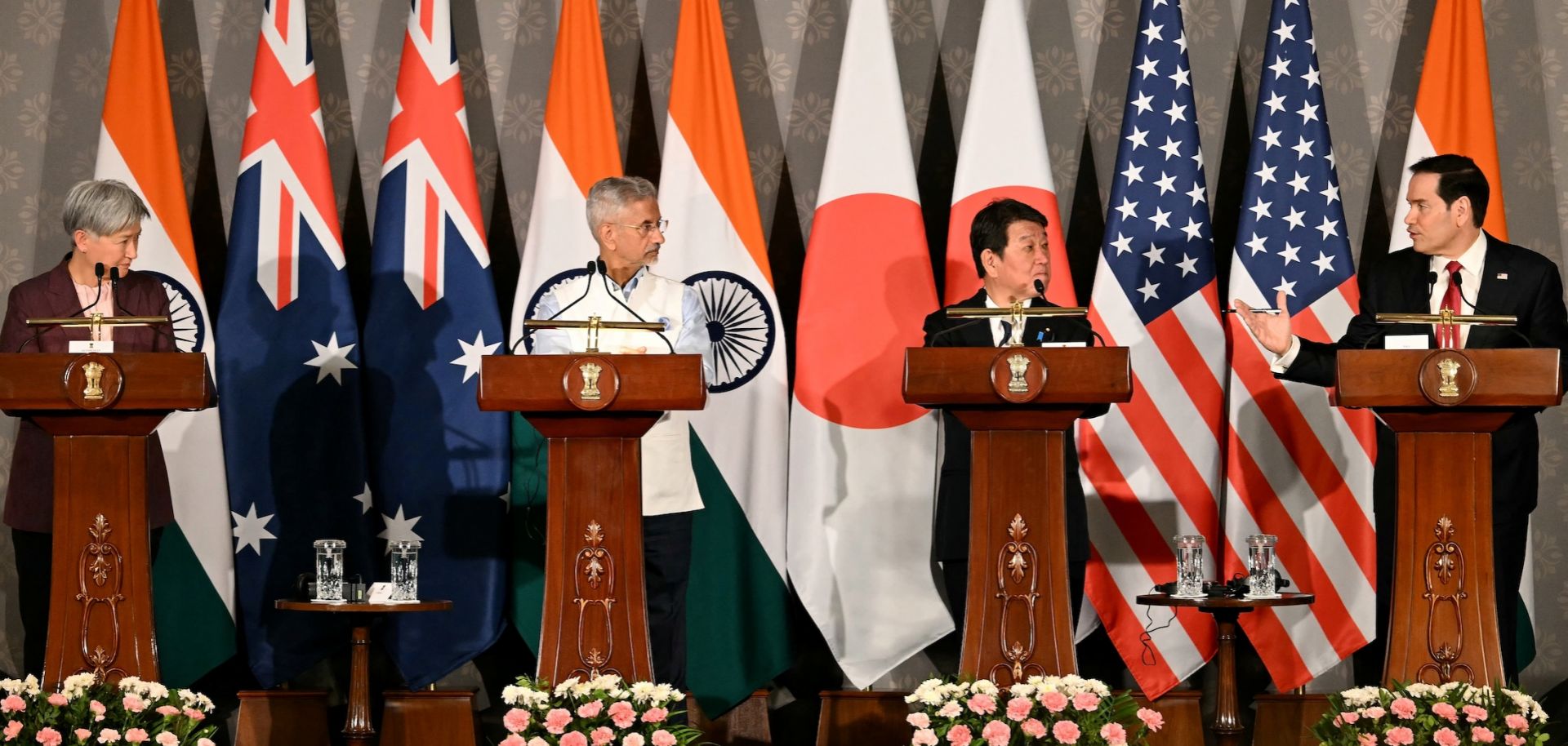
A recent meeting of the Quad partnership showed that the grouping is still functional despite the de facto suspension of leader-level summits, but it faces strong constraints in turning ambitious coordination frameworks into functional maritime, infrastructure, critical minerals and energy initiatives that blunt Chinese regional influence. The foreign ministers from the four countries in the Quadrilateral Security Dialogue (Quad) — the United States, India, Australia and Japan — announced several new initiatives after meeting in New Delhi on May 26. The most concrete deliverable is a plan to work with Fiji on port infrastructure, marking the Quad's first joint regional infrastructure project and giving the grouping a visible Pacific Islands initiative after years of promising practical alternatives to China-backed infrastructure. The bloc also launched the Indo-Pacific Maritime Surveillance Collaboration, intended to integrate Quad maritime surveillance capabilities, improve real-time information sharing and support a shared operating picture across the wider region, starting with the Indian Ocean. Additionally, the grouping announced the Quad Critical Minerals Initiative Framework, which is designed to guide coordination of policy tools and investment across mining, processing and recycling, reflecting shared concern over China's dominance in critical mineral supply chains. It separately launched the Quad Initiative on Indo-Pacific Energy Security, focused on regional energy resilience through cooperation on technology, management, policy, market analysis and emergency response exercises.

- The New Delhi meeting brought together Australian Foreign Minister Penny Wong, Indian External Affairs Minister S. Jaishankar, Japanese Foreign Minister Toshimitsu Motegi and U.S. Secretary of State Marco Rubio.
- The joint statement also covered undersea cables, secure digital infrastructure, 5G, 6G, artificial intelligence, biomanufacturing, health security, humanitarian assistance and disaster response.
The May 26 meeting ended a period of dormancy marked by uncertainty about the Quad's role during the second term of U.S. President Donald Trump, after years of increasing coordination among the four countries. The Quad entered its current phase in 2021, when the members' four leaders began meeting at annual summits and widened the agenda beyond maritime security to vaccines, climate, critical technologies, infrastructure, cyber, space, health security and humanitarian assistance. That broader agenda was meant to make the Quad more palatable to Southeast Asian and Pacific Island governments that are reluctant to be perceived as aligning with a U.S.-led effort to counter China but remain open to cooperation that advances their priorities of maritime surveillance, infrastructure, disaster response and supply chain resilience. Since then, however, the grouping has shifted back toward maritime security, economic resilience and strategic competition with China, exemplified by the 2022 Indo-Pacific Partnership for Maritime Domain Awareness and the 2024 summit's coast guard, logistics, secure technology and infrastructure initiatives. Upon returning to the White House in January 2025, Trump initially appeared set to preserve Quad continuity, with Rubio hosting a foreign ministers' meeting on his first day as secretary of state and a second ministerial meeting in Washington in July 2025, which launched the Quad Critical Minerals Initiative and the Ports of the Future Partnership. However, the rest of 2025 exposed deeper uncertainty over the grouping's direction under a second Trump administration. India did not host the expected leaders' summit in 2026 amid U.S.-India trade tensions, and New Delhi became more cautious about embracing a format that could be pulled into Washington's transactional tariff and security agenda. The absence of a leaders' meeting revived doubts about whether the Quad would remain a top-level diplomatic priority for the United States or drift into a lower-profile coordination mechanism. Against that backdrop, the recent foreign ministers' summit in New Delhi served as both a policy meeting and a reassurance exercise, showing that the four governments still see value in the Quad, even as various uncertainties cloud its future.
- Initially established as a disaster effort after the 2004 Indian Ocean tsunami, the Quad transitioned into a security dialogue in 2007 but subsequently lost momentum amid concerns about provoking China. The grouping was later revived in 2017 as U.S., Japanese, Indian, and Australian concerns over Chinese military and economic behavior increased.
The Quad may make partial progress on the initiatives announced at the meeting, but success will be limited by vague project details, uncertain financing and long development timelines. Many of the hoped-for gains will depend on private companies, lenders and project developers that Quad governments can influence but not direct. The grouping is thus likely positioned to pursue lower-profile, project-specific cooperation amid bilateral frictions and divergent stances toward China. Maritime surveillance is the likeliest area to show short-term progress because it builds on existing Quad work and can advance through data sharing and technical support. The Fiji port project will mark a key test case, but the Quad has so far only announced support for improving the island nation's port capacity without identifying specific locations, funding, construction plans or timelines. Progress on critical minerals cooperation will move slowest because the Quad initiative is still a framework for coordinating policy tools and investment across mining, processing and recycling, lacking identified mine and refinery construction projects, timelines or offtake agreements. Even if the Quad reaches that stage, new mining and processing projects would still face decade-long development timelines. Amid these and other constraints, it is possible that a scenario of even sharper failure emerges in which the Fiji port project stalls, maritime surveillance cooperation produces only limited or delayed information sharing and/or critical minerals cooperation fails to identify investable projects. In that case, the New Delhi summit would instead confirm doubts about the Quad's inability to convert strategic alignment into even minimal concrete gains, allowing China to face less coordinated scrutiny while regional states treat the grouping as a diplomatic forum rather than a meaningful source of practical support.
- The Quad's own language on ports, energy security and critical minerals repeatedly emphasizes coordination, policy tools, investment and partner country cooperation, indicating that implementation will depend on financing, private sector participation and host country buy-in, rather than ministerial agreement alone.
Nonetheless, even partial implementation of the New Delhi initiatives would make it easier to expose Chinese maritime coercion and grant regional states more non-Chinese options for infrastructure, energy and supply chains, though this would also invite stronger pressure from Beijing. If Quad members can overcome constraints, the announced initiatives would give them a stronger platform for coordinating China policy without establishing a formal alliance. For other countries in the wider region, these initiatives would likely materialize as opt-in, project-level cooperation that allows them to use the Quad's maritime data, training and information sharing tools. This would, in turn, make Chinese maritime activity easier to detect and expose by pooling surveillance data and real-time information, thereby helping regional governments identify suspicious coast guard, maritime militia, fishing and survey activity. A more functional Quad would also weaken Chinese infrastructure and supply chain leverage at the margins by giving regional governments greater room to hedge through non-Chinese options. However, this would prompt Beijing to further frame the Quad as an anti-China bloc, exert pressure on cooperating regional governments and offer faster financing alternatives. Consequently, a more competitive regional landscape would emerge in which the Quad delivers some usable cooperation, China works to blunt or outbid it, and smaller states engage both sides while avoiding overt alignment.
- The broader ports agenda has already involved prospective partner countries beyond the four Quad members, with the October 2025 Quad Ports of the Future conference including participants from Fiji, Palau, Kiribati, Tuvalu, Vietnam, Sri Lanka and Tanzania.
- The joint statement from the New Delhi summit said the Quad would continue to support undersea cable connectivity for all 18 Pacific Islands Forum members and identify additional cable projects, extending the grouping's regional infrastructure agenda beyond ports to digital connectivity.