
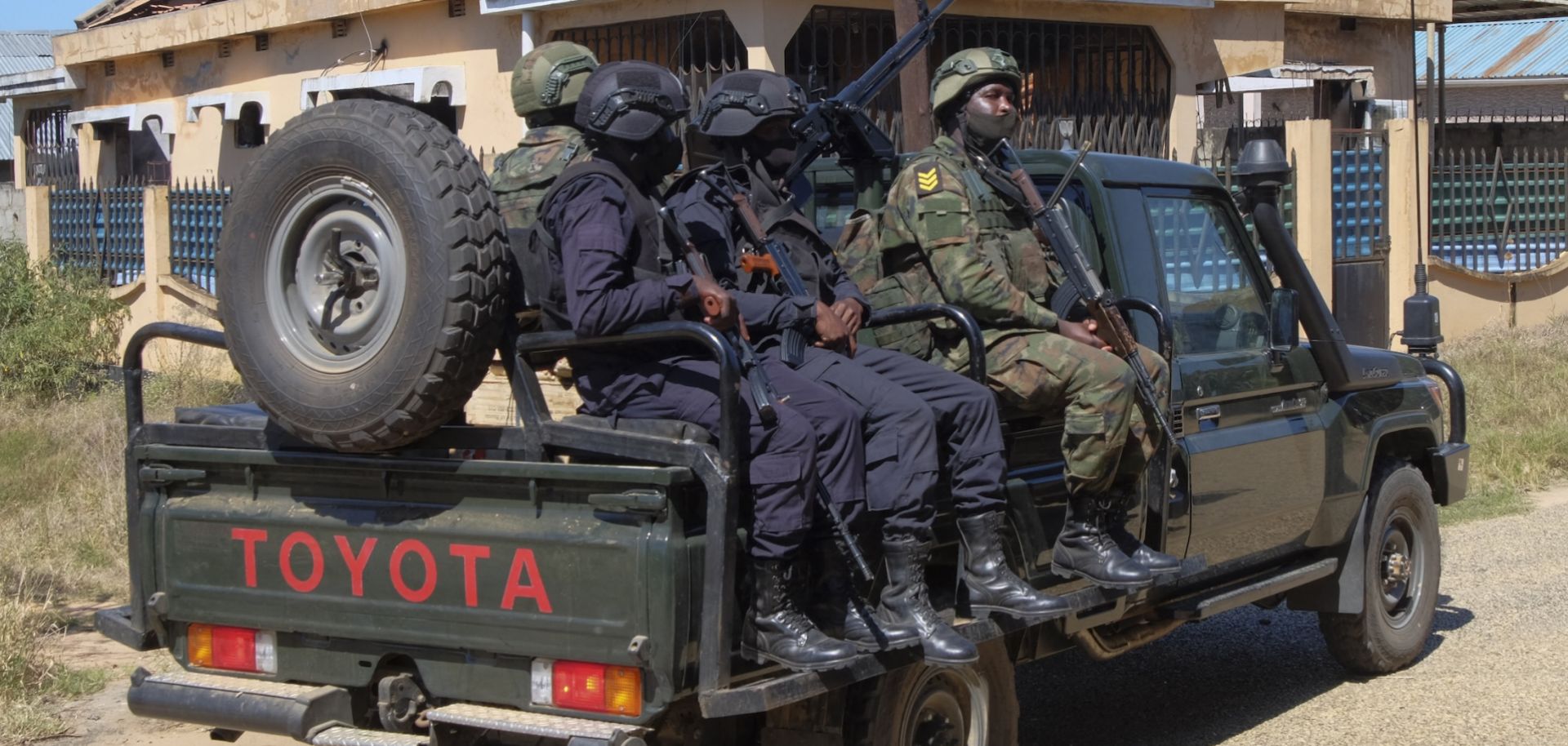
Rwanda is unlikely to press ahead with a complete troop withdrawal from Mozambique for the foreseeable future, but the European Union's refusal to provide fresh funding would raise the prospect of a partial drawdown of Rwandan forces that would portend rising security risks in the northern Cabo Delgado province and could prompt Maputo to expand counterterrorism cooperation with the United States. On March 14, Rwandan Foreign Affairs Minister Olivier Nduhungirehe said the Rwandan government was ready to withdraw its troops from Mozambique's northern Cabo Delgado province, where they are stationed to combat a jihadist insurgency, if Kiagli's "efforts and achievements [were] not appreciated." This came after Bloomberg reported on March 12 that funding from the European Union for Rwanda's military deployment in Cabo Delgado is set to expire in May and that EU officials have not yet planned any discussions on a possible renewal. Prior to the Bloomberg report, the United States imposed financial sanctions on the Rwandan Defence Forces, the country's military, on March 2 for its support to the M23 movement in the eastern Democratic Republic of the Congo.
Rwanda's troop deployment to Cabo Delgado has played a decisive role in improving the security environment, enabling TotalEnergies and ExxonMobil to resume progress on their liquefied natural gas (LNG) projects in the region. Rwanda deployed security forces to Cabo Delgado in July 2021 after major attacks by Islamic State Mozambique Province (ISMP) prompted French major TotalEnergies and U.S. major ExxonMobil to declare force majeure on their LNG projects. The Rwandan deployment grew to an estimated 4,000-5,000 forces in May 2024, ahead of the termination of the Southern African Development Community's own military deployment to the area. Although ISMP remains a major security threat in Cabo Delgado, Rwanda's troop deployment has helped degrade the jihadist group's capabilities and improve the security environment near the Afungi Peninsula, where the TotalEnergies and ExxonMobil projects are located. Consequently, TotalEnergies lifted force majeure on its $20 billion Mozambique LNG project in October 2025 and formally resumed work in January, while ExxonMobil lifted force majeure for its proposed $30 billion Rovuma LNG project in November 2025. The strategic importance of both projects in diversifying global natural gas production beyond the United States, Russia and the Middle East has been a driving factor behind Rwanda's deployment, as well as the European Union's financial support to Kigali's mission, which amounted to a 20 million euros package in 2024. However, EU financial assistance accounts for only a fraction of the costs of the Rwandan deployment. While Mozambique is also providing monthly payments to Rwanda to cover the costs of the mission, these have been inconsistent, leading at times to multi-month halts and heightening uncertainty about the mission's long-term financing.
- The Southern African Development Community deployed an estimated 2,200 troops to Mozambique from 2021 to 2024, but the mission was chronically underfunded. Moreover, South African troops leading the deployment often lacked the combat readiness of their Rwandan counterparts, who have been praised as the most effective force against ISMP.
- Estimates suggest that Rwanda's troop deployment to Cabo Delgado costs between $120 million and over $250 million a year. Mozambique reportedly sends Rwanda $2 million to $4 million each month to cover expenses linked to the deployment. However, these payments were halted in August 2024, before reportedly resuming in mid-2025.
- In late 2022, the European Union approved an initial 20 million euro package to support Rwanda's troop deployment. However, the approval of top-up funding in 2024 triggered significant controversy among EU member states due to Rwanda's known links to M23 rebels involved in the conflict in eastern Congo.
Even if the European Union does not renew its funding on time, Rwanda is unlikely to swiftly and completely withdraw its troops from Cabo Delgado for the foreseeable future, but a prolonged halt in EU funding would raise the prospect of a partial troop drawdown. Comments by Nduhungirehe and other Rwandan officials are aimed at pressuring the European Union to approve a new round of financial support to Rwanda's troop deployment in Cabo Delgado. European countries' need to diversify their natural gas supply — due to Iran-linked disruptions, the phaseout of Russian gas and uncertainty about the future of transatlantic relations — means Kigali's warnings will likely prompt EU officials to begin drafting plans for fresh financial support, especially given the low sums involved. However, recent U.S. sanctions against the Rwandan military mean that proceeding with this support could expose the European Union to secondary sanctions, which the Trump administration would likely use as leverage in its various disputes with Brussels, even if not directly linked to Rwanda or Mozambique. Although the European Union may still approve a new round of funding, given the strategic importance of the TotalEnergies and ExxonMobil projects, the new legal ramifications suggest there is a high risk that this will not happen before the end of May. However, even if the bloc fails to renew funding by this deadline, Kigali remains unlikely to swiftly and completely withdraw its forces from Cabo Delgado for the foreseeable future, as this presence gives Rwanda leverage over European states and serves as a deterrent against a more confrontational EU stance on Rwanda's policy in eastern Congo, which could involve aid cuts and/or economic sanctions. Furthermore, Mozambique and certain European states, either bilaterally or through mini-lateral agreements, may decide to step up their financial support to Kigali to shelve the prospect of a Rwandan withdrawal. Nonetheless, in the event of a protracted deadlock over funding, Rwanda may announce a partial troop drawdown from the region by the end of 2026 to pressure the European Union and its member states into extending fresh financial support.
A major drawdown of Rwandan troops from Cabo Delgado would portend a degradation of the province's security environment, likely prompting Mozambique to seek expanded counterterrorism cooperation with the United States. In contrast to Rwandan troops and capabilities, the Mozambican military remains confronted with logistical gaps, corruption and uneven discipline that hinder its operational performance, despite capacity-building efforts by Rwanda and the European Union. This suggests that any large drawdown of Rwandan troops from Cabo Delgado would open a security vacuum in the province. While remaining Rwandan troops would likely retain a strong presence near the Afungi Peninsula in the event of a partial drawdown, such a turn of events would still portend a degradation of the broader security environment in Cabo Delgado, as ISMP militants would likely expand operations in areas vacated by Rwandan forces. Against this backdrop, the Mozambican government would likely look for new external support. A first option would be to resume the Southern African Development Community's mission. But the mission would almost immediately face funding challenges, while the deployed troops would likely lack the Rwandan military's combat readiness. Similar difficulties would afflict a potential peacekeeping deployment by the African Union, though Uganda would stand as a credible troop contributor following the withdrawal of its forces from Somalia. Faced with these limited options, Mozambique would likely seek to expand counterterrorism cooperation with the United States as well. Although ISMP's international profile is significantly less prominent than several African jihadist groups in Somalia and West Africa, the Trump administration would likely prove willing to consider those requests, given U.S. commercial interests in the ExxonMobil and TotalEnergies projects, as well as ISMP's attacks against Christian communities — the stated reason for U.S. counter-terrorism cooperation with Nigeria. U.S. security assistance to Mozambique would most likely materialize through intelligence, surveillance and reconnaissance flights, but it could also involve military training, equipment support and eventually aerial strikes against ISMP militants in a less likely, higher-impact scenario. However, the Trump administration would likely condition such counterterrorism support on deeper economic cooperation, particularly expanding U.S.-linked firms' access to Mozambique's critical minerals.
- Rwandan security forces' operations against ISMP have resulted in few known civilian casualties, while their Mozambican counterparts' extrajudicial killings against civilians over the last few years are well-documented and continue on a semi-frequent basis. Rights abuses have exacerbated mistrust from Cabo Delgado's Muslim communities, supporting ISMP's long-term recruitment efforts.
- The U.S. Export-Import Bank approved $4.7 billion in financing to TotalEnergies' Mozambique LNG project in March 2025, meaning that the United States now has a vested interest in the project's completion.
- Uganda has deployed thousands of troops in Somalia to counter al Qaeda affiliate al-Shabab since 2006, but Ugandan Chief of Defence Forces Muhoozi Kainerugaba announced in late January that the Ugandan government intended to "completely withdraw" its forces from Somalia "very soon."
- In late February, the U.S. Trade and Development Agency signed an agreement with British mining company Altona Rare Earths to support pre-feasibility studies for the Monte Muambe project in Mozambique's central Tete province. Mozambique stands as the third largest graphite producer in the world with an estimated 25 million tonnes in reserves, or 8% of known reserves globally — potentially making it an important supplier to the U.S. defence industry, given China's restrictions on graphite exports to U.S. entities.
