
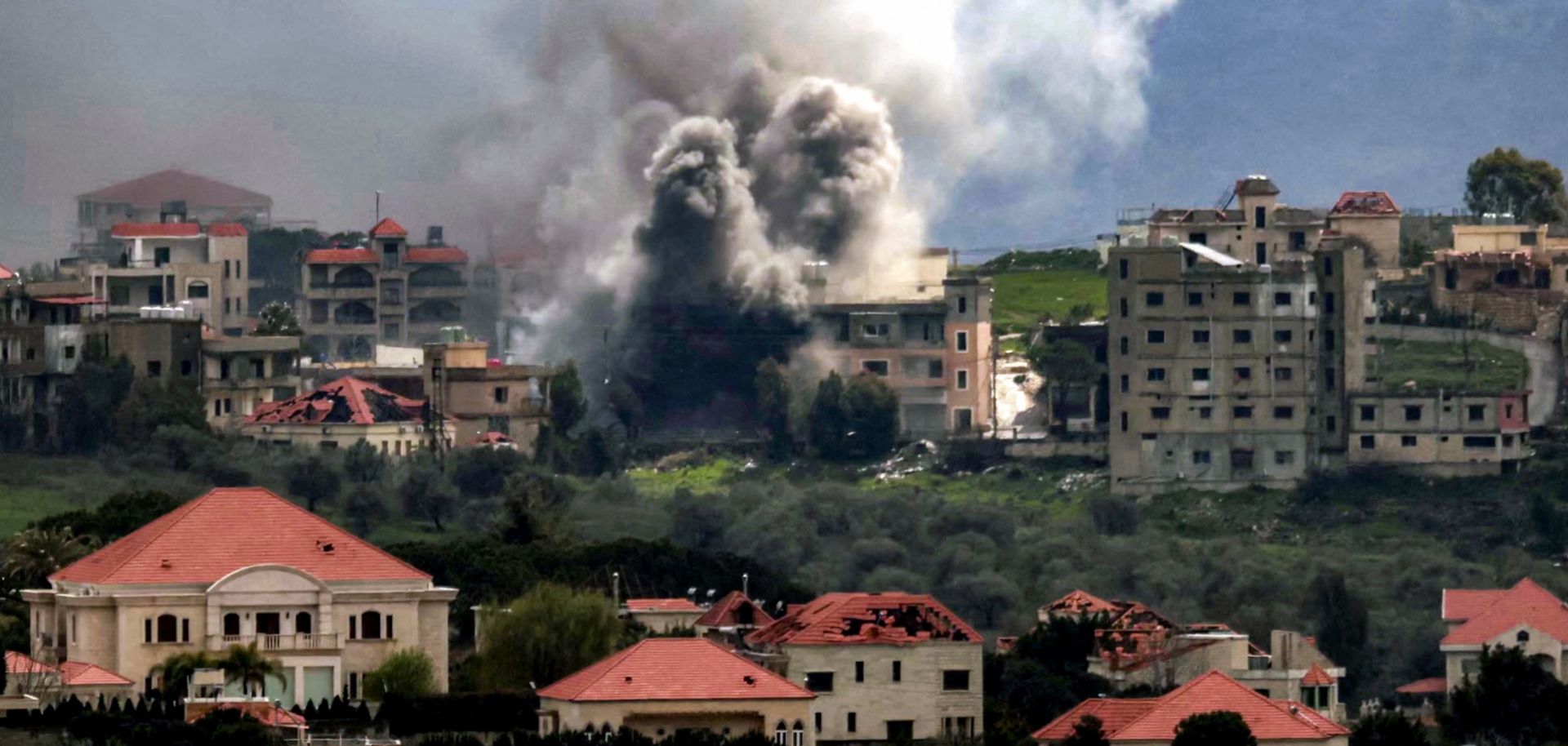
Any negotiations between Israel and Lebanon are unlikely to resolve fundamental disputes, meaning the most likely scenario in the coming weeks is an escalation in fighting between Israel and Hezbollah. On March 16, Israeli Defense Minister Israel Katz announced the start of large ground operations against Hezbollah in southern Lebanon, escalating the renewed fighting with Hezbollah that erupted on March 2 amid Israel and the United States' ongoing war with Iran. Two days earlier, Axios reported that France had drafted a diplomatic framework aimed at ending the ongoing Israel-Hezbollah war and preventing a prolonged Israeli military presence in southern Lebanon. The proposal reportedly calls for direct negotiations between Israel and Lebanon, facilitated by France and potentially supported by the United States, with the goal of reaching a political declaration within approximately one month. The reported framework would see both sides reaffirm their commitment to U.N. Security Council Resolution 1701, which ended the 2006 Israel-Hezbollah war. The Lebanese military would also redeploy south of the Litani River to help stabilize the border area. In exchange, Israel would withdraw from territories captured during the current fighting, while Lebanon would engage in negotiations over a long-term non-aggression arrangement with Israel, potentially opening the door to a broader normalization of ties. The Axios report also noted that Lebanese President Joseph Aoun had begun forming a negotiating team for potential talks, even as Israel continues expanding military operations in southern Lebanon.
- On March 2, Hezbollah conducted its first attack against Israel since the Hezbollah-Israel ceasefire took effect in November 2024 by launching rockets and drones into northern Israel in retaliation for the Feb. 28 killing of Iranian Supreme Leader Ayatollah Ali Khamenei in U.S. and Israeli airstrikes.
- On March 9, Lebanon's government communicated to Israel, reportedly through U.S. mediation channels, that it was open to starting direct talks to reach a framework to halt the current conflict, establish security and diplomatic arrangements, and work on disarming Hezbollah. Beirut is seeking a diplomatic end to the escalating conflict to prevent further damage inside Lebanon.
While the Lebanese government is concerned about a new round of Israeli attacks that cause major damage, the Israeli government views the current moment as a strategic opportunity to impose long-term security arrangements and further degrade Hezbollah's military capabilities. The Lebanese government's apparent openness to negotiations and potential concessions reflects an effort to limit further damage to the country's infrastructure, economy and territorial integrity amid widespread war fatigue in Lebanon, which has endured ongoing Israeli attacks since the last Israel-Hezbollah conflict in 2023-2024. Beirut also appears intent on signaling to international partners that the Lebanese state — not Hezbollah — holds authority over decisions related to war and peace, while potentially creating political conditions that could support longer-term efforts to facilitate Hezbollah's disarmament. By contrast, Israel's far-right government under Prime Minister Benjamin Netanyahu sees an unprecedented chance to completely dismantle Hezbollah's military infrastructure and establish a semi-permanent buffer zone in Lebanon's south, at least until the group is completely disarmed. The Netanyahu government also sees an opportunity to force the Lebanese government with harsh conditions and compel Beirut to establish relations by ending the state of war and negotiating directly.
- Following Hezbollah's March 2 attack on northern Israel, the Lebanese government issued an unprecedented decree outlawing Hezbollah's military activities and prosecuting the group's armed operatives. But Beirut has largely failed to significantly advance efforts to disarm the group, despite significant Israeli and U.S. pressure and the Lebanese government's own tougher rhetoric against the group.
- Hezbollah said its renewed attacks on Israel were not only a show of support for Iran, but a response to over a year of failed Lebanese government efforts to get Israel to halt its attacks and withdraw its troops from the five positions in southern Lebanon that they have occupied since the November 2024 ceasefire.
Even if France facilitates direct Israel-Lebanon talks, a decisive settlement will remain elusive, meaning the Israel-Hezbollah war will most likely intensify in the coming weeks. With Lebanon's government seeking to avert another major Israeli assault, and Israel potentially open to going through the motions of diplomacy, it is possible that representatives from both sides meet in the coming days or weeks. Still, the prospects for a meaningful settlement are dim because Israel is unlikely to agree to any deal without securing severe concessions that Beirut cannot afford. Currently, Israel appears intent on dealing a lasting blow to Hezbollah by capitalizing on the group's weakness. Israel will thus continue to escalate its military operations in southern Lebanon, hoping that sustained pressure will degrade Hezbollah's capabilities and eventually either force the group's disarmament or at least push the Lebanese government to accept stronger border security arrangements (like an expanded buffer zone). Indeed, in terms of weakening Hezbollah, Israel is calculating that its military operations can achieve more than what Lebanon's government is currently offering, and that Beirut will be forced to accept harsh conditions in the end, either way. Hezbollah, for its part, will try to undermine any talks, primarily by hardening its position to prevent Lebanon and Israel from reaching a deal. To prolong the conflict and raise the operational and political costs for Israel, Hezbollah will also likely conduct frequent rocket and drone attacks against Israeli ground forces in southern Lebanon, seeking to maximize casualties. Such efforts would likely be aimed at forcing Israeli concessions or, at a minimum, ensuring that Hezbollah retains enough military and political capacity to claim that it resisted Israeli objectives, which the group sees as essential to preserve its influence and support base in any post-war scenario.
- The Lebanese government's rapid call for negotiations while Israeli forces continue advancing in southern Lebanon suggests Beirut is prioritizing de-escalation, even while operating from a comparatively weaker bargaining position. However, Israeli decision-makers will likely interpret Lebanon's early push for negotiations as evidence of its limited leverage, which may encourage Israel to sustain or expand military pressure in southern Lebanon in order to secure more favorable terms in any eventual agreement.
- The only realistic scenario in which Israel could be compelled to pursue a rapid deal with Lebanon would involve strong U.S. pressure, similar to the diplomatic leverage Washington applied in previous crises involving Gaza or Iran. However, there are currently no signs that the Trump administration intends to exert such pressure. Instead, the White House appears largely aligned with Israel's strategy to weaken Hezbollah.
In the much less likely scenario where an Israel-Lebanon deal is reached quickly, the agreement would likely generate political backlash, social unrest and sectarian violence in Lebanon. The only way Israel could reach a deal with Lebanon relatively quickly through talks is if the Lebanese government offers major concessions, including the potential acceptance of a long-term Israeli buffer zone, border demarcation arrangements widely interpreted as disadvantageous to Lebanon and/or the forceful disarmament of Hezbollah across the country. However, making any of these concessions would likely provoke severe political and security crises in Lebanon. For one, it would exacerbate political divisions within the country's cabinet and parliament, further paralyzing policymaking. The numerous anti-Israel factions in Lebanon would likely also stage widespread protests. The risk of sectarian violence would escalate as well — especially if the army attempts to forcefully disarm Hezbollah, which would anger not only Hezbollah but its Lebanese allies (such as the Sunni-led Jamaa al Islamiya), along with Palestinian factions, raising the potential for direct clashes between the army and these groups. Furthermore, such dynamics would raise the risk of clashes with anti-Hezbollah factions in Lebanon, including the Lebanese Forces or other Sunni groups, who blame Hezbollah for dragging Lebanon into another war, as well as the many internally displaced Shiites now living in majority Christian and Sunni areas. All of these dynamics would further weaken Lebanon's already fragile state institutions and complicate the implementation of any agreement, which would, in turn, sustain the risk of renewed Israeli intervention. Collectively, these internal conflicts would further weaken Lebanon's already fragile state institutions and complicate the implementation of any agreement, thereby sustaining the risk of renewed Israeli military intervention.
