
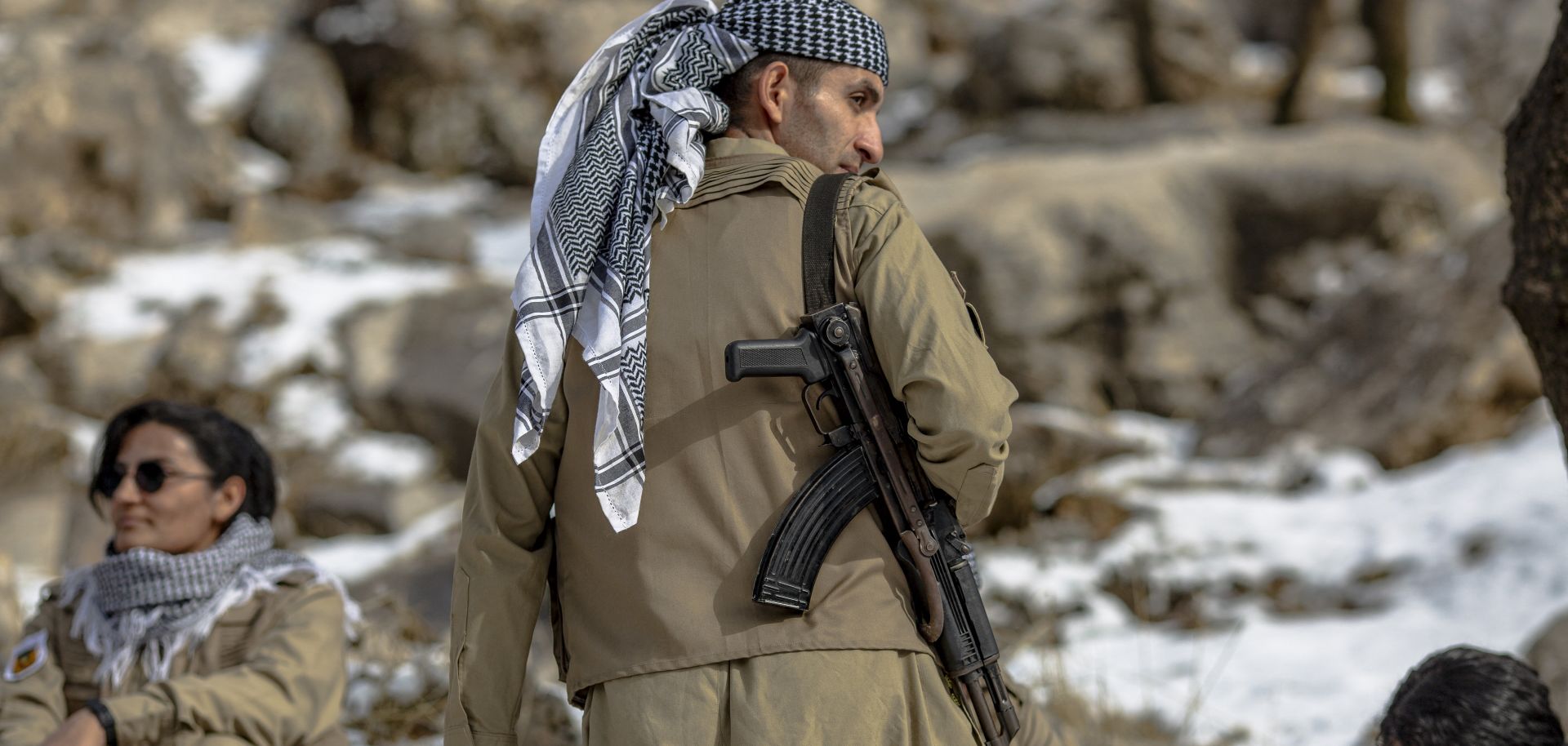
Though the likelihood of a Kurdish offensive against Iranian security forces in the coming weeks is growing, structural constraints mean it would be unlikely to topple the Iranian regime, while simultaneously carrying a significant risk of drawing Turkey and Iraq more deeply into the conflict. On March 5, Iran's Islamic Revolutionary Guard Corps (IRGC) struck Kurdish militant positions in northern Iraq, claiming it was thwarting an infiltration attempt from the region. These developments came amid conflicting reports about the potential start of a Kurdish anti-government offensive in Iran, with some media outlets reporting that one has started and others reporting it is still in the preparatory stages. In recent days, scores of media reports have indicated that the United States is considering leveraging Kurdish armed groups as part of a strategy to increase pressure on the Iranian regime. On March 4, Reuters reported that Iranian Kurdish militias based in Iraqi Kurdistan had consulted with U.S. officials about whether and how to conduct attacks on Iranian security forces, with the groups reportedly requesting U.S. military backing. A day earlier, CNN reported that the CIA had been working on plans to arm Iranian Kurdish opposition forces in an effort to spark an uprising and launch ground operations against Iranian security forces in western Iran. The reports follow reports of a phone call between Trump and Bafel Talabani, the leader of Iraq's Patriotic Union of Kurdistan (PUK), one of the two main political parties in Iraqi Kurdistan, which has fueled speculation that Washington could seek to use Kurdish networks and militant groups to destabilize Iran and potentially advance a broader regime change strategy.
- The PUK maintains a complex and often cautious relationship with Iranian Kurdish opposition groups, such as the Democratic Party of Iranian Kurdistan (KDPI) and the Komala Party. While these Iranian Kurdish factions operate primarily from areas under the Kurdistan Regional Government's control in Iraq, the PUK has historically balanced hosting or tolerating their presence with restricting their activities to avoid provoking Iranian retaliation. At the same time, the PUK has traditionally maintained closer political and security ties with Tehran than its main Iraqi Kurdish rival, the Kurdistan Democratic Party (KDP), partly as a result of longstanding regional alignments and intra-Kurdish rivalries within Iraqi Kurdistan.
- On March 4, the Komala Party of Iranian Kurdistan announced it would join a newly formed coalition of Iranian Kurdish opposition groups opposing Tehran, reversing its earlier decision to remain outside the alliance. The coalition, which was initially announced on Feb. 22 by five Iranian Kurdish opposition parties, aims to unify political and organizational efforts against the Islamic Republic and promote Kurdish self-determination. Komala said the decision to join reflected growing regional tensions and the need for greater coordination among Kurdish groups opposing Tehran.
The attention on Kurdish opposition groups comes as the United States and Israel assess pathways to weaken or potentially change the Iranian regime. In recent days, both countries have focused their attacks on Iran's internal security architecture — particularly the police, intelligence and paramilitary forces responsible for repressing dissent and countering insurgent threats — as potential pressure points. Within this context, Kurdish armed groups represent the most organized anti-regime elements operating inside Iran, with a long history of cross-border activity across the tri-border region between Iran, Iraq and Turkey. Groups such as the Kurdistan Free Life Party (PJAK) — an Iranian Kurdish militant organization linked to the Kurdistan Workers' Party (PKK) — have historically operated from mountainous areas along Iran's northwestern frontier, conducting sporadic attacks against Iranian security forces. While the PKK itself has been significantly degraded by Turkish military action in recent years, leading to a tentative political peace process with Ankara, the PJAK and other Iranian Kurdish factions retain networks and militant infrastructure near Iran's borders with Iraq and Turkey and maintain a limited operational presence in western and northwestern Iran.
- Iran and Iran-backed Iraqi militias have already launched drone and missile attacks on Kurdish opposition infrastructure in Iraqi Kurdistan and within Iran during the current conflict. The targets included bases of Iranian Kurdish groups, such as PJAK, as well as peshmerga — the armed forces of the Kurdistan Regional Government in Iraq — positions and sites in Arbil and Sulaymaniyah provinces, indicating Iran is already attempting to suppress potential Kurdish mobilization before it develops into a broader insurgent threat.
The increasingly likely Kurdish offensive against Iranian security forces would face significant operational and political constraints that would make it unlikely on its own to generate regime-threatening instability. Regardless of the conflicting reports over whether an offensive has already begun or is still being prepared, long-standing relationships between Kurdish factions and both the United States and Israel create channels through which they could encourage or enable renewed insurgent activity in Iran's northwest by expanding arms flows, training and intelligence-sharing. If the United States or Israel were to pursue this option seriously, sustained support — particularly weapons, intelligence and logistical backing — could help transform Kurdish militant activity from sporadic cross-border attacks into a coordinated offensive capable of placing at least some pressure on Iranian security forces. However, several structural limitations would likely restrict the strategic impact of such an effort. First, many Kurdish groups are likely skeptical of U.S. support, given the long history of the United States supporting the Kurds, only to eventually pull their support — as most recently seen with the main Kurdish armed group in Syria. Kurdish groups also represent a minority constituency within Iran and have historically struggled to mobilize broader national support around their goal of self-determination, making it unlikely that Kurdish-led armed pressure alone would catalyze a wider anti-regime uprising, even as the regime is at its weakest point and is becoming increasingly unpopular. At the same time, despite U.S. and Israeli military pressure, Iran's security apparatus — particularly the IRGC and its associated internal security forces — remains broadly intact and capable of rapidly concentrating force against insurgent threats, as demonstrated by ongoing strikes against Kurdish militant infrastructure in Iraqi Kurdistan and claimed prevention of an infiltration attempt. As a result of these constraints, while there is a growing likelihood of increased Kurdish militant activity inside Iran with direct U.S. and Israeli arms support, such operations would be unlikely to trigger regime change on their own.
- Since March 3, there has been a noticeable intensification and concentration of Israeli strikes on western Iran, areas where the Kurds maintain a large presence, which could open the door for the Kurds to launch attacks.
- Another constraint on a Kurdish insurgency is the historic rivalries between many of those opposition groups that, even if temporarily papered over, are likely to unravel over time amid disagreements over strategy and thus undermine the potential for Kurdish autonomy inside Iran.
A Kurdish offensive inside Iran could, over time, provoke other Iranian separatist groups to do the same and draw Turkey and Iraq more deeply into the conflict. Even if unlikely on its own to topple the regime in Tehran, a sustained Kurdish insurgency could have several second-order repercussions within Iran and across the wider region. First, an insurgency centered in Iran's Kurdish regions could also eventually encourage other armed or separatist movements, particularly Baloch militant groups operating in Iran's southeast. That would mean the emergence of simultaneous insurgent fronts that would put further strain on Iranian security forces and that could embolden jihadist groups in Iran and beyond. Meanwhile, Gulf states prefer a scenario in which Iran undergoes a gradual political transformation or leadership change while maintaining state continuity, rather than a full-scale collapse of governance that could spill over toward the Gulf. Even if a Kurdish insurgency is unlikely to topple the regime by itself, Gulf leaders would still prefer not to introduce this potentially destabilizing dynamic. A Kurdish uprising inside Iran would also raise the likelihood of external intervention, particularly from Turkey, which views Kurdish militant mobilization across its southern border as a direct national security threat. Ankara would be particularly concerned that renewed Western support to Kurdish armed groups could embolden militant networks linked to the PKK and undermine the fragile political process currently aimed at disarming and dismantling the rebel group. A deterioration of the security environment in northwestern Iran could therefore incentivize Turkey to conduct cross-border operations to prevent Kurdish militant consolidation near its borders, particularly as refugee flows and/or militant infiltration risks increase. At the same time, escalation in Iranian Kurdish areas would likely spill over into northern Iraq, where Iran-backed militias have already targeted Kurdish-linked positions due to their perceived alignment with the United States. Such dynamics could transform northern Iraq into a secondary arena of confrontation, drawing in Iraqi Kurdish forces, Iranian-aligned militias, PKK elements and potentially Turkish forces operating against Kurdish militant infrastructure.
- An unlikely but plausible future scenario in which a successful Kurdish offensive emboldens other armed groups, like Baloch separatists, would make it comparatively more likely that overstretched Iranian security forces face greater challenges keeping order. Even if this did not lead to regime change, it would leave Iran more fractured and prone to violence and separatism.
- Gulf countries fear a Kurdish offensive because they worry Iran may retaliate by inspiring Shiites to rise up in Gulf monarchies like Saudi Arabia and Bahrain, which have already witnessed violent pro-Iran protests.
- Turkey is likely highly concerned that renewed Western support for Kurdish militant groups operating against Iran could embolden Kurdish insurgent networks across the region and facilitate arms transfers. Ankara has long viewed cross-border Kurdish militant activity as a direct national security threat and would be particularly wary that weapons provided to Iranian Kurdish factions could circulate among affiliated groups, including PKK-linked elements. This would risk undermining Turkey's internal security and complicating efforts to sustain the current peace process with the PKK.
- A March 2 Reuters report indicated that hundreds of Iranians had crossed the border into Turkey to escape the conflict. Turkey has hosted a large number of Syrian refugees since the start of the Syrian Civil War in 2011. Anti-refugee sentiment is significant. As such, there are elevated domestic concerns over large numbers of Iranian migrants crossing into Turkey if the war expands.
