
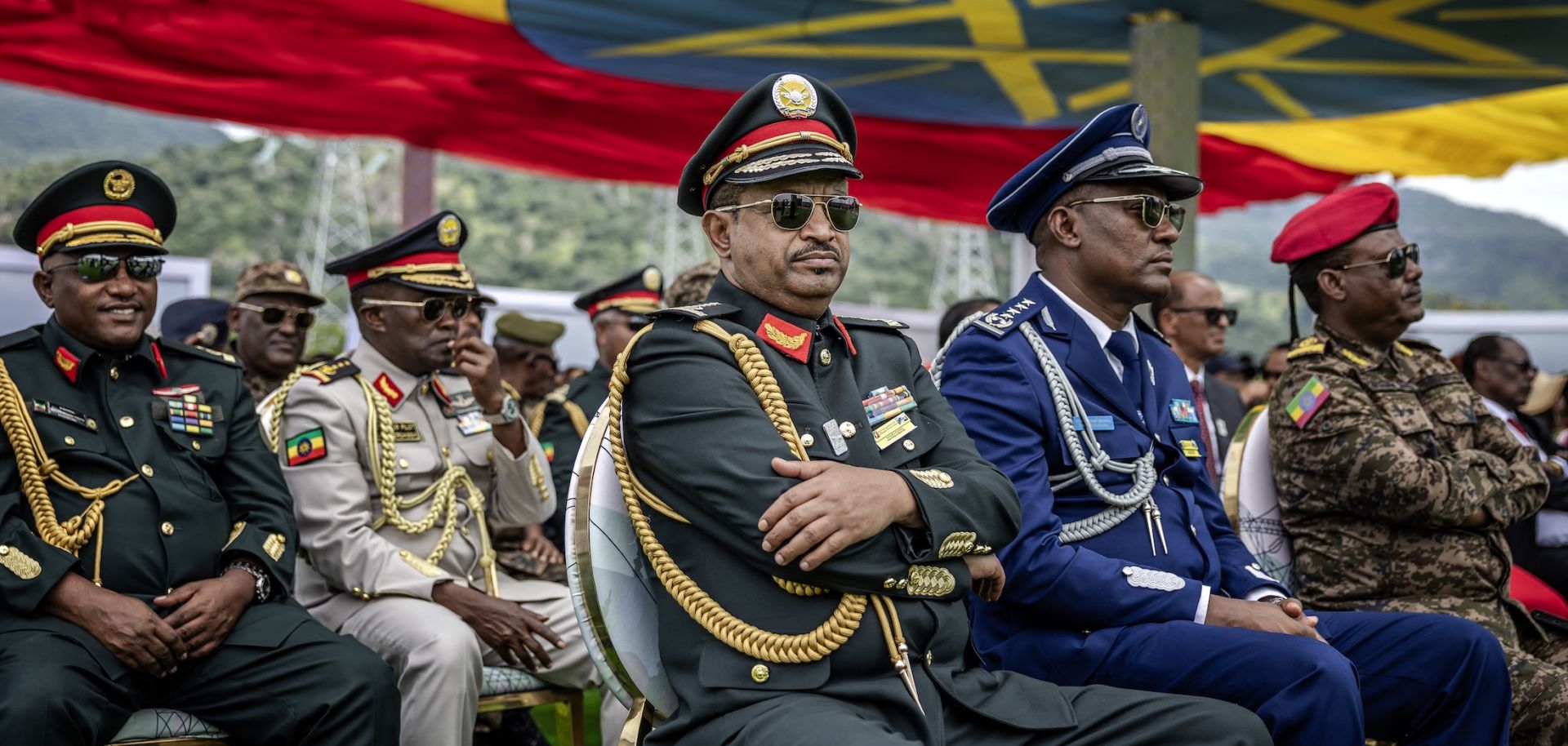
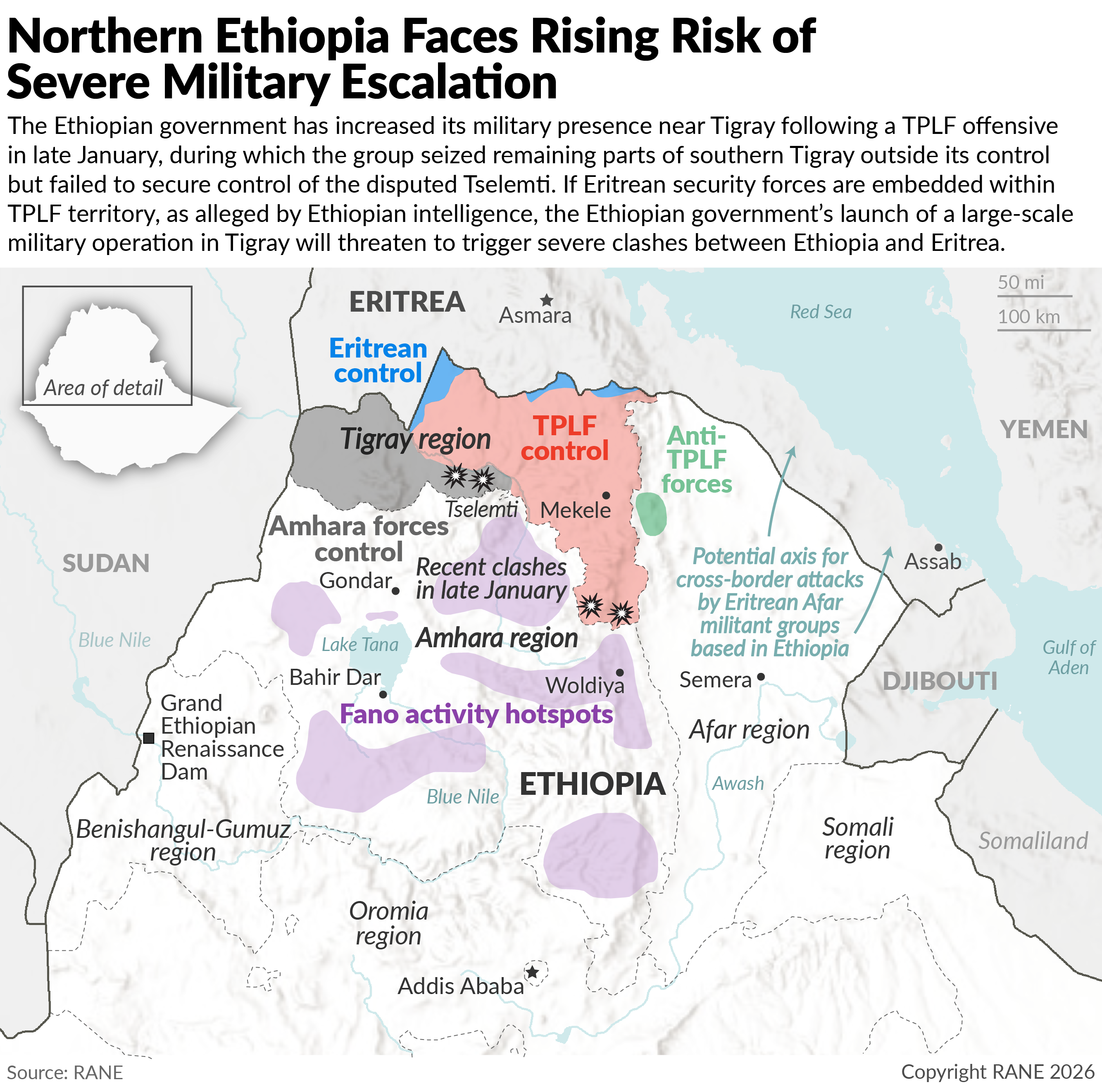
The Ethiopian government's military buildup near the northern Tigray region portends renewed clashes with the Tigray People's Liberation Front, or TPLF. Ethiopia's economic and security constraints, alongside the TPLF's internal divisions, will constrain both sides in pressing ahead with a full-blown escalation before the June 1 general elections, but alternative escalatory scenarios in which severe clashes with neighboring Eritrea are growing more likely. Since early February, Ethiopia's federal government has massed large numbers of tanks, artillery and infantry near the country's northern Tigray region. In response, the TPLF — which effectively controls 65% of Tigray and serves as the region's de facto ruling political party — has pressed ahead with a troop buildup of its own, with TPLF chairman Debretsion Gebremichael saying the group would "not stay idle" if the Ethiopian government breached the November 2022 Pretoria Agreement, which ended the 2020-2022 Tigray War. Addis Ababa's military buildup comes after pro-TPLF forces launched offensives in late January in several areas controlled by pro-government forces that are disputed between Tigray and the neighboring Amhara region. These clashes prompted pro-government forces to exit southern Tigray, while the TPLF withdrew from an area further west along the border with Amhara known as Tselemti. In addressing troops on Feb. 22, Ethiopian Prime Minister Abiy Ahmed said that landlocked Ethiopia's ongoing military training had been broadened to include maritime operations and the elimination of maritime threats. This was a veiled warning aimed at neighboring Eritrea, given Abiy's insistence on Ethiopia's need to access the port of Assab. Addis Ababa has repeatedly accused Asmara of violating Ethiopia's territorial integrity, with Ethiopian military sources alleging that Eritrean security forces not only occupy parts of northern Tigray but are also embedded in TPLF territory along the lines of contact with Ethiopian federal forces. Showcasing the ever-surging tensions between the two countries, Abiy said in a March 3 interview with Ethiopian state television that a renewed attempt by Asmara to destabilize Ethiopia would "be the last."
Against this backdrop, RANE has developed five scenarios ahead of Ethiopia's June 1 general elections, ranked from least to most escalatory. Looking beyond the general elections and through the next few years, the risk of a protracted and high-intensity conflict between Ethiopia and Eritrea is meaningfully higher than indicated in these scenarios. This is due to Eritrea's support for anti-government armed groups inside Ethiopia, its military presence within Ethiopian territory and Addis Ababa's push for direct sea access through Assab. Moreover, risks are tilted to the downside, as even limited clashes could escalate into a major conflict due to miscalculation and/or the need to meet domestic political imperatives.
Scenario 1: International Mediation Averts Military Escalation (25% Likelihood)
International mediation and military constraints prompt the Ethiopian government and the TPLF to avert conflict, potentially following a joint commitment by both parties to re-engage in high-level talks regarding the implementation of the 2022 Pretoria Agreement. Mediation efforts from regional and international players — including the United States, European Union, Turkey and Saudi Arabia — dissuade the Ethiopian government and the TPLF from taking kinetic action against one another. This is potentially accompanied by Abiy and the TPLF agreeing to kick-start high-level talks on implementing the November 2022 Pretoria Agreement. Following mediation efforts, both parties gradually reverse their troop buildup along the line of contact. In the event of a de-escalation agreement, the Ethiopian government eases restrictions on the supply of goods to Tigray, likely in exchange for the TPLF curbing its military cooperation with Eritrea. Alternatively, Abiy refrains from taking military action against the TPLF for fear of triggering a military escalation that could destabilize the entirety of Ethiopia and imperil the country's support program from the International Monetary Fund. This scenario effectively maintains the status quo in Tigray through the June 1 general elections, with Abiy and the TPLF potentially agreeing to extend the mandate of Tigray's interim regional administration beyond polling day in the event of a further breakthrough in negotiations. Meanwhile, the Ethiopian government's troop drawdown around Tigray enables it to redeploy forces to newly emerged security vacuums in central and southern Ethiopia, as well as resume proactive counter-insurgency operations against Fano militants in the Amhara region. However, severe tensions between Ethiopia and Eritrea persist due to other unresolved issues, such as Eritrea's ties to Fano and the question of Ethiopia's maritime access.
Scenario 2: The Ethiopian Government and the TPLF Avert Major Conflict, Despite Limited Escalation (30% Likelihood)
Provocations by the TPLF and/or Ethiopian security forces result in deadly localized clashes, but both parties refrain from a major military escalation — either because the TPLF makes major concessions or because Abiy calls off a large offensive due to economic and security considerations. Abiy leverages the military buildup near Tigray to probe the TPLF's cohesion and try to pressure it into making major concessions, such as by curbing its ties with Eritrea, integrating Tigrayan parties allied to the federal government in Tigray's interim administration and/or entering negotiations on the institutional future of disputed areas between the Tigray and Amhara regions. However, the TPLF initially resists these demands. Amid the deadlock, both pro-government and TPLF forces increase provocations against one another along the line of contact. This eventually results in deadly clashes, most likely near areas disputed by the Tigray and Amhara regions. In response, the Ethiopian government likely launches drone strikes on TPLF-linked positions, potentially claiming that these are targeting Eritrean security forces. Meanwhile, the Abiy-friendly Tigray Peace Force (TPF) — which consists of former Tigrayan military and TPLF officials aggrieved with the party's pivot toward Asmara — may escalate operations against the TPLF along the Tigray-Afar border. This potentially results in localized skirmishes between Ethiopian and Eritrean troops that could result in dozens of fatalities. Despite these clashes, the Ethiopian government does not order a large-scale military intervention against the TPLF, most likely because Abiy coerces the TPLF to halt offensive operations and/or accepts a short-term extension of the status quo to avert a potentially destabilizing military escalation ahead of the June 1 general elections. The TPLF may also accept some of Abiy's key demands to avert a large-scale military intervention by the federal government, potentially following a coup that unseats the current TPLF leadership in Mekelle, Tigray's regional capital. As it averts a major conflict with the TPLF, the Ethiopian government is able to continue economic reforms in the short term and hold elections as planned on June 1. But a severe post-election crisis remains possible due to the TPLF's inability to run in the polls, as the party lacks legal status to contest the election.
Scenario 3: The Ethiopian Military Quickly Reasserts Control Over Tigray, Threatening an Armed Insurgency (15% Likelihood)
The Ethiopian government launches a large-scale military intervention in Tigray that enables it to reassert control over the region's key urban areas and transport corridors within a few months as the TPLF fractures internally, but the region thereafter faces a high risk of armed insurgency from pro-Eritrean TPLF elements. Abiy orders a large-scale military intervention in Tigray to reassert government control over the region. Addis Ababa adopts a shock-and-awe strategy aimed at overwhelming TPLF defences, which materializes through an extensive aerial bombing campaign and heavy artillery shelling on TPLF military assets. The TPLF initially puts up stiff resistance against Ethiopian forces by leveraging its fortified positions, but Ethiopia's edge in heavy weaponry ultimately enables Abiy to rapidly secure a military breakthrough. This fractures the TPLF, pitting pro-Eritrea factions that vow to keep resisting Abiy against Eritrea-skeptic elements that press for negotiations with Addis Ababa. These divisions undermine the group's military cohesion and enable the Ethiopian military to assert its control over Tigray's large cities and key communication axes within a few months, after which the Ethiopian government likely reaches an understanding with Eritrea-skeptic factions within the TPLF. However, Eritrea-friendly factions within the TPLF reject those plans, and some are likely to shift towards guerrilla warfare against the Ethiopian military in Tigray's rural areas with Asmara's military support, portending a low- to medium-intensity conflict in the region. While this forces the Ethiopian government to maintain a significant number of troops in Tigray, the end of conventional fighting enables it to redeploy troops to central and southern Ethiopia, thereby improving security in those regions. The Ethiopian military's advance into northern Tigray potentially triggers direct clashes with Eritrean security forces present in the area. However, Eritrea refrains from engaging in protracted clashes with its larger neighbor in this scenario due to international mediation and/or Asmara's preference to remain in a proxy conflict with Addis Ababa to gradually erode Ethiopian capabilities and morale.
Scenario 4: The Ethiopian Government and the TPLF Enter a High-Intensity Conflict, With Eritrea Directly Backing the TPLF (10% Likelihood)
The Ethiopian government launches a large-scale intervention in Tigray but proves unable to quickly assert control over the region as the TPLF maintains its cohesion and/or secures large-scale support from Eritrea, portending a high-intensity internal conflict that lasts more than a few months, potentially akin to the 2020-2022 Tigray War. In line with the third scenario, the Ethiopian government launches a large military intervention in Tigray to reassert control over the region, which materializes through widespread drone strikes and heavy artillery shelling of TPLF positions. However, the Ethiopian military proves unable to break through the TPLF's defensive lines due to its strong internal coordination and rapidly expanding military cooperation with Eritrea. Alternatively, the TPLF could also launch a major offensive to recapture Western Tigray, which is occupied by pro-government forces and claimed by the Amhara region, with large-scale military support from Eritrea. Despite Eritrea's direct involvement in the conflict, the Ethiopian government only targets Eritrean security forces located within Ethiopian territory to avert a broader conflict. This contains most of the fighting within Tigray, even though localized clashes along the Ethiopia-Eritrea border gradually become more likely to erupt along the border with Ethiopia's Afar region, as Ethiopian proxies potentially launch attacks near Assab. Meanwhile, Fano and the Oromo Liberation Army militants escalate their operations against Ethiopian supply lines in the Amhara and Oromia regions in coordination with the TPLF and Eritrea, forcing Addis Ababa to divert resources away from a tentative push to Mekelle. While the Ethiopian military may still make initial territorial gains, the TPLF retains control over most of the region's key urban areas and bogs down Ethiopian federal troops in protracted fighting, paving the way for a high-intensity conflict lasting for more than a few months. At least thousands are killed in the ensuing clashes, and the humanitarian situation in Tigray severely worsens. The military escalation prompts the IMF to pause its support program to Addis Ababa, which, together with concerns about Ethiopia's broader destabilization, triggers a steep decline in investor confidence. As a result, the Ethiopian government is forced to halt or reverse its recent currency liberalization reforms to avert capital flight, though it likely secures significant financial support from the United Arab Emirates to continue core government functions.
Scenario 5: Ethiopia and Eritrea Enter a Protracted, High-Intensity Conflict (20% Likelihood)
Severe clashes erupt between Ethiopian and Eritrean security forces, likely after Asmara deploys tens of thousands of troops to Tigray, which results in a high-intensity, monthslong conflict between the two countries that threatens to rapidly regionalize. Ethiopia launches a large-scale military intervention in Tigray, initially akin to that in the third and fourth scenarios. But in this scenario, the TPLF's setbacks prompt Eritrea to take a much more aggressive stance, deploying tens of thousands of troops to Tigray as it seeks to counter Addis Ababa's progress in the region and avert the loss of a strategic buffer with Ethiopia. This helps the TPLF stabilize the frontline and maintain control over several large cities, but Eritrean security forces take a leading role in countering the Ethiopian military's push into Tigray, triggering heavy clashes between the two countries' forces. Severe clashes between the two countries could also erupt if the Ethiopian military seeks to assert control over northern Tigray after retaking Mekelle, or if Abiy directs an invasion of Eritrea's Assab region to gain direct maritime access, either before or after a large-scale military intervention in Tigray. Ethiopia denounces Eritrea's violation of its territorial integrity and launches an aerial bombing campaign targeting the Eritrean military's supply lines within Eritrean territory. Eritrea retaliates by launching airstrikes of its own against Ethiopian positions and/or a heavy artillery barrage, which ultimately results in clashes spreading along the countries' shared border. Depending on the military balance in Tigray, this potentially prompts Ethiopia to launch a large-scale operation to seize Assab. Given this possibility, Egypt and Saudi Arabia expand their logistical and financial support to Eritrea to preserve the status quo, while the Sudanese Armed Forces (SAF) extends military support to Asmara, an important partner for Khartoum. The United States, the European Union and Turkey all rush to mediate the conflict, but high-intensity clashes between Ethiopia and Eritrea persist for at least several months as both sides refuse to make concessions due to their domestic political imperatives. The security crisis likely prompts Abiy to postpone Ethiopia's upcoming general elections and reverse recent currency liberalization reforms to avert capital flight, which, together with the nature of the conflict, likely prompts the IMF to halt Ethiopia's support program. Although international mediation could ultimately freeze the clashes, a failure to rapidly do so could lead to tens of thousands of fatalities. This risk is amplified by the potential for the conflict to merge with Sudan's civil war, given Eritrea's close ties to the SAF and Ethiopia's apparent tilt toward the SAF's rival, the paramilitary Rapid Support Forces.
