
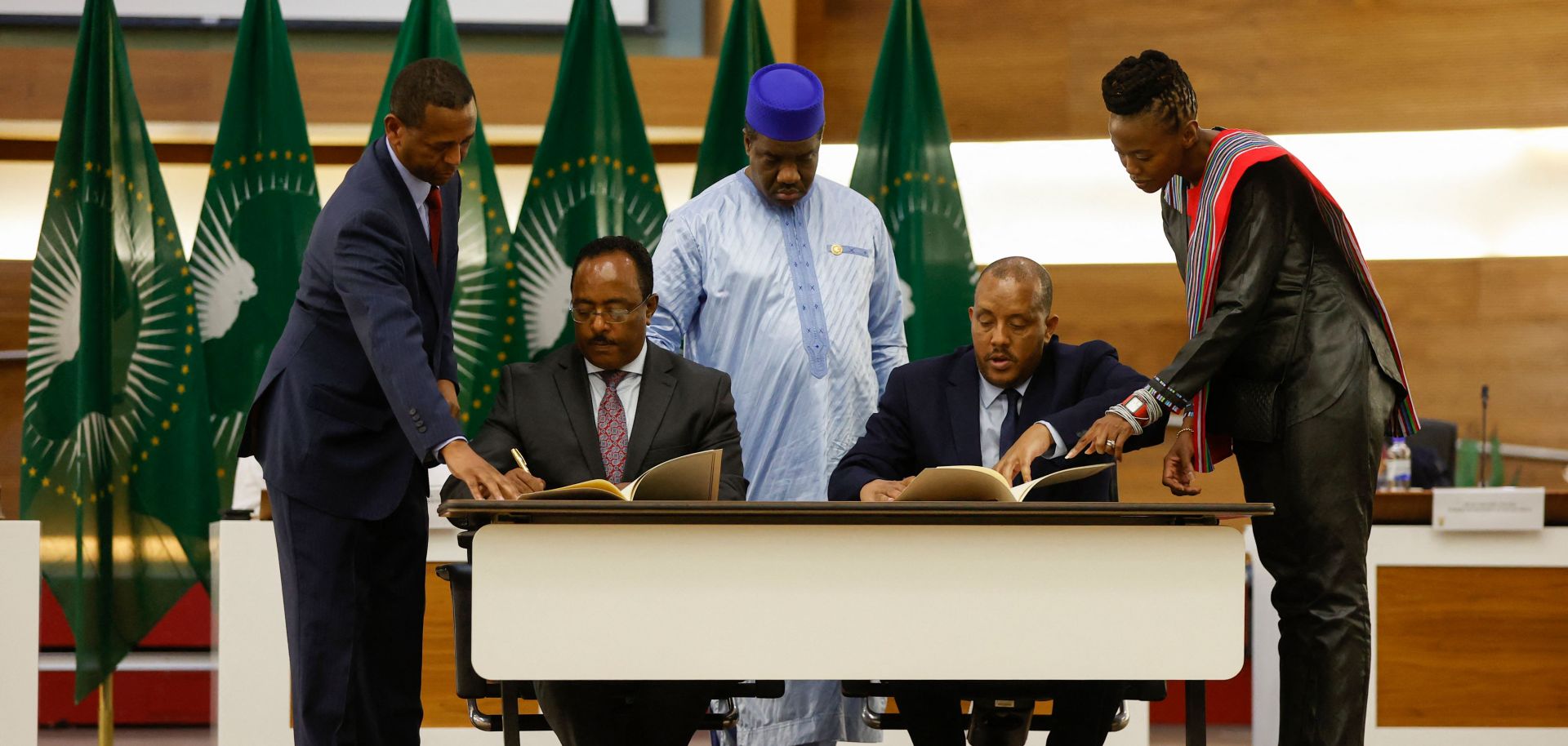
Redwan Hussein (second from the left), a representative of the Ethiopian government, and Getachew Reda (second from the right), a representative of the Tigray People's Liberation Front (TPLF), sign a peace agreement in Pretoria, South Africa, on Nov. 2, 2022.
The Ethiopian government and Tigrayan rebels' latest agreement to cease fighting offers the best chance of peace yet in the two-year war. But historical grievances, implementation challenges, mistrust and third-party spoilers risk the longevity of the deal. The Ethiopian government and the Tigray People's Liberation Front (TPLF) agreed to a Cessation of Hostilities on Nov. 2 following ten days of negotiations in Pretoria, South Africa. In addition to an immediate and permanent halt to fighting, the agreement also includes provisions relating to the demobilization, disarmament and reintegration of TPLF combatants into the Ethiopian military; the restoration of public services in Tigray; increased humanitarian assistance in Tigray; and implementation of transitional measures to restore constitutional order in Tigray. Following the announcement of the deal, an additional, longer document detailing a peace framework circulated on social media and news outlets. However, neither side appears to have agreed to or signed this second agreement, which elicits much greater concessions from the TPLF (including the restoration of federal authority in Mekelle and TPLF disarmament within 30 days).
- Rumors that the Ethiopian government carried out three airstrikes in northern Tigray circulated on Nov. 3, the day after the cessation of hostilities was signed. If confirmed, these airstrikes would be an obvious violation of the agreement.
The preliminary agreement does not attempt to reconcile the historical drivers of the long-standing conflict between rival ethnic groups. The current iteration of fighting between the central government and the TPLF began in November 2020, when the former refused to recognize a newly elected local government in Tigray. However, the drivers of the conflict go back decades — rooted in Tigray's long-sought push for regional autonomy. Successive Ethiopian rulers have tried to unify the country by bringing Tigray under central control, while Tigrayan rebels have staged repeated uprisings to protect and/or enhance the right to self-rule. Meles Zenawi, a founding member of the TPLF, altered this dynamic when he became president of Ethiopia in 1991, shifting the ethnic balance of power to favor Tigrayans rather than Amharas or Oromos by instituting a governance model of ethnic federalism. While this model brought greater power and autonomy to Tigray, government abuses hardened ethnic animosity and resistance to Tigrayan power — eventually culminating in the ascension of Abiy Ahmed, an ethnic Oromo and Amhara, as the country's president in 2018. This core issue of Tigrayan autonomy is not addressed in the preliminary cease-fire agreement signed on Nov. 2, which bodes ill for the new deal's ability to install lasting peace between the warring sides of the conflict. In fact, the leaked document outlining a longer framework for peace (which has not yet been signed) includes provisions that run directly counter the TPLF's mission — namely, the restoration of federal authority in the Tigrayan regional capital of Mekelle and the deployment of Ethiopian military forces along Tigray's international borders with Sudan and Eritrea. In addition, neither the new cease-fire deal nor the leaked peace framework mentions Western Tigray, a swath of territory claimed by Amahara and currently occupied by Ethiopian military forces and Amhara militants.
- During his long reign from 1930 to 1974, Ethiopian emperor Haile Selassie tried to bring Tigray — which at that time was largely self-governed — under his central government's control by dividing the northern region into smaller states, hoping that this would dilute Tigrayan regional power. In response, Tigrayan rebels launched insurgencies in 1943 and 1974 in pursuit of an autonomous region.
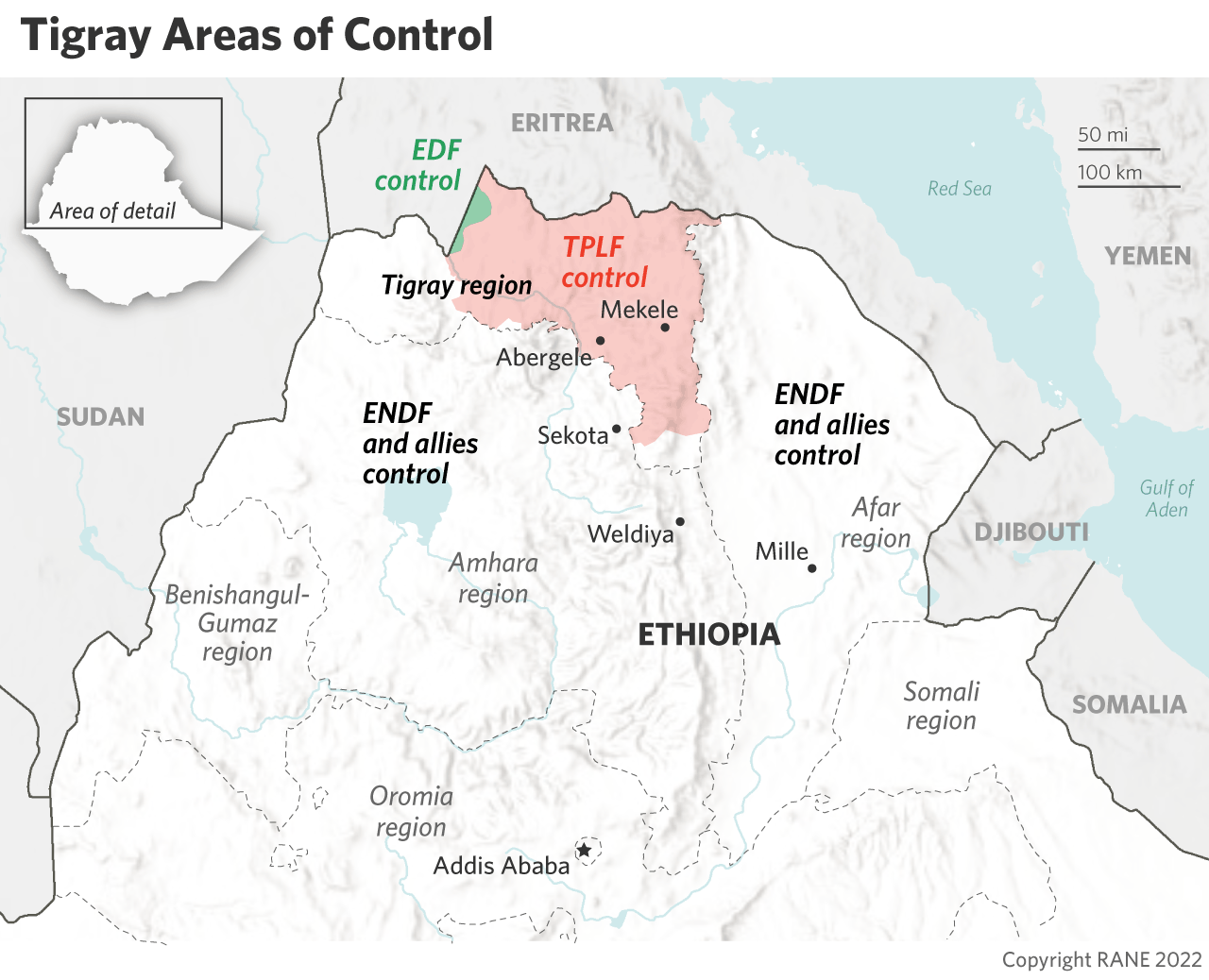
In the coming weeks, longstanding conflict drivers, implementation challenges, mutual mistrust and third party spoilers will risk a breakdown in negotiations and resumption of violence. Barring more comprehensive negotiations that address the historical drivers of the conflict, the longevity of the cease-fire and the likelihood of a more formal peace agreement will likely be hampered by difficulty implementing various parts of the deal. Demobilizing and disarming hundreds of thousands of TPLF combatants following two particularly bloody years of a decades-long bitter ethnic rivalry will be complex and likely mired by flare-ups in violence, which could send the region back into conflict. Deep mistrust between the TPLF and the Ethiopian government — particularly as the latter attempts to exert control over Mekelle — will keep alive the risk of renewed violence being triggered by miscalculations and misunderstandings between the two sides. The third parties in the conflict — namely, Amhara militias (known as Fano) and military forces from neighboring Eritrea — also pose a threat to lasting peace. While the Ethiopian government at different points sanctioned both Fano and Eritrea's continued deep involvement in the war, it's not clear that Abiy has the ability to reign them in. This means that third party clashes will continue to risk broader military escalation, as both Fano and Eritrea remain unlikely to abandon their own interests by adhering to an official cessation of hostilities. Apart from the humanitarian cost, continued violence and instability in Ethiopia will worsen the country's economic crisis and prolong its recovery timeline, as creditors and investors have little interest in supporting an embattled Ethiopia.
- In recent weeks, Eritrean forces have reportedly burned crops, looted vehicles and household items and killed civilians in the northern Tigrayan towns of Shire, Axum and Adwa. Ethiopian military airstrikes have also allegedly killed more than a dozen civilians, including women, children and the elderly — in Mekelle since mid-October.
- According to a U.N. report published in September, Fano militias have also committed serious crimes throughout the war, including large-scale killings of civilians, rape and sexual violence, extrajudicial killings, torture, looting and destruction of civilian property, (as have Tigrayan rebels, Ethiopian government forces and Eritrean government forces).
If the Cessation of Hostilities holds, humanitarian corridors are likely to reopen as the Ethiopian government and TPLF negotiate a more formal peace agreement, which will alleviate humanitarian suffering in Tigray and lay the groundwork for national post-conflict reconstruction. If both sides adhere to the cessation of hostilities, Ethiopian military air strikes and ground offensives into Tigray will stop, which will provide relief to embattled Tigrayans who are contending with famine, drought and disease on top of widespread violence. This will enable humanitarian corridors to reopen, facilitating the delivery of badly needed humanitarian aid to Afar, Amhara and Tigray regions. If peace negotiations proceed, senior commanders from the Ethiopian military and the TPLF will likely meet in coming weeks to work out the details of how to demobilize, disarm and reintegrate TPLF combatants. The government will also likely invite international organizations — like the United Nations, African Union and/or Intergovernmental Authority on Development — to facilitate a transitional justice mechanism that could include truth-telling forums for victims of war crimes, community reconciliation initiatives and/or amnesty programs. The government will also likely lift the terrorist designation of the TPLF. Over the medium term, a lasting peace agreement would enable Ethiopia to rebuild its economy and infrastructure, attract greater foreign investment, and return to international trade deals that it lost due to the war.
- The World Health Organization warned on Oct. 28 that Tigray has run out of vaccines, antibiotics and insulin — with about 9% of health facilities in the region fully functional, down from 90% before the war.
