
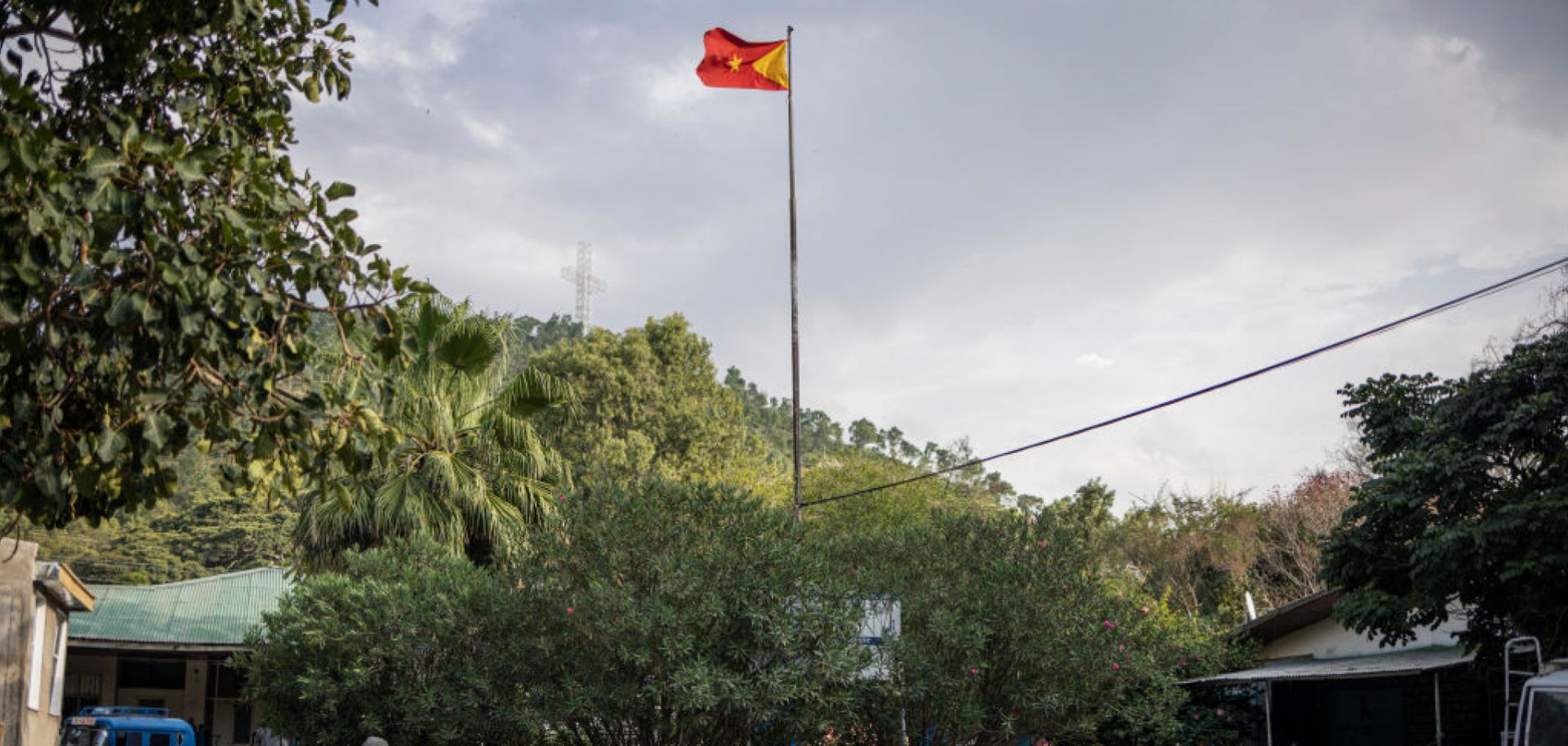
Rising tensions in Ethiopia's northern Tigray region increase the risk of clashes between rival factions that could morph into a proxy conflict between the Ethiopian and Eritrean governments, with the threat of a military escalation set to persist through the end of next year due to likely tensions surrounding Ethiopia's 2026 general elections. On Aug. 1, Tigray's interim regional administration accused the opposition Semeret party, led by former interim regional administrator Getachew Reda, of launching a deadly attack on Tigrayan security forces in southeastern Tigray. While Semeret denounced the accusations as ''baseless,'' the regional administration said that the alleged attack could force it to take ''self-defensive'' measures against what it deemed to be politically disruptive behaviour. The same day, local media outlets released an interview with Lt. Gen. Tsadkan Gebretensae, where he announced the formation of an alliance of four Tigrayan political parties opposed to the governing Tigray Peoples' Liberation Front (TPLF), including Semeret. These developments came amid escalating tensions between Ethiopia's federal government and the TPLF. In a letter to U.S. Secretary of State Marco Rubio dated June 20, Ethiopian Foreign Affairs Minister Gedion Timothewos accused a ''faction of the TPLF'' of preparing ''massive offensive operations'' with Eritrean forces against the Ethiopian military. Simultaneously, Tigrayan officials unilaterally reopened the border with Eritrea on June 22 for the first time in five years. Against this backdrop, Ethiopian Prime Minister Abiy Ahmed called on July 3 for religious leaders to ramp up mediation efforts to prevent the region from ''entering war,'' stressing that such efforts would be ''worthless after it begins.''
- According to Tigray's regional administration, Semeret launched the attack on Tigrayan security forces in the locality of Mlazat near the Afar region on July 30, which it claimed killed one security force member.
- At a ceremony to celebrate the reopening of Tigray's border with Eritrea, TPLF Chairperson Debretsion Gebremichael stressed the party's commitment to strengthening ''people-to-people relations'' across the two sides of the border, a marked departure from the party's historic rivalry with Eritrea.
Rising tensions in Tigray come as the TPLF has shored up its influence over the regional government and key factions in the party have tilted closer to Eritrea, which has prompted Abiy to increase his support to anti-TPLF groups in the region. Since the end of the 2020-2022 Tigray war, the TPLF has faced growing factionalism due to tensions regarding key provisions of the November 2022 peace deal, known as the Pretoria Agreement, which many in the party's old guard perceived as a capitulation to the federal government. These internal divisions ultimately led to the expulsion of Getachew, then the TPLF spokesperson and leader of Tigray's interim regional administration, and his allies from the party in September 2024. While this saw Getachew lean increasingly toward the federal government, this rapprochement prompted the TPLF to tilt closer to Eritrea — the party's decades-long foe — out of opportunism to shore up its own leverage against Abiy. In March, the TPLF then forcefully seized control of the regional administration in Tigray, effectively forcing Abiy to appoint Tadesse Werede, the Commander in Chief of the Tigray Defence Forces, as the new interim regional administrator to avoid a new military escalation. While Tadesse adopted a conciliatory stance and distanced himself from Eritrea, his appointment still marked a setback for Abiy, as it enabled the TPLF to grow its influence over the regional administration. Since then, the federal government has expanded its political backing to anti-TPLF parties like Semeret, evidenced by the party swiftly securing a provisional registration certificate. It also appears that Abiy has been supporting anti-TPLF armed groups along the Tigray-Afar border for the last several months, though evidence currently remains inconclusive.
- Intra-TPLF tensions surrounding the Pretoria Agreement notably touched on provisions involving the demobilization of TPLF forces. Many party cadres considered that this provision should not have been agreed to by the TPLF delegation at the peace talks, which was led by Getachew, or that it was approved without sufficient consultation within the party. While the TPLF handed over much of its heavy military equipment soon after the signing of the Pretoria Agreement, the disarmament program has since largely stalled.
- Although Eritrea played a decisive role in supporting the Ethiopian government's military effort against the TPLF during the 2020-2022 Tigray war, bilateral relations rapidly soured after Abiy struck a peace deal with the TPLF without involving Eritrea in the negotiations. Tensions between the two sides have since been further heightened by Eritrea's decision to maintain a troop presence in northern Tigray and Abiy's recurring calls for landlocked Ethiopia to secure direct access to the sea.
- The TPLF and Eritrean government have had a decades-long rivalry driven by border disputes, which notably resulted in the 1998-2000 Ethiopia-Eritrea War. Despite this, reports indicate that TPLF and Eritrean have held several meetings since mid-2024. However, the scale and nature of Eritrean support to the TPLF currently remains unclear.
- In June, Brig. Gen. Gebreegzabher Beyene, a former commander of the Tigray Defence Forces, unveiled that he was building a new force to remove the TPLF from power, which he claimed comprised four army divisions. News outlet Africa Intelligence reported in May that the federal government was providing military training and logistical support to the group, but further evidence has yet to emerge.
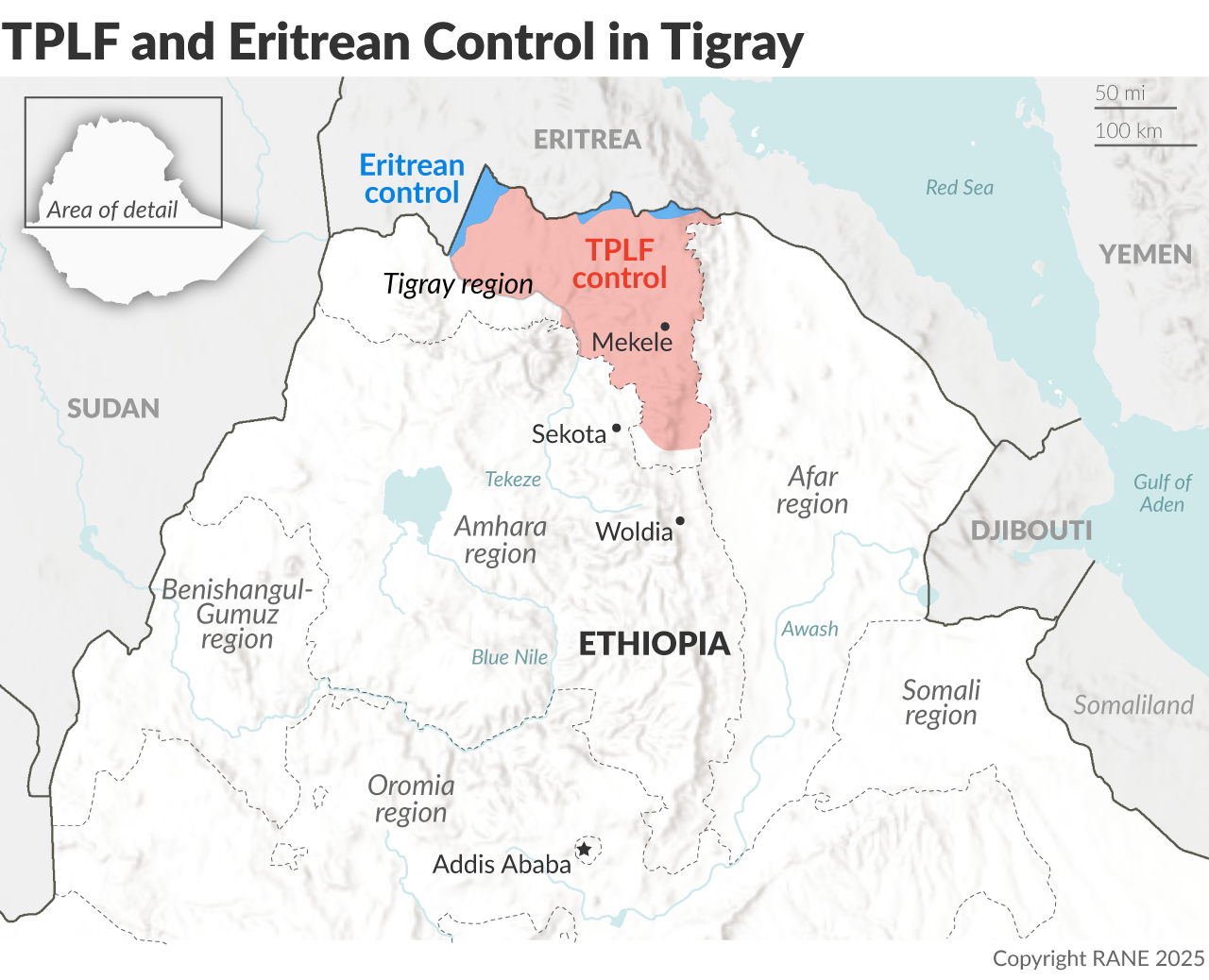
The likelihood of clashes between pro- and anti-TPLF factions in Tigray will grow in the short term as Abiy and his Tigrayan allies sustain efforts to undermine the TPLF's influence in the region. Given the newfound proximity of key TPLF factions with Eritrea and the party's pushback against Abiy's authority, the federal government is set to sustain efforts to erode the TPLF's power and legitimacy. To that end, Addis Ababa will likely maintain curbs on the flow of essential goods to Tigray. It will likely also resist key TPLF demands, such as a rapid return of the Western Tigray/Welkait area to Tigrayan control. Together with the TPLF's own corruption challenges, shortages of essential goods will create more favorable conditions for Getachew and other anti-TPLF groups in Tigray to agitate the public against the TPLF. While this will raise the prospect of anti-TPLF demonstrations, the TPLF and its allies within Tigrayan security forces will likely crack down on anti-party activity. If sustained, such a crackdown would likely prompt key factions among anti-TPLF forces to prioritize armed confrontation, which could eventually result in frequent clashes between the two sides. However, armed clashes would also create a new impetus for backchannel diplomacy, which could result in a de-escalation agreement that, for example, includes anti-TPLF parties in Tigray's regional administration in exchange for the federal government easing restrictions on the entry of essential goods in the region. Nonetheless, deep mistrust between the two sides would make such a deal difficult to achieve and highly susceptible to collapsing should it be reached.
- During the Tigray war, Amhara militias seized control of Tselemti and Western Tigray (known as Welkait in Amhara) areas, claiming they were rightfully part of the Amhara region. Since the war ended in November 2022, the TPLF has insisted that these areas be returned to Tigray's interim regional administration. Abiy vowed to hold a referendum on Western Tigray/Welkait's membership of Tigray or Amhara in 2023, but little progress has been made on the issue since.
A steep escalation in clashes between pro- and anti-TPLF factions in Tigray would raise the risk of a proxy conflict between the Ethiopian and Eritrean governments in the region, which would threaten the Pretoria Agreement and increase the likelihood of a direct military confrontation between Ethiopia and Eritrea. If clashes between pro- and anti-TPLF elements become more frequent, Abiy is unlikely to immediately order a large-scale federal intervention in Tigray to stop them, as such clashes would fit within his efforts to weaken the TPLF. Moreover, the Ethiopian military is already stretched thin due to ongoing insurgencies in the country's Amhara and Oromia regions. The federal government would, however, likely expand its logistical, financial and potentially military support to anti-TPLF groups, which could eventually capture Mekele, Tigray's regional capital, in a less-likely, higher-impact scenario. Given this risk, the TPLF would likely seek military assistance from Eritrea, which Asmara would probably provide in a bid to weaken Abiy and his allies. Escalating clashes between pro- and anti-TPLF factions would thus threaten to trigger a proxy conflict between the Ethiopian and Eritrean governments in the region, which would raise the likelihood of a direct military confrontation between the two countries. Moreover, escalating bilateral tensions due to Eritrean militant groups' use of Ethiopia's Afar region to launch attacks into Eritrea could also act as a catalyst for a military escalation in Tigray. Signs of growing links between the TPLF and Eritrea would create a justification for Abiy to remove Tadesse as Tigray's interim regional administrator, which would risk collapsing the Pretoria Agreement. However, having handed over most of its heavy military equipment since the end of the Tigray war, the TPLF would likely be unable to confront the Ethiopian military conventionally, and would instead probably shift to an insurgency, leveraging its support in rural areas. That said, a conventional conflict would become more likely if Eritrea provided large-scale military support to the TPLF or became directly involved in the conflict.
- In July, the Eritrean Afar National Congress announced that it was setting up a political office in the regional capital of Ethiopia's Afar region, Semera, while Eritrea's Red Sea Afar Democratic Organization held its general conference in the town the same month, with both groups stressing their readiness to engage in an armed struggle against the Eritrean government. This showcases the rising risk of Ethiopian-backed militant attacks in regions of Eritrea inhabited by Afar people, which would risk catalyzing tensions in Tigray.
Even if clashes do not sharply escalate in the coming months, the risk of a major military escalation in Tigray will remain elevated until at least the end of next year, as Ethiopia's 2026 elections will likely worsen tensions between the TPLF and the federal government. Although the TPLF and its Tigrayan rivals appear unlikely to reach a comprehensive agreement anytime soon, clashes between the two sides may remain limited, whether that is due to lingering war fatigue, limited deconfliction deals or federal government pressure on anti-TPLF groups to avoid a major escalation. This scenario would portend a strategic stalemate in the region, but tensions would most likely remain high as both sides gradually shift their attention toward Ethiopia's upcoming general elections, scheduled for mid-2026. With the TPLF now having lost its legal status, the party is currently unable to run in the elections. While it can re-register with Ethiopia's electoral board, the TPLF will likely remain unwilling to meet the conditions required by the board to secure its re-registration. This suggests that the TPLF will be unable to run barring a major compromise from Abiy, which currently appears unlikely given tensions between the two sides. In this scenario, the TPLF would likely refuse to recognize the outcome of the elections and could, subsequently, withdraw its recognition of the federal government, which would raise the risk of a military escalation between the two sides. Even if the TPLF is allowed to run, Ethiopia's upcoming general elections will likely increase tensions between the party and the federal government due to disagreements over the ballot's organization — particularly, the Ethiopian election board's plan to shift to a centralized digital voting system, which is likely to amplify opposition concerns about electoral fraud. The campaign period will also increase the likelihood of clashes between the TPLF and its Tigrayan rivals, as well as the harassment and intimidation of TPLF officials and members by the federal government. Against this backdrop, the TPLF could still refuse to recognize the election's outcome — thereby sustaining the risk of a military escalation between the party and the federal government through mid-to-late 2026.
- Shortly following the outbreak of the Tigray war, the Ethiopian government designated the TPLF as a terrorist organisation and revoked its legal status as a political party. In August 2024, Ethiopia's election board registered the TPLF as a political party, but did so under ''specific circumstances'' that required the party to hold a general assembly within six months and notify the board 21 days in advance. However, the TPLF refused to comply with these conditions, arguing that the Pretoria Agreement requires the reinstatement of its pre-war legal status. This eventually resulted in the party once again having its legal status revoked in May.
