
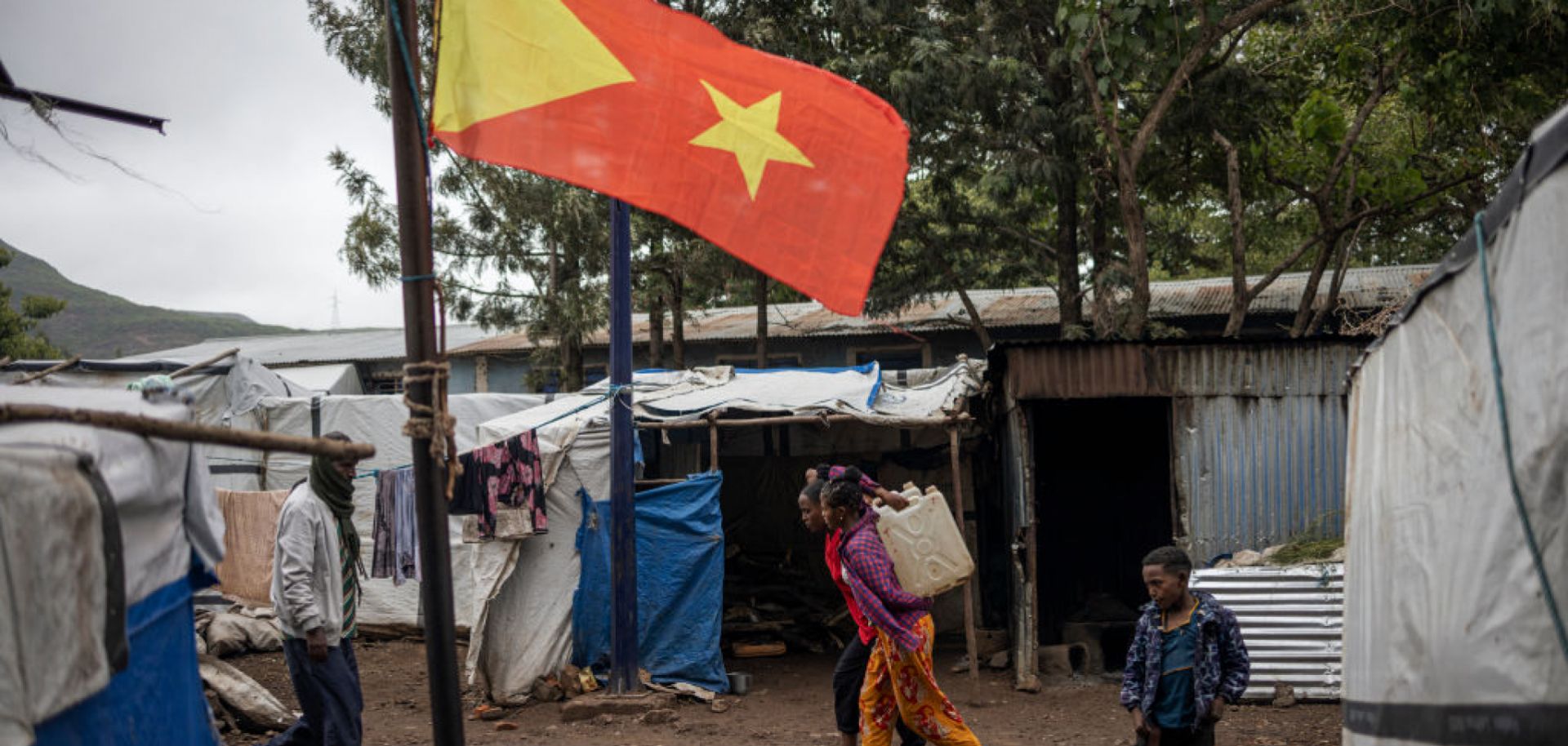
The growing split within the Tigray People's Liberation Front, or TPLF, risks triggering a resurgence of violence in Ethiopia's northern Tigray region, which would give Egypt, Somalia and Eritrea opportunities to increase their leverage over Addis Ababa, and could delay external financial support to Ethiopia. On Sept. 18, allies of Tigray interim regional administration leader Getachew Reda accused TPLF members of plotting a coup against the regional government and urged authorities to "restore order." This came amid a rapidly widening rift within the TPLF between a Getachew-led faction and another led by TPLF chair Debretsion Gebremichael. The spat escalated after the National Election Board of Ethiopia, or NEBE, refused in August to fully reinstate the legal status the TPLF held before the November 2020-November 2022 Tigray war, instead deeming it a new political party under "special consideration." Debretsion denounced the NEBE's decision and convened a TPLF congress in violation of NEBE rules, which Getachew and his allies boycotted. Despite the boycott, the party congress went ahead and expelled Getachew and his allies from the TPLF's central committee. Leveraging his position as regional administrator, Getachew subsequently dismissed zonal administrators loyal to Debretsion, which resulted in Getachew and 15 of his allies being expelled from the TPLF on Sept. 15. Getachew has since claimed that Tigrayan security forces were operating under the interim administration's command, a statement that Debretsion has rejected, stressing that the interim administration did not command the Tigrayan armed forces.
- The spat between Getachew and Debretsion became public after Getachew held an interview on July 29 in which he accused the TPLF's party leadership of corruption and of undermining the regional government.
- The NEBE granted the TPLF its status as a new political party on Aug. 9, with Debretsion convening the party's 14th congress on Aug. 14. This move violated the NEBE's rules, according to which newly registered parties can only convene a general assembly at least 21 days after having informed the board of their intent to hold such an assembly.
- The NEBE suspended the TPLF's status as a political party in January 2021 amid the Tigray war. Although the Ethiopian parliament ratified a law in June 2024 that paves the way for the reintegration of formerly rebellious parties, the NEBE claims that there are no legal grounds to grant the TPLF its former status, which the TPLF perceives as an attempt to undermine its legacy in the Tigray region.
The TPLF's internal rift comes as the implementation of Tigray's peace agreement has slowed over the past year due to territorial disputes with the neighboring Amhara region and Eritrea's continued military presence in Tigray. In November 2022, the TPLF and Ethiopia's federal government struck a peace agreement that ended the two-year Tigray war. In addition to a cease-fire, the agreement involved a phased disarmament of the Tigray Defense Forces, or TDF, unhindered humanitarian access to the region, the reinstatement of federal authority in Tigray, the withdrawal of non-federal forces from the region, the return of displaced people, and accountability for the victims of the conflict. At first, the agreement's implementation progressed steadily, with humanitarian agencies regaining access to the region, an interim regional government forming, and the TDF handing over most of its heavy- and medium-caliber weapons to the federal government. However, the TDF's disarmament has been delayed since mid-2023 due to Eritrea's refusal to withdraw its forces from northern Tigray, as well as an escalating dispute with the neighboring Amhara region over the status of western and southern Tigray, which remained under the control of Amhara militias after November 2022. Tensions between Tigray and Amhara led to armed clashes between TPLF-linked groups and Amhara militias in April that resulted in the TPLF regaining control over large parts of southern Tigray. Thereafter, Ethiopia's federal government reportedly brokered an agreement between Tigray's interim administration and Amhara's regional government whereby local Amhara administrations in nominally Tigrayan territory would disband and displaced Tigrayans would return to the contested areas. While this agreement marked a first step in settling the status of Tigray's administrative borders, progress on the deal's implementation remains unclear.
- The Tigray war erupted in November 2020 after the TPLF conducted regional elections in spite of Prime Minister Abiy Ahmed's directive to postpone them in response to the COVID-19 pandemic. According to African Union mediators, the conflict led to the death of 600,000 people — primarily due to malnutrition — and the displacement of nearly two million people.
- Eritrea's leadership has held deep-seated grievances against the TPLF for decades and supported the Ethiopian government's military intervention against it during the Tigray war, deploying troops in northern Ethiopia. However, relations between Addis Ababa and Asmara nosedived after Abiy struck the November 2022 peace agreement with the TPLF, which Eritrean President Isaias Afwerki opposed. Eritrea has since retained a troop presence in northern Tigray, claiming these areas as "sovereign" Eritrean territory. These claims suggest that Asmara might be reneging on a 2018 agreement that ended its border conflict with Addis Ababa.
- Amhara nationalists claim that western and southern Tigray rightfully belong to the Amhara region and that the TPLF wrongfully included the two areas in the Tigray region following its ascent to power in 1991. The TPLF asserts that the areas were mostly inhabited by Tigrayans prior to the start of the Tigray war, but Amhara militias have rejected this assertion by claiming Tigrayans had migrated to these regions in recent decades.
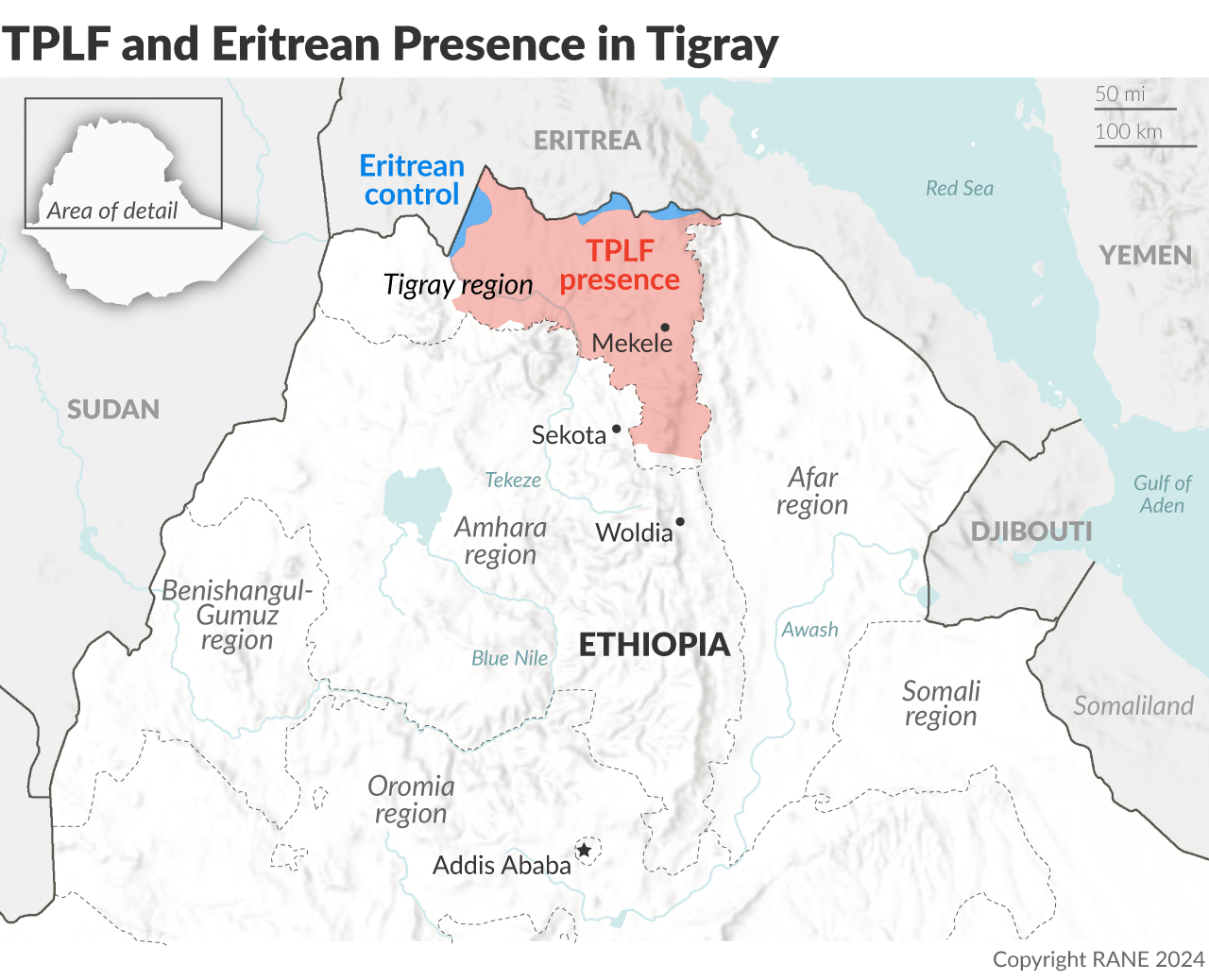
TPLF infighting threatens to devolve into intra-party clashes that Amhara militias and Eritrea could exploit to consolidate and expand their positions in Tigray, and clashes could lead to an intervention by the Ethiopian federal military that would risk prompting TPLF members to accuse the government of violating the November 2022 peace deal. As the Debretsion and Getachew factions vie for control of the regional government, the Getachew faction's coup accusations threaten to escalate the TPLF's internal dispute. In addition to the risk of localized clashes over the control of specific zonal districts, accusations of a coup provide a justification for Getachew to crack down on the Debretsion faction by leveraging his control of Tigrayan police. Conversely, Debretsion could leverage his close relations with the TDF's leadership to remove Getachew from office. While a peaceful resolution of the dispute remains possible, the involvement of Tigrayan police and/or the TDF in the TPLF's internal dispute, which until now has remained a public spat, would threaten to fracture Tigray's security apparatus along factional lines. Eritrea would likely exploit the party's escalating divisions to expand its territorial control in northern Tigray, a move that Asmara has reportedly already been pursuing since the internal spat began. Similarly, Amhara militias — which have recently escalated action against federal forces in the Amhara region — could take advantage of the TPLF's escalating internal dispute to consolidate their presence in Amhara-controlled territory within Tigray and could launch fresh attacks to reclaim parts of southern Tigray seized by TPLF-linked forces earlier this year. Given these risks, armed clashes between the Getachew and Debretsion factions could prompt Ethiopia's federal government to intervene militarily in Tigray to halt fighting. However, such an operation would risk alienating at least one of the TPLF's two warring factions, which could subsequently denounce the intervention as a violation of the November 2022 peace deal. In turn, this would raise the prospect of clashes between certain elements from the TDF and TPLF with federal government forces.
- The Eritrean military reportedly expanded its territorial control in Tigray's Gulomahda and Irob areas in September.
- Heavy clashes took place in the city of Gondar, Amhara region, in mid-September as Ahmara militias launched an offensive on the city, pointing to rising activity from these groups.
Ethiopia's regional rivals would likely exploit any outbreak of violence in Tigray to weaken Addis Ababa, while TPLF accusations of the government violating the November 2022 peace deal could delay disbursements of external support from the International Monetary Fund. The TPLF's expanding internal rift comes as Ethiopia has been embroiled in growing regional tensions with Somalia and Egypt, primarily due to Ethiopia's maritime port deal with Somalia's breakaway region of Somaliland and its unilateral operation of the Grand Ethiopian Renaissance Dam. Given Abiy's commitment to the port deal, Mogadishu appears likely to leverage Tigray's political turmoil to pressure Ethiopia into making concessions in ongoing Turkey-mediated talks between the two sides. In the event of an intervention by Ethiopia's federal military in Tigray, Somalia would likely seek to isolate Ethiopia diplomatically and highlight potential human rights violations by federal forces. Should this intervention cause a breakdown in relations between Ethiopia's federal government and one of the TPLF's two factions, the TPLF faction aggrieved with Addis Ababa would be a partner of choice to Somalia, which could grant it military support through Eritrea. Meanwhile, Egypt would likely exploit a potential resurgence in Tigray's instability by increasing its leverage over Addis Ababa, but it is likely to do so by providing logistical support and diplomatic cover to Eritrea, rather than by directly supporting armed groups within Tigray, as this would threaten Cairo's relations with the West. Moreover, the collapse of Ethiopia's 2019 IMF support program due to the Tigray war suggests that accusations by leading TPLF figures of the federal government breaching the November 2022 peace deal would risk delaying disbursements from the IMF and/or the World Bank to Ethiopia following key agreements signed in late July. This would heighten Addis Ababa's economic challenges, whether by depriving the federal government of funds to press ahead with a targeted support program for low-income households or by complicating debt restructuring talks with bondholders.
- Somali Foreign Affairs Minister Ahmed Moalim Fiqi stated on Sept. 12 that Mogadishu was open to supporting the TPLF and other rebel groups in Ethiopia should Addis Ababa move forward with the implementation of its port deal with Somaliland.
- An Egyptian delegation led by Egyptian intelligence chief Abbas Kamel and Foreign Affairs Minister Badr Abdelatty traveled to Eritrea on Sept. 14 and met with President Afwerki. Egypt and Eritrea are reportedly mulling a new defense pact, and Cairo is allegedly attempting to mediate tensions between TPLF elements and Eritrea.
- On Sept. 10, Debtretsion said talks between TPLF leaders and Eritrea had been ongoing for over six months. Debretsion noted that Ethiopia's federal government had endorsed these talks.
