
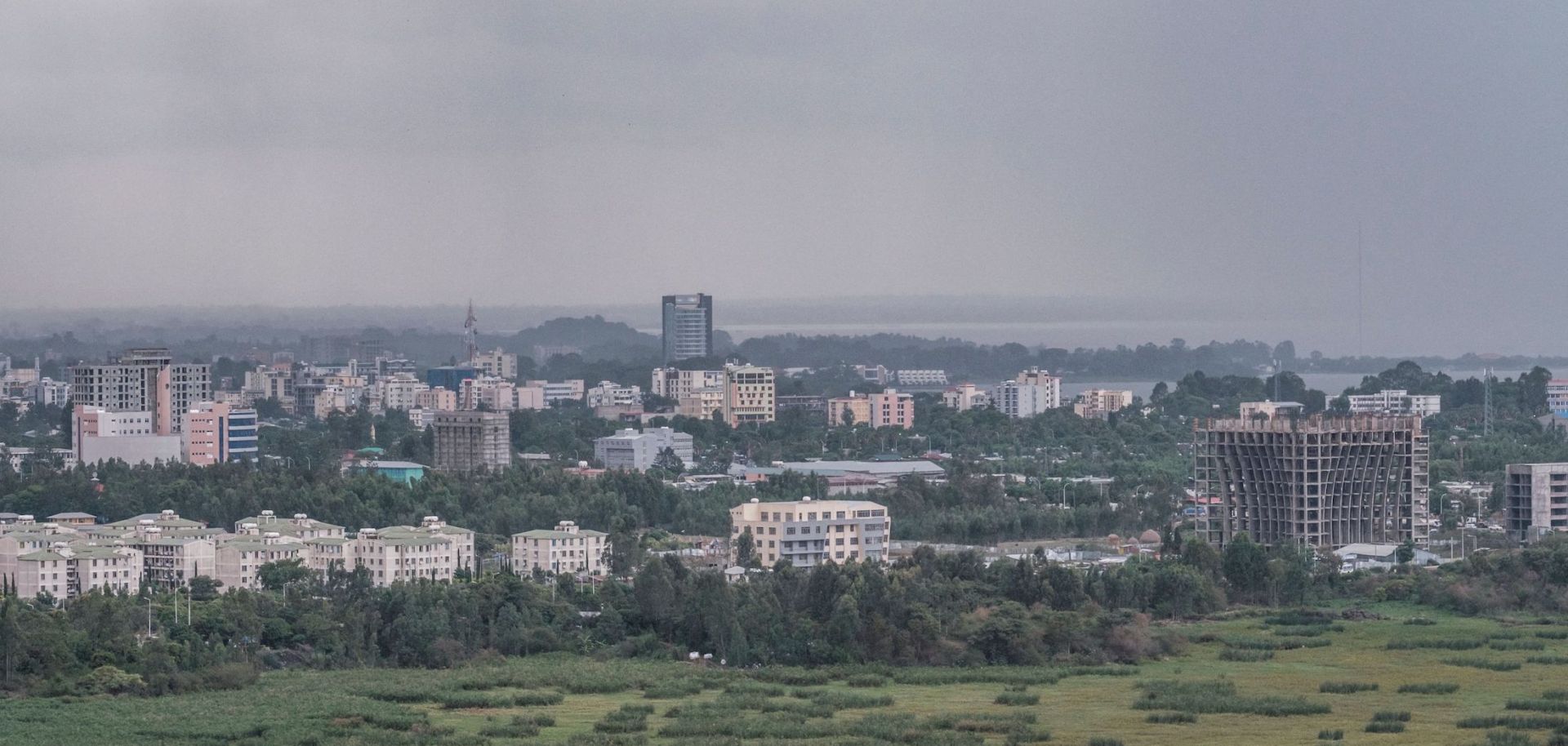
A view of the city of Bahir Dar, the capital of the Amhara region in northern Ethiopia, on June 19, 2021.
A widening rift between Amhara regional special forces and Ethiopia's central government threatens to destabilize the tenuous peace in the north and pose long-term political risks to Prime Minister Abiy Ahmed's mandate. Protests and gunfire broke out in Ethiopia's Amhara region on April 9 against a federal government order to dissolve regional special forces and integrate them into the national army. The following day, an explosion in Bahir Dar, the capital of the Amhara region, killed two people, although the cause of the explosion is unknown and it is not clear if it was connected to the protests. Ethiopian Prime Minister Abiy Ahmed announced on April 8 that the government will implement its plan to dissolve and reintegrate regional special forces into other federal security structures "even if there is a price to be paid," and he said the government will take "appropriate law enforcement measures on those who are deliberately playing a distractive role." Clashes between Amhara's local military, allied militias and federal security forces were ongoing as of April 11.
The government's announcement comes amid a fragile peace in the Tigray region, which regional Amharan leadership views as undermining key interests. Following the November 2022 cessation of hostilities signed by the federal government and the rebel Tigray People's Liberation Front (TPLF), fighting between Tigrayan rebels and the Ethiopian military has largely ceased. While this has enabled Tigray to establish an interim regional government and progress in peace talks with the federal government, the agreement did not include Amhara regional special forces or militias that were also combating the TPLF over long-standing territorial and ethnic grievances. One of the key points of conflict between Amharas and Tigrayans is control over the western Tigray zone, which falls inside Tigray's political borders but has been occupied by Amhara regional special forces and militias since the beginning of the war in November 2020. Since Abiy's announcement regarding the federal integration of regional security forces, Amhara leaders have condemned the prospect of disarming and abandoning their regional posts due to the opening it would give the TPLF to take back western Tigray. Secondarily, Abiy's announcement underscores an ongoing nationwide debate over the centralization of political and military power, which has been a key objective of the prime minister since he took office and a trigger of the war in Tigray. Until recently, Abiy's efforts to centralize government control over Ethiopia's disparate regions had been focused in Tigray, but the recent announcement expands federalization to Amhara, which regional leadership opposes, as it would constrain autonomy and political power.
Divisions between Amhara regional leadership and the central government threaten to destabilize the already tenuous peace in northern Ethiopia and undermine Abiy's primary political support base. Amhara special forces say that demobilization leaves them vulnerable to incursions from Tigray and Oromia (the region to Amahara's south) — a credible claim given that conflict in Oromia is ongoing and Amhara forces continue to occupy parts of highly contested western Tigray. Therefore, Amharas are unlikely to demobilize and will probably continue to protest the mandate, which will pose security risks in Amhara itself if protesters and federal forces continue to clash. It is also possible that Amhara special forces and/or militias will retaliate against the order by carrying out incursions and/or abuses against civilians in Tigray, where the humanitarian situation remains dire and security is unsteady. This could push the TPLF to rearm, which would lead to the resumption of violence in the region and raise the risk of a breakdown in the cessation of hostilities with the central government. Furthermore, ethnic Amharas have been Abiy's primary political support base up to this point, which means a split could grievously undermine the prime minister's political mandate for his remaining four years in office, potentially complicating resumptions in infrastructure development and investment. While rumors are circulating that Abiy has been courting alternative groups — including ethnic Oromos, with whom the central government has been at war for years — to replace Amharas, a rift with such a politically powerful group could throw the country back into turmoil.
- A conflict separate from the war in Tigray has flared in Ethiopia's central Oromia region in recent months, with clashes between the Oromo Liberation Army (OLA) and the Ethiopian military displacing hundreds of thousands of civilians. The OLA has a long history of rebellion against the central government, but disappointment with Abiy (who is an ethnic Oromo) triggered a resurgence in violence in 2020.
