
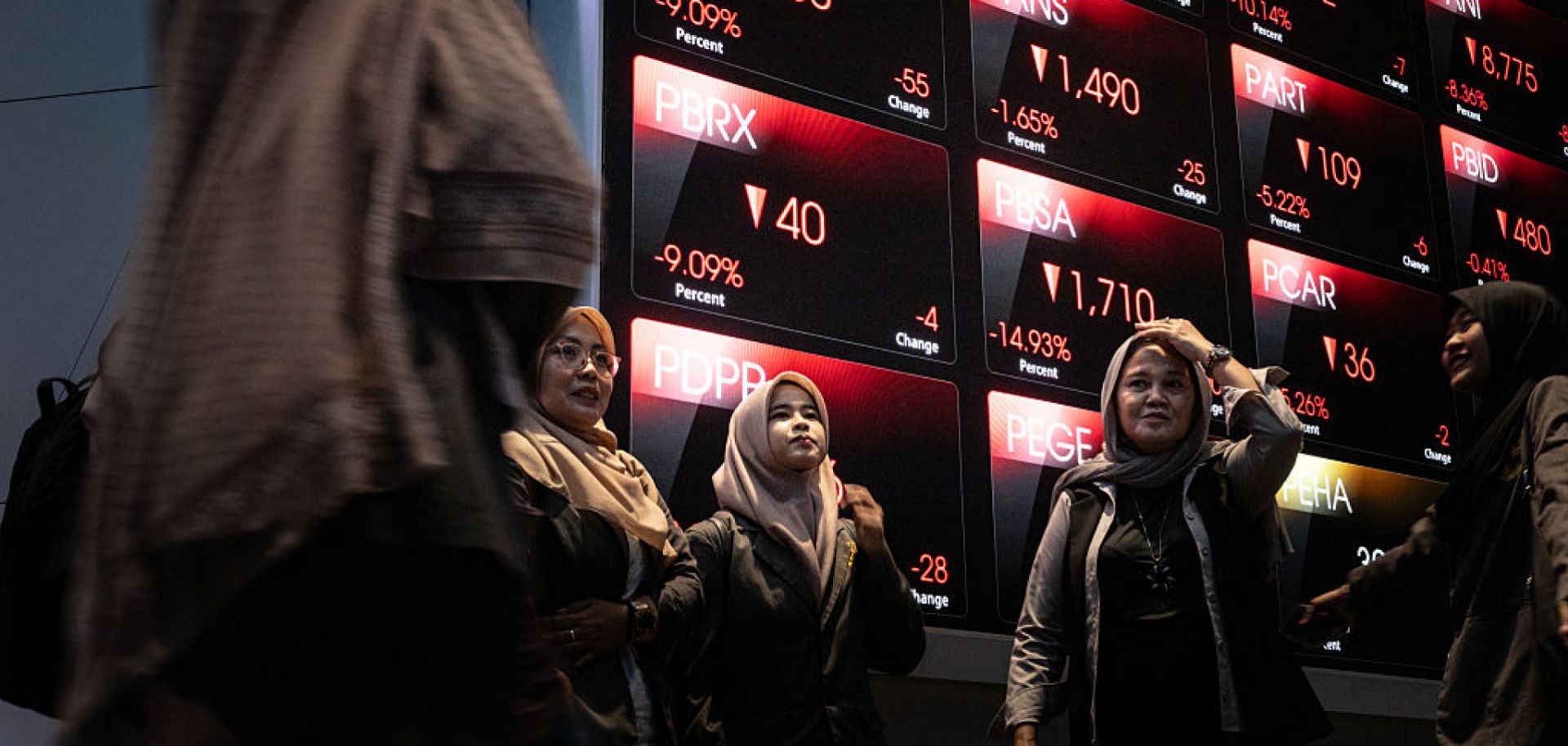
Indonesia's market rout has exposed deeper structural and governance vulnerabilities that now threaten investor confidence, complicate the government's investment-led growth strategy and raise risks to the country's competitiveness as a regional manufacturing hub. On Jan. 29, Indonesia's equity market sold off sharply after MSCI, a U.S.-based global index provider, raised concerns about the "investability" of Indonesian equities. MSCI cited opaque ownership structures, a small proportion of shares available for public trading and insufficient transparency around trading and shareholder data, and warned that Indonesia's equity market could be downgraded from "emerging market" to "frontier market" status if deficiencies were not addressed ahead of MSCI's scheduled May index review. Following the warning, the benchmark Jakarta Composite Index fell more than 8% over two consecutive trading days, including a steep intraday decline on Jan. 30 that triggered an automatic trading halt under exchange volatility rules. The selloff wiped out an estimated $80 billion in market capitalization before prices stabilized later in the day, following public statements and press briefings by the Ministry of Finance, Bank Indonesia, the Financial Services Authority and the Indonesia Stock Exchange outlining prospective regulatory and market support measures. At the same time, financial stress spilled into currency markets, causing the Indonesian rupiah to weaken by approximately 4%; the currency traded near record lows before stabilizing. The episode escalated further on Feb. 5 when Moody's Ratings cut Indonesia's sovereign credit rating outlook from "stable" to "negative," citing lower policy predictability, rising fiscal pressures, weakening foreign reserves and debt risks linked to state-owned enterprises, broadening the episode from an equity market shock into an explicit warning about sovereign policy credibility. The market selloff was followed by significant leadership changes at key financial institutions. On Jan. 30, the head of Indonesia's financial regulator, several senior officials overseeing capital markets and the chief executive of the stock exchange all resigned. The sudden departures have fueled fears that less independent individuals will fill these leadership positions, potentially opening these key market institutions to greater influence by the president, even as authorities sought to reassure investors that day-to-day market operations would continue without disruption. Since the selloff, markets have stabilized but not recovered.
- "Emerging market" status means a country is included in the core benchmarks used by large global investors such as pension funds, sovereign wealth funds and insurance companies, while "frontier market" status signals higher risk and weaker market infrastructure, making it more likely major funds automatically limit or exclude exposure, shrinking the pool of available capital.
- Measures proposed by the Ministry of Finance, Bank Indonesia, the Financial Services Authority and the Indonesia Stock Exchange include requiring companies to make a larger share of their stock available for public trading, tightening rules that require firms to clearly disclose who ultimately owns and controls their shares, and relaxing limits on how much domestic insurance companies and pension funds are allowed to invest in stocks in order to bring more long-term local investors into the market. As of early February, MSCI had not publicly endorsed Indonesia's reform proposals and declined to comment on the substance of post-crisis meetings, maintaining uncertainty about whether the measures would be sufficient to avert a downgrade.
- While the rupiah's decline was modest in percentage terms, touching a record low was symbolically significant and reinforced perceptions of mounting financial stress rather than reflecting routine currency volatility.
The immediate trigger for the selloff was MSCI's warning, but Indonesia's vulnerability to capital flight and market volatility runs deeper and has been building for years. Much of Indonesia's stock market is dominated by companies with concentrated ownership, leaving relatively few shares available for everyday trading and amplifying price swings during periods of stress. This structure has long raised concerns among foreign investors about whether prices accurately reflect underlying value, particularly when ownership and trading activity are not fully transparent. Investors have also expressed concerns that thin liquidity can enable insiders or related parties to distort prices through coordinated trading, reinforcing perceptions of uneven enforcement. Proposals to require companies to release more shares into public trading are intended to address these distortions, but they emerge amid broader doubts about governance and policy credibility. Those doubts were sharpened after Moody's downgraded Indonesia's sovereign rating outlook, explicitly citing lower policymaking predictability and rising fiscal risks, escalating what was initially a market structure problem into a broader warning about institutional effectiveness. Indonesia's political and economic direction under President Prabowo Subianto, who took office in October 2024, has also become a growing concern, as his presidency has been marked by wider fiscal deficits, a far more prominent state role in economic activity and signs of weakening institutional safeguards that previously anchored investor confidence. As a result, MSCI's technical assessment landed in an environment already primed for pessimistic interpretation, while Moody's move provided a second, independent validation of governance risk. Subsequent resignations at the financial regulator and the stock exchange further intensified uncertainty, raising questions about enforcement capacity and policy continuity just as Indonesia faces a compressed timeline to demonstrate credible reform ahead of MSCI's May review.
- Foreign investors have recorded sizeable net outflows from Indonesian equities and bonds throughout 2025 and into early 2026, reflecting a reduced foreign appetite for Indonesian assets amid governance and policy concerns. Foreign ownership of Indonesian bonds has fallen to just over 13% from nearly 40% in 2019. Overseas investors also sold around $834 million worth of Indonesian shares in 2025.
- Indonesia's fiscal deficit widened in 2025 to about 2.9% of GDP, equivalent to roughly $42 billion, exceeding earlier targets. This reinforced investor concerns about fiscal discipline as government spending expanded under the Subianto administration.
- MSCI's influence is significant because global investors widely rely on its index classifications when allocating capital across markets. Even the possibility of being downgraded can prompt fund managers to reduce exposure in advance, while an actual downgrade would likely trigger automatic selling by funds that track MSCI benchmarks, further shrinking liquidity.
- Investor concerns about institutional guardrails and policy continuity were reinforced by recent senior personnel changes. In September 2025, Subianto abruptly replaced long-serving Finance Minister Sri Mulyani Indrawati, a technocrat commonly associated with apolitical fiscal discipline. Also, on Jan. 29, parliament approved Subianto's nephew, Thomas Djiwandono, as a deputy governor of the central bank.
The episode serves as a stress test for Indonesia's investment-led growth model and how investors will assess economic governance under President Subianto, with implications for the country's broader competitiveness as a regional manufacturing destination. Indonesia's growth model is built on attracting foreign capital to finance manufacturing, infrastructure and downstream mineral processing. As such, even if Indonesia avoids a formal MSCI downgrade in May, the episode matters for three reasons. First, while foreign manufacturers do not typically finance projects through Indonesia's equity market, market stress raises the country's overall cost of capital through higher risk premiums, currency weakness and tighter domestic financial conditions. This directly affects Indonesian and listed companies' ability to attract and retain foreign capital needed for manufacturing expansion, infrastructure buildout and downstream minerals processing, areas the government has prioritized as part of its effort to move up the value chain. If investors conclude that markets are harder to trust or rules are applied inconsistently, financing costs rise, raising the risk that marginal investment flows shift toward regional competitors like Vietnam, Malaysia, Thailand and India, weakening Indonesia's position in efforts to attract manufacturing and supply chain relocation away from China. Second, the episode is shaping perceptions of how economic policy is executed under Subianto. While Subianto's greater reliance on centralized decisionmaking and state financial tools could help manage short-term economic uncertainty, these dependencies also increase medium- and long-term uncertainty over whether investment decisions will be made by independent regulators or political authorities, whether policy commitments will be revised abruptly with limited transparency, and whether commercial outcomes will be determined more by clear rules or political discretion. Third, the market shock has become a test of Indonesia's economic credibility.
- In response to the market rout, Indonesian officials encouraged state investment vehicles and domestic asset managers to continue buying equities to stabilize prices, highlighting the government's willingness to use centralized, state-directed financial tools to manage market outcomes.
Indonesia's recent market stress will most likely lead to a period of slower, more selective foreign investment, though worse outcomes remain possible if uncertainty persists or the government introduces new shocks. Sustained volatility or heavier state intervention would not trigger a financial crisis on its own, but it would reinforce broader investor concerns about Indonesia's economic trajectory, particularly regarding central bank independence, fiscal discipline and the expanding role of the state in capital allocation. These concerns have a much greater potential to affect long-term investment decisions and Indonesia's financial stability than just stock market governance alone, and could ultimately erode the country's appeal relative to other regional manufacturing hubs. Looking ahead, the most likely outcome is that Indonesia avoids a formal downgrade but enters a period of slower, more selective foreign investment as investors stay cautious amid Subianto's evolving policies and more sensitive to attendant political and policy signals. A less favorable outcome would emerge if uncertainty persists or market stress recurs, leading authorities to rely more routinely on state mechanisms to stabilize markets. While this would temper short-term volatility in equities and the rupiah, it would also encourage investors to factor in higher medium-term governance and policy risk. Such intervention could also reinforce perceptions of political discretion in market outcomes, leading investors to demand higher compensation for policy uncertainty, as reflected in persistent currency weakness, higher hedging costs or valuation discounts relative to regional peers. A materially worse outcome would require the government itself to trigger a new shock — such as through abrupt regulatory changes, further leadership changes or heavier political direction of investment decisions — prompting sustained outflows and accelerating a shift of marginal investment toward competing manufacturing hubs.
- Indonesia's industrial strategy is dependent on sustained foreign investment. The government's "downstreaming" policy bans exports of raw nickel ore and requires companies to build domestic processing facilities, while 2025 amendments to the mining law prioritize access for firms that commit capital to smelters, manufacturing plants, and associated infrastructure, making investor confidence and financing conditions directly relevant to Indonesia's ability to execute its value-chain ambitions.
