
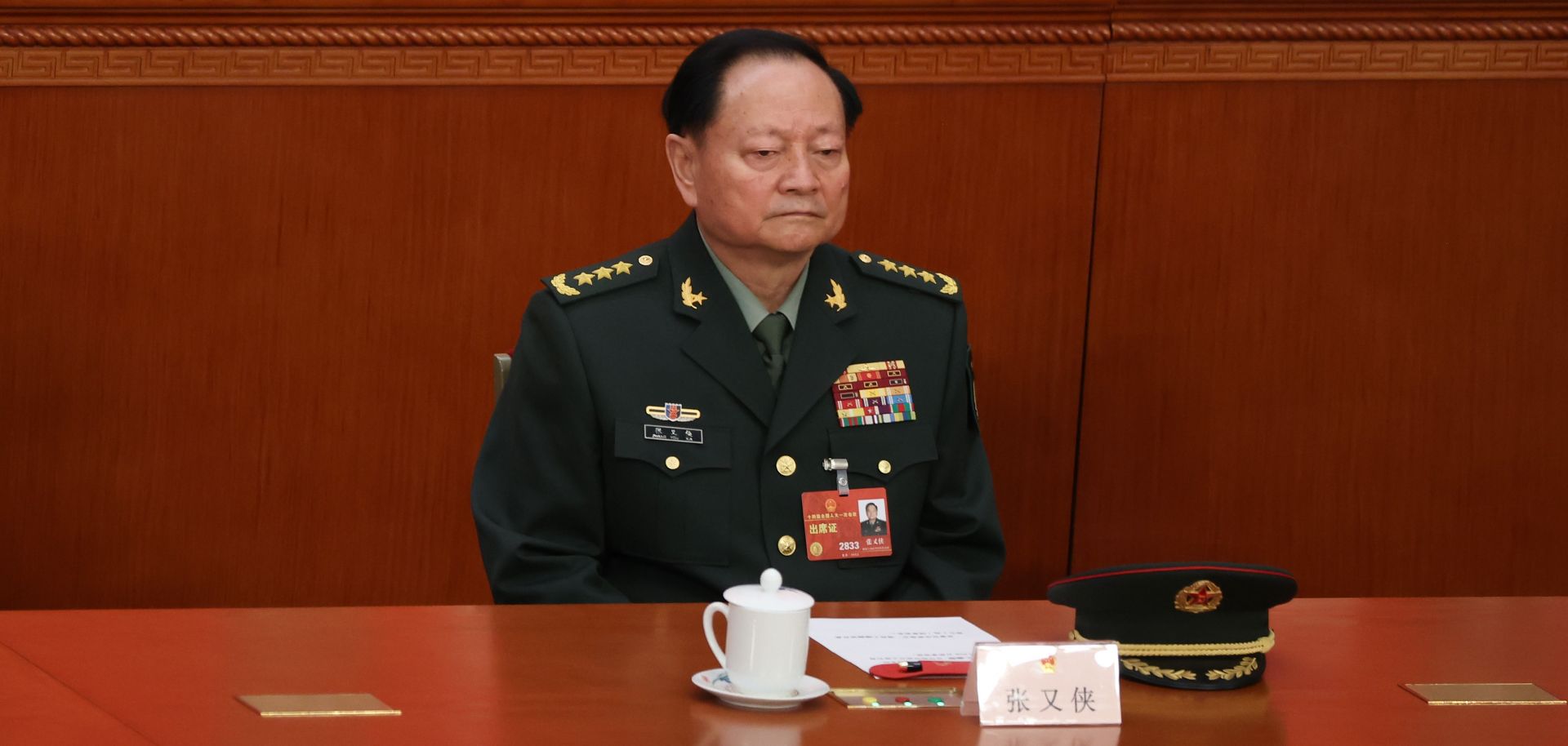
China's highest-level military purge in decades indicates Beijing will accelerate anti-corruption work and prioritize regime security above other strategic goals; the hollowing out of China's top military advisors also deepens uncertainty over Chinese military intent toward Taiwan, which, when combined with foreign efforts to deter Chinese aggression, could raise the risk of a future conflict. On Jan. 24, China's top military news outlet, the PLA Daily, announced that Zhang Youxia, senior vice chairman of the Central Military Commission (CMC) and former chief of arms procurement for the People's Liberation Army (PLA), was being investigated for "serious violations of discipline and law." The editorial noted that Liu Zhenli, the head of the CMC Joint Staff Department (a role that involves formulating military strategy and assessing combat readiness), was also under investigation. The editorial asserted that both Zhang and Liu "undermined" the CMC Chairman (Chinese President Xi Jinping), "fostered political and corruption problems" and "severely impacted" political and ideological unity among officers and soldiers. According a Wall Street Journal report, a Chinese military briefing with top officers on the morning of Jan. 24 also asserted Zhang had leaked secrets related to China's nuclear weapons program to the United States, and that Zhang was being investigated for forming "political cliques" — a phrase the Chinese Communist Party (CCP) uses to signify an unsanctioned political faction or alternative power structure challenging Xi's authority.
- Zhang was known to be close professionally with Xi, as he was one of only a handful of senior cadres (in addition to Xi himself) to be granted exemptions in 2022 to the CCP's mandatory retirement age of 68, after which Zhang became senior CMC vice chairman, second in military rank only to Xi.
- China's CMC is the top orchestrating and decision-making body for China's military. It is the chief military advisory body to President Xi, who leads the CMC. Crucially, the CMC alone has the power to issue operational directives, such as ordering a military strike or declaring war. It is subordinate to the CCP as a political organ, not to the Chinese government, as is common in most other countries.
- Since Xi came to office in 2012, the CMC has been whittled down from 11 members to just two (one of whom is Xi), now that Zhang and Liu are on their way out. The other remaining member of the CMC is Zhang Shengmin, who was recently appointed junior CMC vice chairman, below only Zhang Youxia and Xi in the military hierarchy. Zhang Shengmin has been in charge of anti-corruption efforts in the military since 2017.
Regardless of the reasons for Zhang's removal, Xi's anti-corruption purges will almost certainly continue to accelerate, as will Beijing's prioritization of security above all other state goals, including military and economic development. The language used in the PLA Daily editorial strongly suggests that Zhang was removed for political reasons, with the CCP's allegations that he leaked nuclear secrets likely spurious but intended to signal the finality of Zhang's dismissal and warn all military personnel who were under his command against associating with his ilk or emulating Zhang's professional or political conduct. Details are scant, but the political threat Zhang posed could have been as simple as passive opposition to Xi's preferred means for bolstering military readiness. Having fought in China's ill-fated invasion of Vietnam in 1979, Zhang is one of the last remaining top Chinese military officials with real combat experience, which means he may not have shared Xi's strategy on how, whether, and when to take Taiwan. Zhang is also likely connected in some way to genuine corruption, particularly the vast promotion-for-sale network in the PLA, though this type of activity is widespread and is usually not alone sufficient reason to be purged. Moreover, Zhang has personal and professional connections to many of the PLA officials who have been purged over the past three years, including ousted defense minister Li Shangfu, suggesting that Zhang's dismissal aligns with the CCP's long precedent of taking out underlings to isolate and eliminate the superior. But regardless of the reasons for Zhang's removal, Xi's military purges are almost certain to steadily accelerate. This is because, even as Xi has largely consolidated power since becoming CCP General Secretary in 2012, he has lacked a strong network of military ties, and Zhang's removal suggests Xi believes his efforts to build that network remain insufficient. Moreover, anti-corruption purges have been Xi's primary tool for asserting his political supremacy since 2012, with the total number of investigations and purged high-level officials growing every year — and he will not give this tool up just because Zhang is gone. Rather, dismissing such a close PLA contact, despite over a decade of efforts to co-opt the military, likely suggests Xi's concerns about his hold on power will only grow in the coming years, as will his purges. More broadly, this also indicates that the CCP under Xi will continue to prioritize security — of Xi's political supremacy, of the CCP regime, and of the state — even if it comes at the expense of military readiness or the economy.
The hollowing out of the CMC increases uncertainty about Xi's decision-making regarding Taiwan, which will accelerate efforts by U.S. allies to modernize their militaries while raising the risks of conflict, even if only due to a miscalculation. The purges of Zhang and Liu have left Xi with only one remaining advisor on the CMC. This raises serious questions about the quality and content of the military advice that the Chinese president will now receive, particularly on the timing and feasibility of a Taiwan blockade or invasion. Xi remains unlikely to direct the PLA to take Taiwan anytime soon, given his long-standing concerns about the military's insufficient combat readiness and his push to modernize its platforms and organizational structure for modern warfare. In fact, without other senior advisors, especially battle-tested ones like Zhang, Xi may temporarily be even more reluctant to conduct a risky military campaign in which failure could put his own job on the line. That said, Xi will likely replace those purged — whether on the CMC or elsewhere — with loyalists, including political commissars (i.e., lifeline CCP apparatchiks working in the PLA), trusted anti-corruption professionals, and younger PLA officers who lack combat experience and for whom more of their professional careers are indebted to Xi's personal favor. These replacements will be more afraid to tell Xi things he does not want to hear, like the reality of China's combat readiness — a dynamic common in the CCP's history when under more dictatorial leaders, like Mao Zedong. This could, in turn, lead Xi to overestimate China's military capabilities, thereby raising the risk of a miscalculation over Taiwan in the coming years, including a premature decision to invade or blockade the island. When combined with China's steadily escalating military drills around Taiwan, uncertainty about Xi's decision-making will drive the United States and its Asian allies (namely, nearby Japan and the Philippines) to accelerate efforts to strengthen their militaries and deter or defend against Chinese aggression. But this preparation, paradoxically, could also risk conflict, as witnessed by China's recent military drills near Japan and Taiwan after Tokyo suggested it could militarily intervene in a Taiwan conflict. Though both China and interested outside powers continue to assert that a conflict is neither inevitable nor desirable, these developments show that fears of a conflict can become a self-fulfilling prophecy.
- China can somewhat measure its military readiness with weapons tests, air and sea drills around Taiwan and limited maritime engagements (e.g., in the South China Sea). But the military personnel who advise Xi will be the ones interpreting these events for him, so much of the truth about combat readiness can still be hidden from the Chinese president.
- Recent U.S. policy documents, including the Pentagon's National Defense Strategy released on Jan. 23, assert that China remains a key threat to the United States, second only to homeland defense, but that Washington wants its allies to take on a greater share of their own defense burden. Thus, even if the Chinese threat does not alone sufficiently motivate U.S. allies like Japan or the Philippines to expand their own militaries, they would still likely do so under pressure from their primary benefactor, the United States.
- On Nov. 7, Japanese Prime Minister Sanae Takaichi claimed in a Diet session that Japan could intervene in a Taiwan invasion scenario. Afterward, China sent long-range bombers and an aircraft carrier through Japan's Miyako Strait, with state media reviving old narratives that Japan's Ryukyu Islands belonged to China. In addition, China launched the Justice Mission 2025 military drills around Taiwan on Dec. 29-30. These included missile strikes in Japan's maritime exclusive economic zone, Chinese Coast Guard drills around the Japan-claimed Senkaku Islands, and an explicit warning from the PLA's Eastern Theater Command that the drills aimed to deter "external interference."
- The hollowing out of the CMC also makes it more likely that a Chinese attempt to take over Taiwan would fail due to a false impression of PLA readiness. Such a development could threaten Xi's tenure and that of the CCP by undermining their narratives about China's growing strength relative to the West and the inevitability of territorial unity — particularly given that Xi and his predecessors have based the legitimacy of their rule in part on the ability to reunify with Taiwan.
