
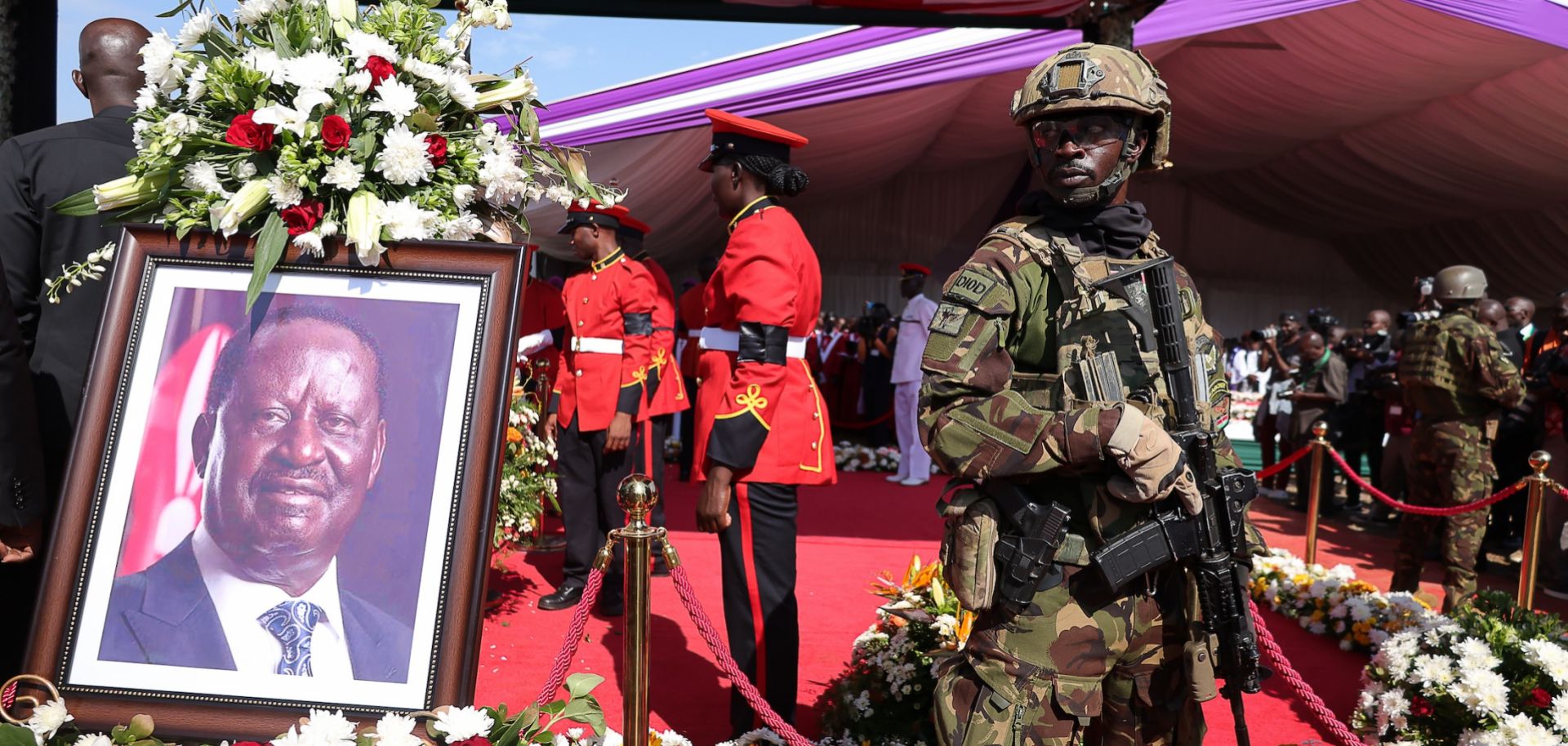
The death of former Kenyan Prime Minister and opposition leader Raila Odinga risks fragmenting his political party, creating space for other opposition figures to challenge the incumbent president. Odinga, widely known as the "people's president" despite never serving in the role, died on Oct. 15 after reportedly suffering a stroke while receiving medical treatment in India. The 80-year-old, a central figure in Kenyan politics for decades, was granted a state funeral and seven days of national mourning. However, his death quickly sparked unrest across the country from the capital, Nairobi to his home region of Western Kenya. In the intervening days four people were killed when security forces used live fire to disperse crowds at the Kasarani stadium where Odinga's body was to be publicly viewed. On Oct. 16, Odinga's supporters also stormed airport grounds, breaching security and forcing authorities to temporarily halt operations. Some mourners denounced President William Ruto, whom they accuse of bad governance, exacerbating economic hardships and further undermining public trust in state institutions.
- In 2005 Odinga co-founded the Orange Democratic Movement (ODM) following a contentious constitutional referendum. Since then, he had led ODM, which has remained the country's main opposition party. Under his leadership, ODM, mainly rooted in Western Kenya, became a key advocate for political and electoral reforms and a decisive force in Kenya's polarized political landscape.
- In 2017, the National Super Alliance (NASA) coalition, led by Odinga, successfully petitioned Kenya's Supreme Court to annul the presidential election results, citing widespread irregularities in vote transmission and tallying. The ruling marked the first time in Africa that a court had overturned a presidential election, reinforcing Odinga's role as a key opposition figure and setting a historic precedent for judicial independence.
Odinga was a decades-long Kenyan political leader and advocate for democracy who maintained influence through strategic alliances, though younger generations increasingly criticized him for perceived compromises with those in power. Following in the footsteps of his father, Kenya's first Vice President Jaramogi Oginga Odinga, Odinga was a towering figure in Kenyan politics for over four decades. Early in his career, he was one of the longest-serving political prisoners under former President Daniel arap Moi. Upon release, he took on a central role in the pro-democracy movement that led to the reintroduction of multiparty democracy in 1991. After the contested 2007 elections — in which he alleged electoral manipulation, helping to spark Kenya's deadliest post-election violence — Odinga agreed to a 2008 power-sharing agreement that ended the crisis with him serving as prime minister and Mwai Kibaki serving as president. He later played a pivotal role in the negotiations that led to the 2010 constitution, which redefined governance, devolution and citizen rights. However, in the years that followed, Odinga engaged in pragmatic political maneuvers that many viewed as a departure from his longstanding role as a voice for accountability and democratic reform. These included the 2018 "handshake" with former President Uhuru Kenyatta, which produced the Building Bridges Initiative (BBI) aimed at fostering inclusivity and reform after Odinga's loss in the 2017 elections and his later alliance with President William Ruto. These and other moves ensured his continued influence despite being out of formal office, but drew growing criticism from his supporters, particularly during the series of Gen Z-led nationwide anti-government protests in 2024 and 2025, which he did not directly back.
- In June 2024, a series of protests against a finance bill which would have increased taxes quickly escalated into broader anti-government demonstrations driven by grievances over poor governance, police brutality, femicide and other socio-economic issues. The protests ultimately compelled President Ruto to revoke the bill and dismiss his entire cabinet.
- Following the disputed 2017 presidential election, Odinga held his own swearing-in ceremony on January 30, 2018, declaring himself the "people's president." However, this eventually paved the way for reconciliation efforts between him and President Kenyatta, culminating in the historic "handshake".
Odinga's death creates a leadership vacuum within ODM, increasing the risk of fragmentation and providing an opportunity for Ruto to shape the succession process and position allies at the party's helm, which would bolster divisions by courting disillusioned ODM politicians and allies ahead of the 2027 elections. Odinga's political stature and ability to manage internal factions allowed him to consolidate control over the party while maintaining influence across Western Kenya and certain urban centers. With his death, ODM is set to face a leadership vacuum that risks fragmenting the party. This is partly evidenced by the appointment of Raila's brother, Oburu Odinga, as the acting head of the party following Odinga's death. While Oburu is also a politician and it is common for a relative of the deceased to assume their public position, the appointment highlights the absence of a clear long-term successor. Even within ODM and among Raila's allies, no one commands the same national influence or can easily rally the party's diverse support base. Regional power bases within the party, particularly in Western Kenya, may push their own preferred candidates, intensifying internal competition that will likely lead to disputes that further fracture the party. One core line of fracture within ODM is likely to emerge around whether to align with or oppose President Ruto in the 2027 elections. Should ODM's new leadership fail to fill the void to establish unity, the party will likely struggle to mobilize young voters ahead of the 2027 elections. Meanwhile, ODM's fragmentation also affects President Ruto, who had recently formed an alliance with the party under Odinga, which Odinga had said was only until the 2027 elections, leaving open the possibility that the party could field its own candidate. Odinga's death alters this dynamic. Ruto's potential support from Odinga's stronghold in Western Kenya and among smaller ethnic groups would likely have materialized only if Odinga had chosen not to run or refrained from backing another candidate. His death now creates uncertainty, suggesting Ruto may need to expend more political capital to secure votes in these regions. However, Ruto will likely attempt to consolidate support by leveraging the backing of state machinery, by promising key government positions in the next cabinet or during a reshuffle, reassigning or removing politicians with limited political weight and controlling the allocation of tenders. At the same time, the likely fragmentation within ODM could work to Ruto's advantage. A divided opposition may make it easier for him to court disillusioned politicians and voters.
- In early 2025, President Ruto and Odinga formed a Broad-Based Government (BBG) coalition through a 10-point power-sharing framework aimed at national unity, inclusive governance and policy coherence. The coalition integrated key opposition figures into decision-making but faced public skepticism, with critics arguing it concentrated power, undermined the opposition's role and allowed Ruto to solidify his hold on power amid popular anti-government protests and sentiments.
- President Ruto lacks full backing in the Mount Kenya region, which represents roughly a quarter of Kenya's electorate, leaving a significant gap in his national support. Votes from Western Kenya are therefore strategically crucial. While Ruto can consolidate support in regions where he is strong, broadening his appeal in Western Kenya and other opposition-leaning areas will likely be essential for him to secure at least 25% of votes cast in more than half of the 47 counties, meeting the constitutional threshold and strengthening both his numerical and symbolic legitimacy for re-election in 2027.
Odinga's death and the resulting leadership vacuum in ODM are likely to create opportunities for other opposition parties and leaders who had been sidelined by the alliance with Ruto, but building a unified anti-Ruto coalition may be slow due to regional fragmentation and internal rivalries. The leadership vacuum within ODM presents a strategic opening for other opposition parties and leaders, such as former Vice President Kalonzo Musyoka or even impeached former Deputy President Rigathi Gachagua to strengthen their political bases, attract disillusioned ODM supporters and position themselves as key power brokers or alternative opposition figures ahead of the 2027 elections. Regions where ODM has traditionally commanded strong support are likely to become highly contested, offering rival opposition parties a chance to erode ODM's vote share and build alternative power bases. Beyond regional dynamics, urban areas and youth constituencies that have felt underrepresented within ODM could also become key targets, allowing other parties such as Musyoka's Wiper party to cultivate support. This scenario risks spurring the emergence of a broader anti-Ruto coalition among opposition groups. While such a coalition could undermine Ruto's electoral prospects, he still retains significant support, particularly after recently reuniting with the former President Moi's party, the Kenya African National Union, or KANU, which has bolstered Ruto's standing among the Kalenjin people, President Ruto's core constituency. Moreover, the formation of a cohesive anti-Ruto alliance could take time, especially as non-ODM strongholds such as Central Kenya (predominantly inhabited by Kikuyus, Kenya's largest ethnic group and one of its most influential voting blocs), are facing internal fragmentation following the impeachment of Gachagua. His loss of key allies and the absence of support for President Ruto from former President Kenyatta, a major political figure in the region, further complicates efforts to unify the Kikuyu vote against Ruto.
- Gachagua, who played a key role in delivering part of the Kikuyu vote for President Ruto in the 2022 election, was impeached in October 2024 on charges including corruption, inciting ethnic divisions and undermining the president, with the Senate upholding the decision on appeal. His removal has deepened divisions within the Kikuyu community, driven by disagreements over political loyalty to Ruto, competition among local elites for influence and differing views on the future leadership of the community.
While ethnic-based patronage remains, Odinga's death and a potential ODM fragmentation could open the way for the weakening of ethnic-based political cohesion and create opportunities for activists to further mobilize in the next elections. Though significant obstacles remain, including enduring ethnic loyalties, entrenched elites and the limited penetration of issue-based movements in rural strongholds, Odinga's death and the potential fragmentation of ODM may accelerate a gradual shift away from Kenya's entrenched ethnic-based politics. If traditional ethnic politics break down and build on the generational pressures seen in Gen Z-led protests of 2024 and 2025, which emphasized demands for reforms in governance and accountability over ethnicity, youth engagement may become an increasingly important political force over time. It is also plausible that a hybrid system could emerge in the medium term, in which ethnic affiliations and generationally driven reformist agendas coexist side by side. With Odinga no longer serving as a stabilizing figure in ODM strongholds, young voters are likely to assert greater influence on Kenyan politics, particularly in urban centers and key swing regions. Whichever political leader or party emerges as a genuine representative of Gen Z could gain a significant advantage in the 2027 elections.
