
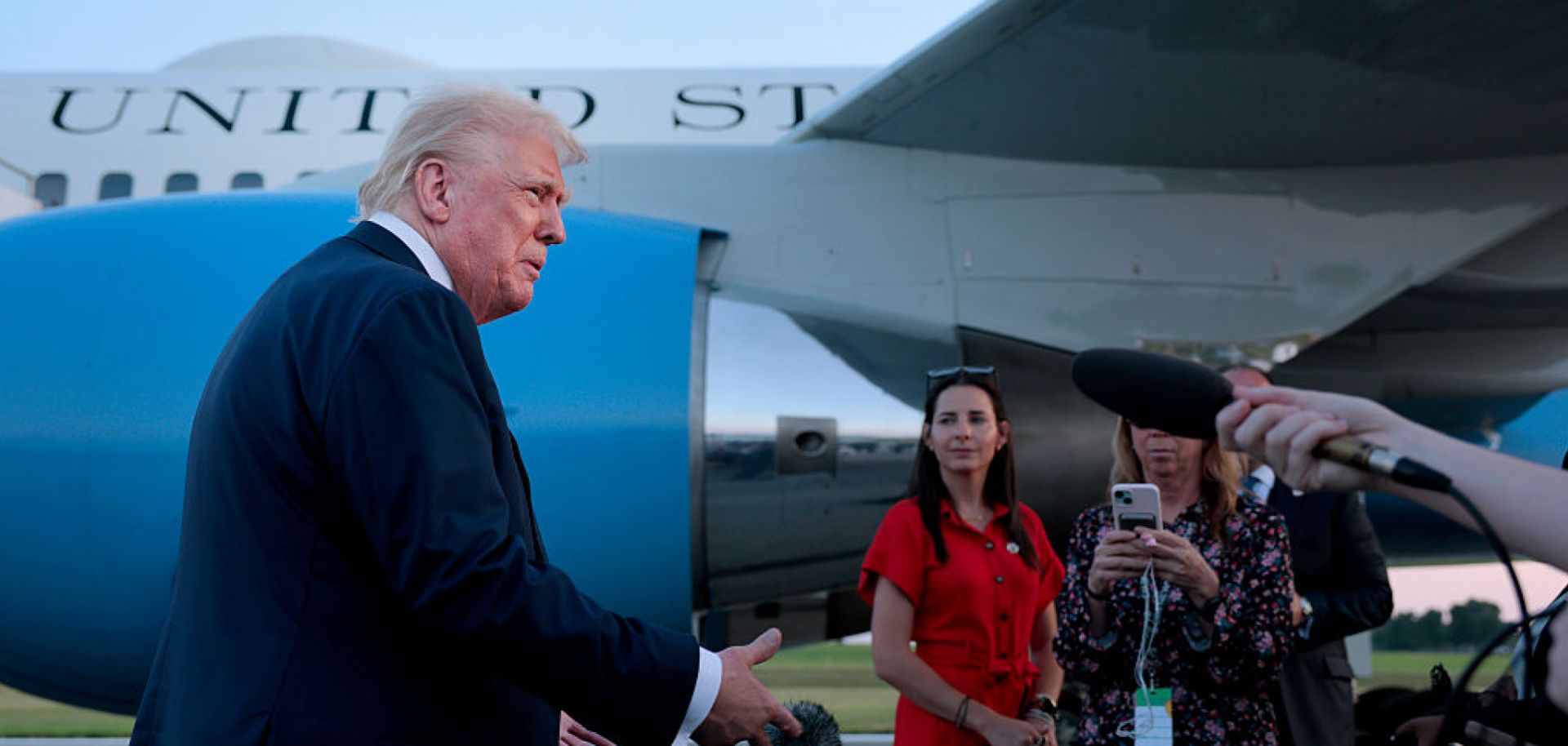
Later this week, U.S. President Donald Trump and Russian President Vladimir Putin will meet in Alaska, where their conversation will focus on the war in Ukraine — a meeting my colleagues have already previewed. But the two leaders are also likely to discuss a range of bilateral issues, as both have publicly expressed an interest in reviving relations that have nosedived following Russia's invasion of Ukraine in February 2022.
U.S. and Russian representatives have held sporadic meetings since Trump took office in January. And if the two countries can align on a strategy to wind down the war in Ukraine (which media reports indicate would involve Washington backing Moscow's key demand to retain most of its captured territory in exchange for freezing the front lines), bilateral cooperation could increase in other areas as well.
Nonetheless, as many previous White House occupants have discovered when they attempted to reset relations with the Kremlin, the scope for collaboration is narrow amid diverging strategic interests. This means that while there is room for a comparative warming of ties, a massive breakthrough that dramatically changes U.S.-Russia relations remains unlikely for the foreseeable future.
Trump Tower Moscow?
The drivers for both sides to de-escalate their tensions are clear. For Russia, there would be myriad benefits from closer ties with the United States, after having endured years of U.S. sanctions, restricted diplomatic engagement, and competition for influence in various areas around the world. These benefits include, at a tactical level, being able to reopen and restaff diplomatic facilities in the United States that have been shuttered or strictly limited, and increasing U.S. trade, investment and access to technology that have been stymied by sanctions and tense ties. More broadly and strategically, Russia appears to want at least tacit U.S. recognition that there is a regional sphere of influence across the post-Soviet space where Russia has primacy and can act as it sees fit without interference from the United States. In fact, according to some media reports, the Kremlin has gone as far as mobilizing a cross-government effort to secure this U.S. understanding by, among other things, offering the prospect of access to Russian-controlled critical minerals, cooperation on oil and gas operations, and even the creation of a Trump-branded property in Moscow.
The United States also has reasons to improve ties with Russia. Aside from the aforementioned opportunities that the Kremlin has either already floated or is rumored to be planning to dangle, by far, the greatest motivation for the United States is to try to disrupt the growing partnership between Russia and China. This is frequently called a ''reverse Kissinger'' in recognition of former Secretary of State Henry Kissinger's famed outreach to Beijing in the early 1970s that amplified the preexisting Sino-Soviet split and helped Washington balance against Moscow during the height of the Cold War. The contemporary version envisions the United States finally being able to fully pivot its attention to counter China's expansion of influence in the Asia-Pacific by reducing its military presence in Europe. But a prerequisite to do so would be a less threatening Russia (or at least one against which European states were better able to defend). According to this vision, a side benefit also would be Russia reducing support for U.S. adversaries like Iran and North Korea.
Already, there are signs of reviving U.S.-Russia cooperation in narrow areas. At the end of July, Russia's space chief visited the United States, where he met with his U.S. counterpart, the first face-to-face meeting since 2018, signalling an opportunity for greater coordination. And even if not at the upcoming Putin-Trump summit in Alaska, there are other areas of lower-hanging fruit where progress could be made in the coming weeks and months, such as restoring normal levels of diplomatic staffing in each other's countries and direct flights between them. Further ahead, both sides also profess to have a mutual interest in at least some forms of arms control, as New START, the last major nuclear arms treaty still in effect, expires in February 2026.
'Reset' vs. 'Overload'
Despite these opportunities, history indicates there is likely to be a ceiling on the scope and intensity of closer ties between the United States and Russia. After all, the Trump administration is hardly the first in recent history to try to reset ties. Infamously, in 2009, then-U.S. Secretary of State Hillary Clinton gave her Russian counterpart a red button with the English word ''reset'' and the English transliteration of what she believed was the Russian word meaning the same thing, but in fact was the word for ''overload'' — a diplomatic gaffe that has often symbolized the state of Russo-U.S. ties in recent years. During his first term, even Trump added to the web of U.S. sanctions on Russia and overall made little progress in seriously warming ties beyond some positive rhetoric.
The reasons for this are both tactical and structural. In the former, many of the theorized areas for greater cooperation are simply too narrow or wholly unrealistic to make much of a difference. Take trade in goods, which peaked at about $43 billion in 2011 and has since declined to about $3.5 billion in 2024. Compared to overall U.S. trade levels, such figures are a rounding error and, even if Russo-U.S. trade were to rebound, it would still be infinitesimal compared to that with top U.S. trading partners like Canada, Mexico and China. Given differences in each country's trade profile, any increase would also likely remain driven by only a handful of products, such as the Russian export of fertilizers and the U.S. export of medical products, rather than a wide expansion of trade into different industries in any serious way. For similar reasons, foreign investment and business ties will likely remain subdued. Even if the United States removed all sanctions on Russia, American businesses would still face a steep uphill battle and high-risk endeavor to reenter the Russian market. Russian firms, meanwhile, have always been minnows in foreign direct investment in the United States, and there is no reason that this is likely to change. Additionally, even if Russia were to grant U.S. firms access to joint projects to extract critical minerals, oil, gas or other natural resources, there are myriad constraints on such partnership projects coming to fruition, let alone generating financial returns and output.
The more powerful restraints on Russia-U.S. ties, however, are structural. Fundamentally, the strategic aims of both sides not only diverge but, in many respects, directly conflict. Put bluntly, the Kremlin's geopolitical imperatives to, among other things, dominate its border regions, draw closer to China and others in the Global South, and insulate its economy and financial system from Western influence all cut against long-running U.S. strategic goals.
Let's start with Moscow's budding ties with Beijing, Washington's chief complaint. Despite the grand vision for a ''reverse Kissinger,'' and even with the acknowledgement that there are limits to expanding Russo-Sino ties in which Russia is the weaker partner, Russia's strategic interests are far more in alignment with China than with the United States. Among other things, Moscow and Beijing share an imperative to weaken Western-dominated multinational institutions and, in particular, to insulate their economies and financial systems from the West to limit their exposure to sanctions and other restrictions. To this end, Russia has comparatively been even more aggressive than China, including by using BRICS+ as a forum to push these ideas with other members of the Global South. This shared desire to push back against the Western-backed global order indicates Moscow will continue to prioritize its relationship with Beijing over any warming of relations with Washington. Indeed, in any future conflict over Taiwan — and, with it, the possibility of U.S. involvement — it is clear which side Russia would back.
Russia's relations with other U.S. adversaries also reveal clear limits on the hope of exerting pressure on them to facilitate rapprochement with the United States. For instance, with North Korea having provided crucial support for Russia's war in Ukraine and ties between the two only growing, there is little expectation that Moscow would lean on Pyongyang to make major concessions in any negotiations with Washington. Moreover, Russia's strategic partnership with Iran, formally inked in January 2025, suggests Moscow is in it for the long haul with Tehran. And even if this is not the case, Russia's lack of support for Iran during its brief war with Israel in June may mean that Russia has less leverage over Iran to even offer to the United States.
Elsewhere, Russia's imperatives to establish and enforce buffer spaces and spheres of influence around European territory will continue to undermine relations with the United States. Even if the war in Ukraine reaches some sort of agreement in the coming weeks or months, the outlines of a deal point to a persistent risk for future Russian aggressions, not only in Ukraine but in other regional states, such as Baltic nations. For as long as the United States remains in NATO, Russian threats to Europe will remain stumbling blocks in warmer Russo-U.S. ties. Elsewhere, the recent U.S.-brokered deal between Armenia and Azerbaijan, which envisions an expansion of U.S. commercial and political influence in the Caucasus, indicates that the United States and Russia will clash over supposed spheres of influence. The same goes for parts of the Middle East, Africa, the Americas, the Arctic and elsewhere — including cyberspace and outer space, where all trends point to continued, if not growing, competition.
Putin Up With One Another
To be sure, there is not an all-or-nothing outlook for ties between the former Cold War adversaries, in that it is not a choice between complete partnership or frozen relations. There are many levels of engagement in between, ones that can ebb and flow over time.
In fact, this has largely been the state of Russo-U.S. ties since the fall of the Soviet Union. Despite periods of relatively closer or more distant relations, for most of the past 30 years, the two sides have co-existed in an uneasy dynamic in which they have simultaneously cooperated, competed and, at times, even conflicted with each other. Thus, while there is certainly room for the Trump administration to attempt another reset, there will still be strong upper limits on just how far the relationship can go for the foreseeable future.
